


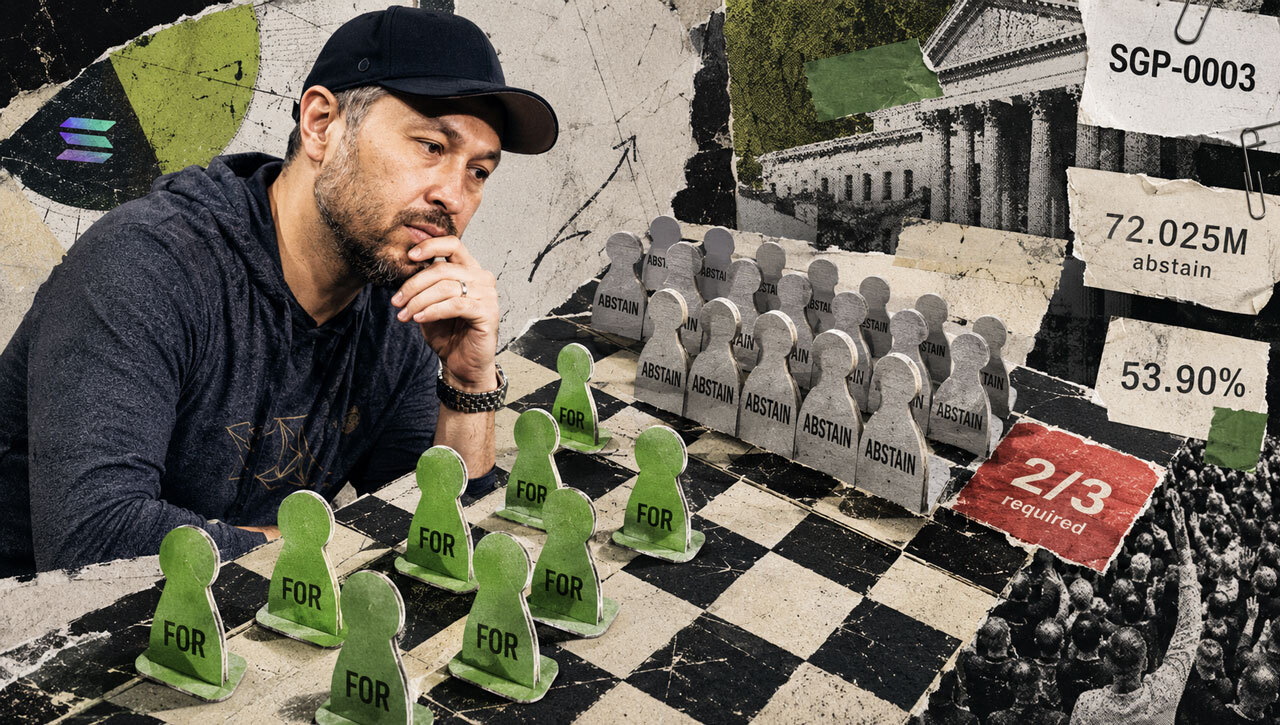
The Aug. 28 Solana fee vote on SGP-0003 produced an unusual result: a majority of participating stake supported the reform, yet the proposal failed. The outcome offers the clearest evidence so far that co-founder Anatoly Yakovenko can shape the network’s economic agenda while validators and stakers retain formal authority over a mandate.
SGP-0003 finalized with 142.844 million SOL in favor, 50.146 million against, and 72.025 million abstaining across 1,152 voters. About 265.015 million SOL participated, equal to 61.14% of the 433.486 million SOL snapshot. Quorum was comfortably cleared. Approval stood at 53.90% because the governing calculation included abstentions, leaving the For side roughly 33.83 million SOL short of the required two-thirds.
Abstaining stake remained separate from opposition, but it still increased the support needed for approval. That rule turned the large middle of the electorate into a decisive part of the result and made coalition breadth more important than a simple For-versus-Against comparison.
The vote bundled a rulebook test with an economic package
The rejection exposed a conflict inside Solana’s new governance record. The frozen text of SGP-0003 said no quorum applied and excluded abstentions from its approval calculation. The current governance FAQ and the Constitution ratified in the same cycle count For, Against, and Abstain toward quorum participation and the two-thirds denominator.
The official system applied that inclusive rule and finalized the proposal as rejected. The frozen ballot’s wording would have yielded a different approval percentage, but the recorded outcome follows the FAQ and Constitution. For voters, abstention therefore offered a way to decline the full mandate without joining the Against camp. That describes the ballot’s effect rather than any individual voter’s motive.
CryptoSlate’s earlier coverage of Solana’s governance framework outlined how stake can sponsor proposals and override validator choices. SGP-0003 provides a live demonstration of how the denominator shapes power: public advocacy can put a policy on the agenda, while approval still depends on a sufficiently broad stake coalition.
The economic package made that coalition difficult to assemble. Yakovenko’s public support focused on the proposed starting rate. On Aug. 25, he backed a rate of one-tenth of a lamport per requested cost unit, according to Solana Compass. The ballot covered a full three-stage path, with later feature gates lifting the resource-fee rate to one-quarter and then one-half of a lamport.
Validators and stakers were thus deciding on more than the first step Yakovenko highlighted. They were asked to endorse the entire ramp and the distributional consequences built into SIMD-0553.
The technical plan would replace Solana’s 5,000-lamport fee per signature with a 2,500-lamport inclusion fee per transaction, paid to the block leader. It would add a resource fee based on the scheduler cost requested by a transaction and burn that fee in full. Priority fees would remain unchanged and continue going to the leader.
Charging for requested resources would affect users unevenly. Applications that set loose compute limits could pay more or encounter insufficient-balance rejections. Efficient low-resource transactions could pay less. Legacy validator vote transactions would need compute-budget and fast-path updates ahead of Alpenglow, and every validator client implementation would need the relevant feature gates before the consensus-breaking change could first activate.
CryptoSlate previously examined the design’s potential burn effect. The final Solana fee vote supplies the political lesson. General support for pricing scarce resources left major questions about the rate path, the cost burden, and how much policy should be approved in a single mandate.
The Solana fee vote makes coalition-building part of protocol design
The recorded positions crossed prominent operators and delegated-stake holders. Validator Info listed Jupiter, Drift, Bitwise Onchain Solutions, and Forward Industries among opponents. Figment, Staking Facilities, Kiln, and P2P.org were among the supporters.
The arithmetic rules out a single-voter explanation. Jupiter’s allocation of roughly 11.78 million SOL was substantial, yet the For side needed approximately 33.83 million additional SOL to reach two-thirds. The wider distribution of opposition and abstention produced the shortfall.
Yakovenko’s public comments also complicate a founder-versus-validator reading. In an Aug. 27 reply, he said validator revenue encourages more people to stake. His argument placed validator economics within the network’s security model, even as he promoted the reform’s initial resource-fee rate.
Formal governance covers only one stage of the change. An SGP provides a directional stake mandate. Technical design lives in a SIMD, and deployment still requires compatible validator-client releases and separately scheduled feature activation. Finalizing a vote locks the tally. The implementation process follows separately.
That division of authority defines the practical constraint on Yakovenko. His endorsement elevated the fee question and supplied an economic argument. The full three-stage package still fell short of the coalition required for a stake mandate. Validators and stakers exercised the authority granted by the ratified rules, while developers retain responsibility for technical review and implementation.
Yakovenko’s agenda-setting role remains visible in the proposed response. AMBCrypto reported after his initial endorsement that he favored splitting the reform into one proposal replacing the fixed signature fee and another deciding whether validators or an automatic mechanism should set future rates. Unbundling those choices could isolate areas of agreement and give voters a clearer view of each tradeoff.
A smaller successor could begin through the optimistic SIMD process. Under Solana’s governance process, holders of 15% of active stake can still force a network vote. The Constitution also directs fundamental economic changes toward the SGP path. Splitting the plan would improve its packaging while leaving open the possibility of another validator and staker decision.
SGP-0003 therefore marks a change in how founder influence operates on Solana. Yakovenko’s support helped define the problem and the first proposed rate. The electorate rejected the bundled mandate under a supermajority rule. Any successor now needs either a more focused technical scope, a broader stake coalition, or both.
The Solana fee vote demonstrated the governance system’s ability to stop a founder-supported implementation. The next round will test the other half of the power equation: how effectively the same founder can reframe the policy, separate its contested parts, and persuade enough stake to move it forward.