


Payward, the parent company of crypto exchange Kraken, is not expected to pursue an initial public offering before the second quarter of 2027 at the earliest, according to two people familiar with the matter cited by CoinDesk. The timetable pushes a potential listing further into the future after the company froze its IPO plans in March 2026. Kraken declined to comment.
The longer delay comes despite Payward having secured an $800 million fundraising round at a $20 billion valuation. Its own first-quarter figures, however, showed a markedly weaker crypto trading backdrop, with lower platform transaction volume alongside broad declines in Bitcoin, total crypto market capitalisation and industry spot activity.
Payward pushes its earliest IPO window to Q2 2027
The revised timing means Payward will remain private for at least another year, based on the reported window. CoinDesk reported that the company is not planning an IPO before the second quarter of 2027.
It extends the pause announced in March, when difficult conditions across crypto prices, trading volumes and valuations prompted Payward to freeze its multibillion-dollar listing plans. That decision had left the timing of a return to the public markets unresolved; the new reporting provides the first more specific lower bound on the wait.
Market conditions matter particularly for an exchange operator because activity levels can affect transaction-related business volumes, while crypto-asset prices and peer valuations can shape investor appetite for a new listing. Payward has not publicly commented on the reported revised IPO schedule.
A confidential S-1 was already on file
Payward had already taken an early formal step toward an offering. On November 19, 2025, the company said it had confidentially submitted a draft Form S-1 registration statement to the US Securities and Exchange Commission.
A confidential draft filing allows an issuer to begin the registration process without making the full document public at that stage. In its announcement, Payward said any offering would remain subject to the SEC’s review process and market conditions.
Those conditions were therefore part of the company’s stated framework from the outset, rather than a new qualification attached after the March freeze. The filing itself did not set a public timetable for an IPO.
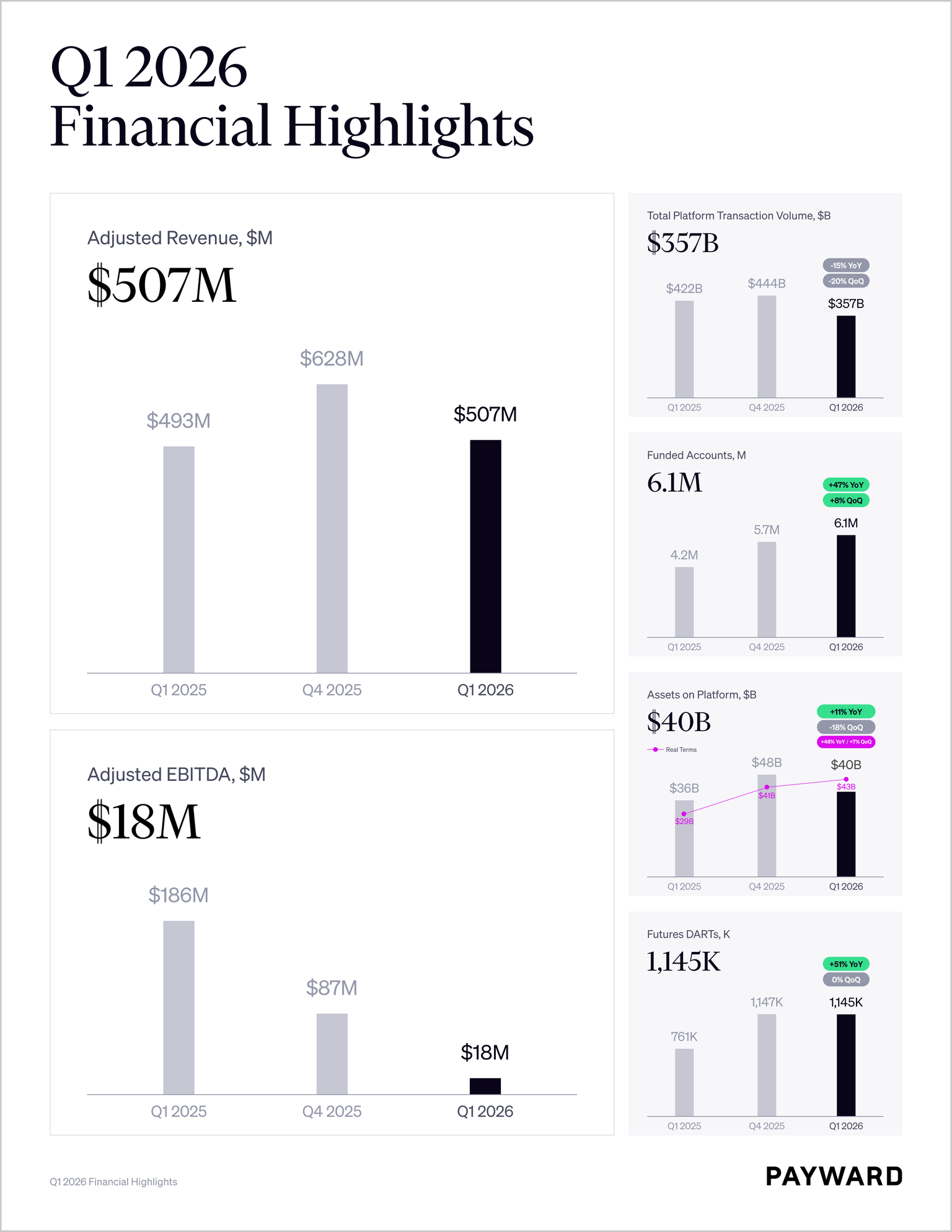
Payward Q1 2026 Financial Highlights chart showing adjusted revenue, transaction volume, funded accounts, assets on platform and futures activity. — Source: Payward
Private funding set a $20 billion valuation
The confidential filing followed an $800 million fundraising round that valued Payward at $20 billion, according to the CoinDesk report. Citadel Securities accounted for $200 million of that total through a strategic investment.
The private valuation gives a reference point for the scale of Payward’s ambitions, but it does not settle the valuation a public-market offering could achieve. The decision to defer an IPO instead underscores the difference between raising capital privately and choosing a listing window amid weaker market conditions.
For Payward, the extra time also leaves its SEC registration work and its prospective public offering on separate tracks. The company’s 2025 statement made clear that an offering was conditional, while the latest reported timing suggests that condition will not be met in the near term.
Q1 trading conditions weakened across Payward’s market
Revenue rose, but trading activity weakened: Payward recorded adjusted revenue of $507 million in Q1 2026, up 3% year over year, while total platform transaction volume fell to $357 billion, according to the company’s financial highlights.
Payward said the quarter also brought a 22% decline in Bitcoin’s price, a 23% drop in total cryptocurrency market capitalisation and a 38% fall in industry spot volume.
That combination reflects the broad weakness in crypto prices and spot-market activity cited when Payward froze its IPO plans in March. It does not, by itself, establish the precise internal basis for the reported 2027 timetable.
Disclaimer: This article is provided for informational purposes only. It is not offered or intended to be used as legal, tax, investment, financial, or other advice.