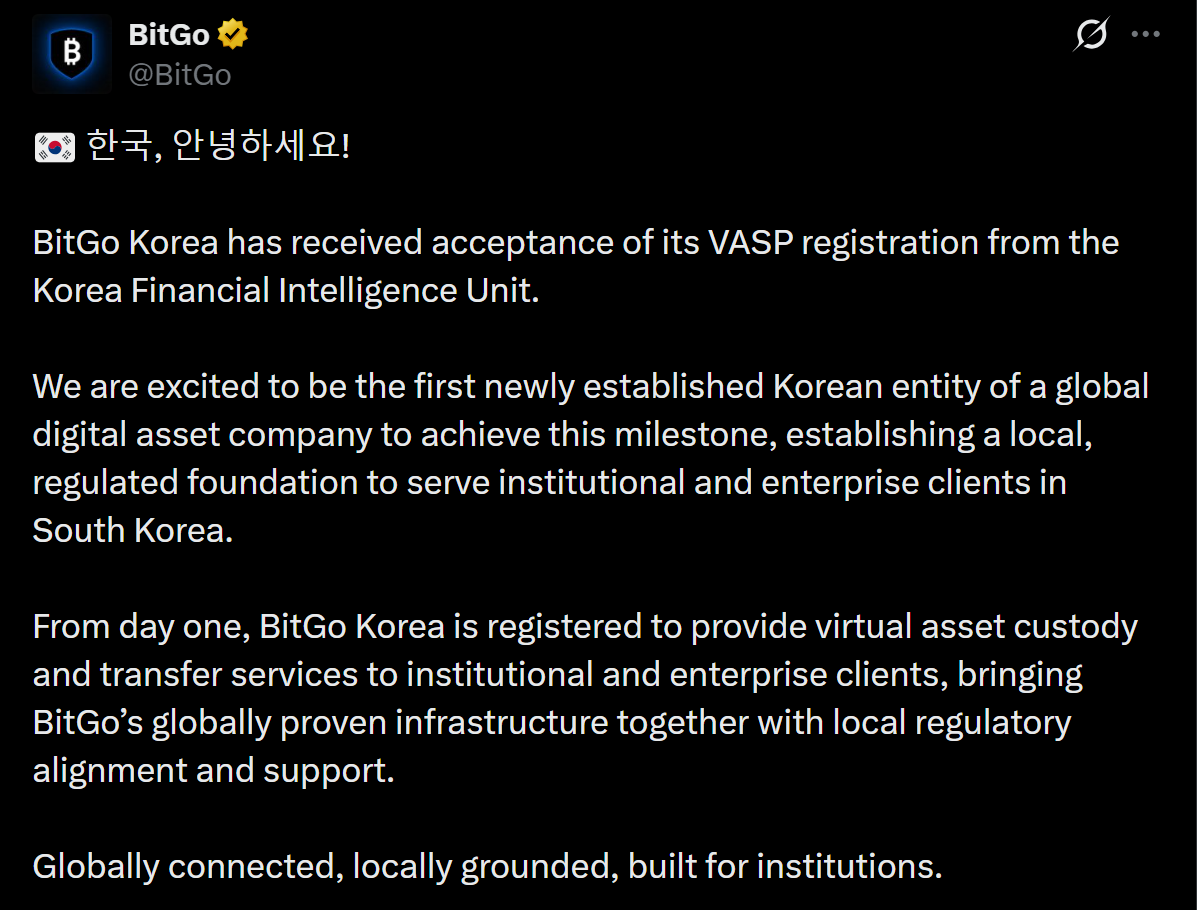
BitGo secured a regulated foothold in South Korea after the Financial Intelligence Unit (FIU) accepted BitGo Korea’s Virtual Asset Service Provider (VASP) registration.
The approval makes the first time that a Korean-based subsidiary of a foreign cryptocurrency firm has been registered as such directly.
Rather than purchasing an existing licensed operator, BitGo was able to register with the FIU, thereby creating their own regulated infrastructure.
Chen Fang, BitGo Korea CEO and BitGo Chief Revenue Officer, said the approach reflects a “long-term commitment” to Korea’s regulatory framework.
Supporting the move, Abel Seow, Managing Director and Head of APAC Sales at BitGo, stated that there is growing interest in security alongside local regulatory alignment.
All together, the approval expands institutional custody competition while showing foreign crypto firms can enter South Korea directly by meeting domestic requirements.
HTX-Kraken compliance dispute deepens
As BitGo builds regulated infrastructure for institutions, another exchange dispute shows how those same compliance systems can affect ordinary fund transfers.
HTX, which has been under scrutiny over address poisoning, said its internal review found no official accounts involved in address-poisoning transfers reported by users.
Instead, several cases emerged after Kraken froze customer funds, with affected balances reaching roughly $4.2 million.
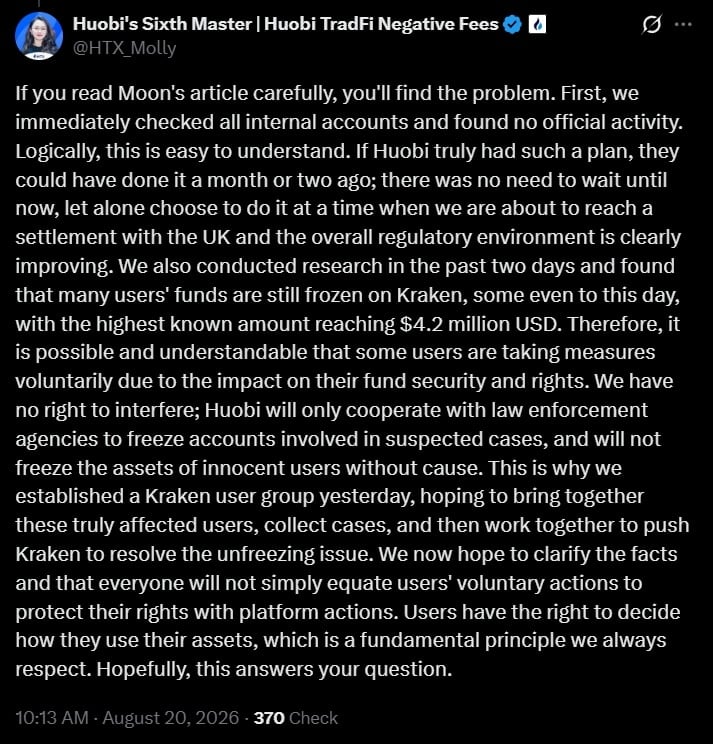
Since then, HTX has spent more than two months to resolve the restrictions placed upon the accounts. Nonetheless, these extended account freezes have raised a larger question about how exchanges distinguish between potentially suspicious transactions and legitimate transfers of funds.
Stronger compliance can protect platforms from illicit flows, yet overly broad controls can also restrict innocent users. However, overrestrictive compliance measures can also limit access to innocent parties.
Therefore, exchanges must develop methods to reconcile this conflict, as continued use of extended account freezes may ultimately lead exchanges to trade off user trust for regulatory protection.
South Korea tightens offshore crypto transfers
The HTX-Kraken controversy has illustrated why South Korea is enhancing controls on the flow of funds offshore from domestically regulated entities. Under the updated framework, domestic VASP transfers now require sender and recipient information regardless of transaction size.
Meanwhile, offshore exchanges and self-hosted wallets are subject to further verification requirements for the identities of users. This is with most transfers requiring same-person ownership.
Transfers worth 10 million won or more also trigger mandatory internal monitoring when sent to these destinations.
This creates a clearer divide between domestic and offshore access. Registered firms such as BitGo Korea can operate within the local framework, while unregistered counterparties face greater scrutiny.
As implementation advances, transfer delays and rejection rates will reveal how strongly these rules reshape offshore crypto access.
Final Summary
- BitGo gains direct South Korean VASP access as tighter rules favor locally registered crypto firms.
- HTX-Kraken frozen-fund disputes highlight the growing compliance friction facing offshore crypto transfers.