Bitcoin is showing some of the strongest capitulation signals of the current downturn, suggesting the selloff may be entering a later stage even as the market offers little evidence of an imminent rebound.
Eight of the 12 indicators tracked by VanEck are currently flashing capitulation, while all 12 reached extreme levels at some point during the past three months.
The measures are designed to capture unusually severe market stress and selling pressure, conditions that have often clustered around the later stages of previous Bitcoin bear markets.
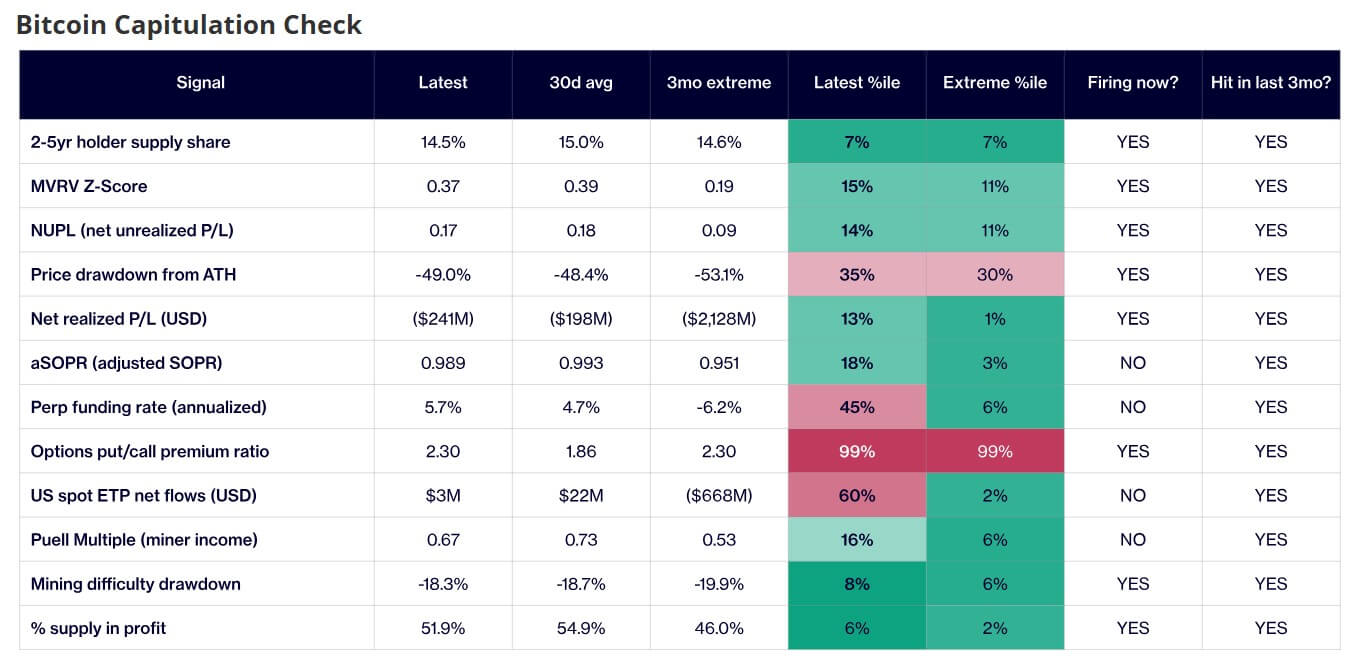
The readings come as Bitcoin trades around $65,000 after spending recent weeks trying to establish a floor above its June low of $58,500 following a sharp decline from its October 2025 peak of over $126,000.
The downturn is now entering its 10th month, bringing it closer to the duration of previous major bear markets.
Excluding the unusually short 2011 decline, the past three major drawdowns averaged about 12.7 months to reach their troughs, placing October or November within the historical window in which an accumulation phase could begin.
Yet VanEck’s latest ChainCheck analysis suggests capitulation is a poor tool for timing that turn.
Bitcoin gained an average of 12.8% during the 90 days after eight to 12 capitulation indicators were triggered, below its broader 15.2% baseline return. Over 180 days, returns averaged 32%, again trailing the 36.3% baseline.
The signals only outperformed over a one-year horizon, a result VanEck cautioned was based on relatively few distinct episodes because many of the 115 observations overlapped.
The historical record points out that Bitcoin may be moving deeper into a bottoming process without giving investors a reliable timetable for when that process will translate into higher prices.
Options traders are still paying heavily for protection
The options market is showing considerably more anxiety than Bitcoin’s subdued spot trading would suggest.
VanEck data show 30-day realized volatility fell to an annualized 27.2%, far below Bitcoin’s long-term average near 80%, as the cryptocurrency traded within a relatively narrow $62,265 to $66,509 range during the measurement period.
Yet spending on downside protection increased sharply.
Premiums paid for Bitcoin puts climbed 42% over the past month to $551.8 million, while call premiums fell 10% to $237.6 million. That pushed VanEck’s put-to-call premium ratio to 2.30, a reading higher than 99% of observations since 2021 and more than three times its historical average of about 0.71.
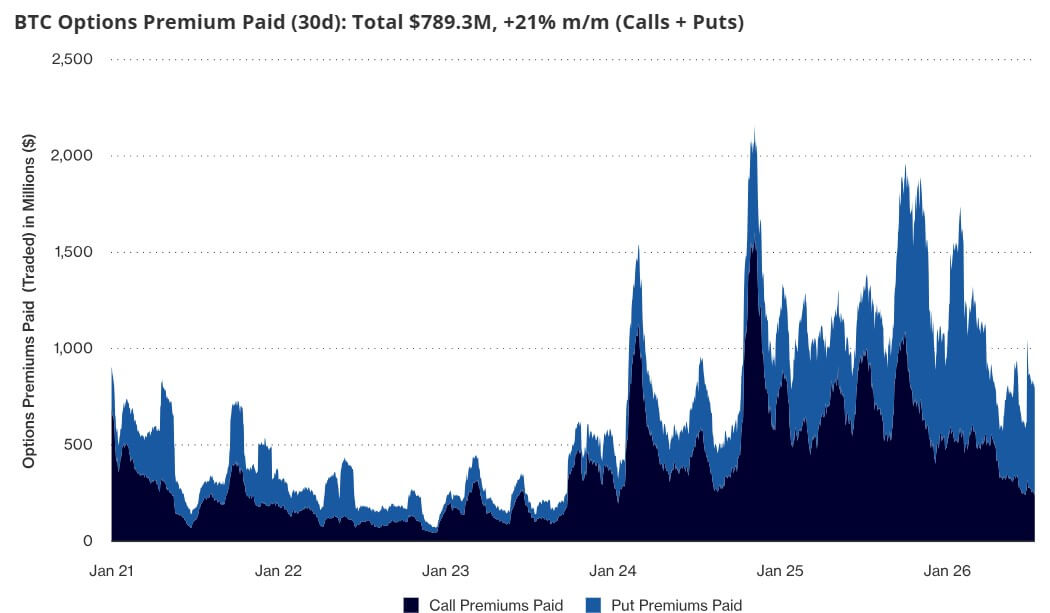
The imbalance shows investors devoting unusually large amounts of capital to downside insurance even as realized volatility has collapsed.
However, outstanding positions tell a more complicated story.
Call open interest increased 5% to $19.1 billion, while put open interest fell 11.5% to $10.8 billion, pushing the put-to-call open-interest ratio down to 0.57 from 0.67.
That leaves an unusual divergence: outstanding options positions have shifted further toward calls even as put spending has surged.

VanEck said the discrepancy may partly reflect older, shorter-dated puts expiring alongside the higher relative cost of new downside protection. Fewer put contracts can therefore remain outstanding even as investors spend considerably more to obtain protection.
One-month call implied volatility fell to 32.7%, near the bottom of VanEck’s readings since 2021, while put implied volatility remained around 40%.
The options market is then pricing relatively subdued overall moves while still demanding a substantial premium for protection against the risk that Bitcoin’s apparent stability breaks to the downside.
Bitcoin is stabilizing despite a difficult macro backdrop
That reluctance to abandon downside protection comes as Bitcoin attempts to form a floor against conditions VanEck described as unusually challenging.
The 30-year US Treasury yield has climbed above 5.3%, reaching its highest level since 2007, while the conflict between the US and Iran has stretched into a fifth month. Strategy, the largest corporate Bitcoin holder, has also sold Bitcoin this year to help fund dividends on its preferred stock.
Bitcoin has so far absorbed those pressures without revisiting its June low of under $60,000.
Data from CoinGlass shows that the flagship digital asset has risen nearly 3% this month, even as spot trading activity weakened considerably. The 30-day spot volume fell 27%, which is near levels last seen during the 2023 bear market.
The apparent stabilization has also come despite renewed distribution from longer-term holders. Coins held for more than one year fell by roughly 356,000 BTC over the previous 30 days, while the share of supply held by those investors slipped below 60%.
At the same time, institutional fund flows have significantly improved.
US spot Bitcoin exchange-traded products attracted more than $1 billion of net inflows over the past 30 days. That reversed the prior month’s significant $2.4 billion of outflows.
The renewed ETP inflows have provided a source of demand even as broader spot activity remains unusually thin and longer-term holders continue to distribute coins.
Bitcoin’s ability to remain above its June low through those competing pressures gives the market the appearance of an asset trying to establish a floor, but the options market shows traders remain unwilling to assume that floor will hold without another test.