


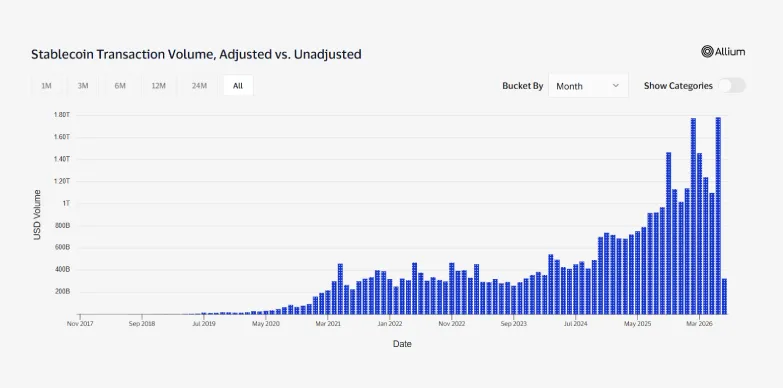
Stablecoins have had a breakout month because the numbers for the month of June 2026 are hard to ignore. According to the data presented by Visa, in June 2026, stablecoins adjusted transaction volume hit a record $1.8 trillion, up 63% from May and 125% from a year earlier, even while the broader crypto market stayed under pressure. These numbers indicate that stablecoins are actually becoming a part of the core financial infrastructure.
Stablecoins Are Moving Beyond Crypto Trading
Stablecoins have been considered to be the bridges between dollars and digital assets. With the transaction volume increasing, it is clear that these stablecoins are now being used for payments, settlements, cross-border transfers and treasury movements. Moreover, as this usage is rising when the market is weak, it simply indicates that the demand is coming from utility and not speculation.
USDC Leads Stablecoin Volume
USDC, a stablecoin issued by Circle, led the pack by a great margin. However, Tether’s USDT remains the largest stablecoin by market cap, USDC accounted for around 67% of the transaction volume in June, or about $1.21 trillion. USDT followed with roughly 32%, equal to about $576 billion. PayPal’s PYUSD ranked third, but its volume was still much smaller at around $2.42 billion.
Network activity also showed where stablecoin flows are concentrated. Coinbase’s Base, an Ethereum layer-2 network, handled about $565 billion in volume, making it the top network with 31.5% of the total. Ethereum was close behind at $562 billion, while Tron came in third at roughly $320 billion, or about 18%.
The data is important because it separates real usage from noisy blockchain activity. Visa said it worked with Artemis, Allium Labs and Castle Island Ventures on an adjusted methodology that removes things like bot-driven trading, exchange treasury transfers and repeated smart contract transactions. This gives a cleaner view of organic stablecoin activity.
Regulation is Adding Confidence
The GENIUS Act is already shaping the regulatory framework for payment of stablecoins, and the proposed CLARITY Act could play an important supporting role if it becomes a law. Unlike the GENIUS Act, which focuses specifically on stablecoins, the CLARITY Act aims to establish a market structure for digital assets by defining the responsibilities of regulators and providing clearer rules for exchanges, token issuers, brokers and custodians.
This clarity is important because many financial institutions have been hesitant to expand their digital asset businesses without knowing which regulator oversees different products or how existing securities laws apply. A more predictable regulatory framework could encourage banks, fintechs and payment providers to invest further in blockchain infrastructure, indirectly supporting a huge stablecoin usage.
However, the bill has not yet become a law. It has advanced through key stages in Congress but it is still waiting on the Senate floor. Discussions are ongoing around ethics, legislative priorities and Senate scheduling have slowed the progress and have made the timeline uncertain. Moreover, the CLARITY Act’s July 4 target has slipped and the bill now faces a much tighter path through Congress. The next big test is whether lawmakers can settle the remaining disputes before the Senate recess on August 7, or risk pushing final passage deeper into a more uncertain political window.
Supply Shrinks Usage Stays Hot
According to crypto analyst Ali Charts, stablecoin supply has dropped by about $10 billion, which indicates that some capital is being pulled back into cash or leaving the market during a softer phase.
However, the bigger point here is that usage of these coins, however, has not faded. Transaction volume is still running very high, which means the stablecoins that remain in circulation are being used more often and more actively. This also points to a market with lower idle liquidity but stronger turnover.