
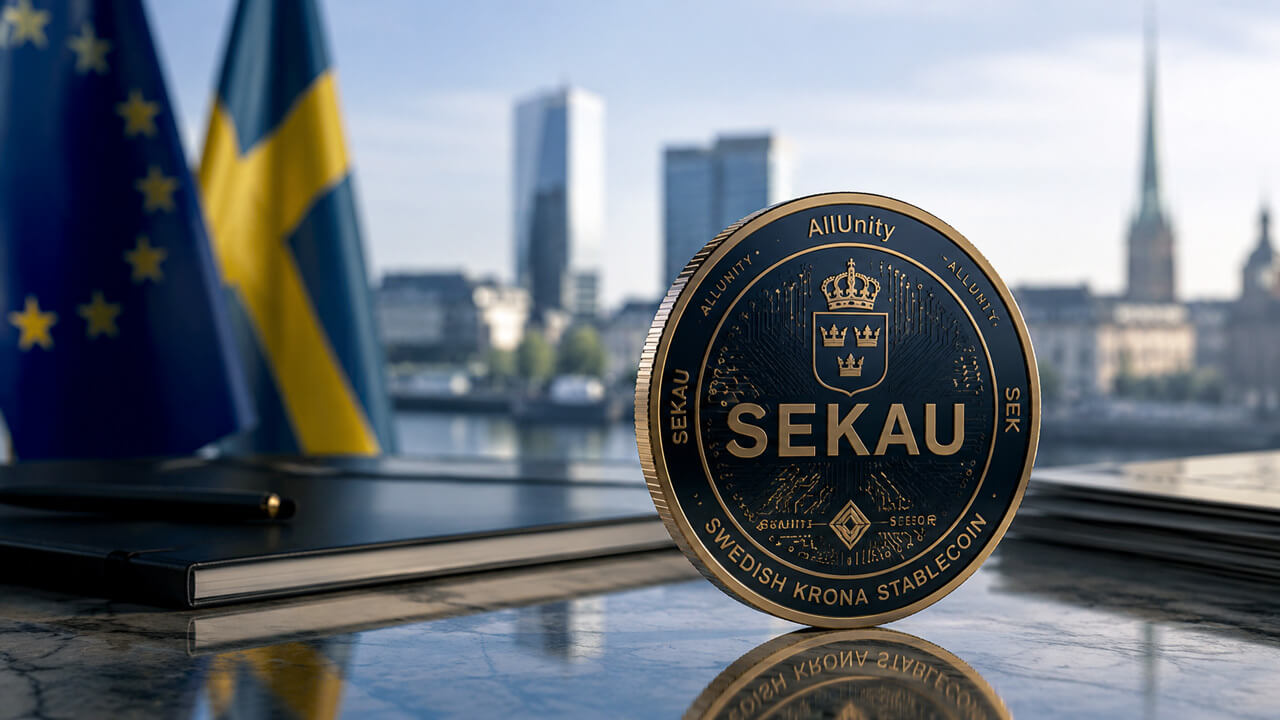
AllUnity launched SEKAU on June 19, giving Europe a Swedish krona stablecoin under MiCA while dollar tokens still define most on-chain payments. The SEKAU stablecoin is live on Ethereum, Solana, Base, Tempo, and Polygon.
The launch raises the question of usage. SEKAU can be compliant, fully reserved, and multi-chain, while still needing banks, market makers, treasury teams, tokenized-asset platforms, and payment companies to prove that SEK liquidity belongs on public chains.
AllUnity said SEKAU is the first fully reserved and MiCA-compliant Swedish krona-backed stablecoin. The token is positioned as an E-Money Token, redeemable 1:1 against SEK and backed by segregated reserves.
Its launch page lists the same five chains and frames the product around treasury, settlement, and business payment use cases rather than consumer speculation.
For AllUnity, the krona token also stretches a multi-currency strategy beyond EURAU and CHFAU. For Europe, it tests whether local-currency settlement rails can develop before dollar stablecoins become the default cash layer for on-chain payments.
That institutional question gives the launch its consequence: who needs krona settlement in crypto-native workflows badly enough to choose a SEK token over deeper dollar liquidity?

A Swedish krona stablecoin built for institutions
AllUnity frames SEKAU as a business and institutional product. The company’s Business Mint Account path is built for companies that complete onboarding and connect corporate bank accounts and wallet addresses.
The SEKAU white paper context also points to verified-institution primary access and lists no public trading venues by name at launch.
Stablecoin launches can be misread as instant liquidity events. In SEKAU’s case, available disclosures show a more operational product: AllUnity has created a regulated SEK rail, while exchange access, secondary-market depth, and consumer minting remain unproven.
The launch also leans on institutional credibility. AllUnity says Banking Circle is the designated reserve and transaction bank for SEKAU, while Marginalen Bank supports the product as a banking partner.
The company itself was established by DWS, Flow Traders, and Galaxy, a sponsor mix that fits a treasury and market-structure product more than a retail stablecoin campaign.
SEKAU also extends AllUnity’s portfolio beyond exposure to the euro and Swiss franc. The company already has an EURAU page, and the SEKAU release describes the krona token as another step in a multi-currency strategy.
That leaves a new question: where does a SEK rail fit if euro and franc rails alone are insufficient for regional settlement?
| Confirmed by disclosures | Awaiting evidence |
|---|---|
| AllUnity announced SEKAU on June 19 as a SEK-backed E-Money Token. | Initial circulating supply, holder count, and transaction activity after launch. |
| AllUnity says SEKAU is backed 1:1 by segregated reserves. | Independent post-launch reserve attestations or reserve composition details. |
| The launch list includes Ethereum, Solana, Base, Tempo, and Polygon. | Whether each chain develops meaningful SEKAU liquidity. |
| Access is framed around onboarded business and institutional clients. | Named public trading venues or direct retail minting access. |
The table keeps the launch in proportion. SEKAU’s regulatory setup is clear enough to report; the usage layer needs numbers from circulation, venue support, and client activity.
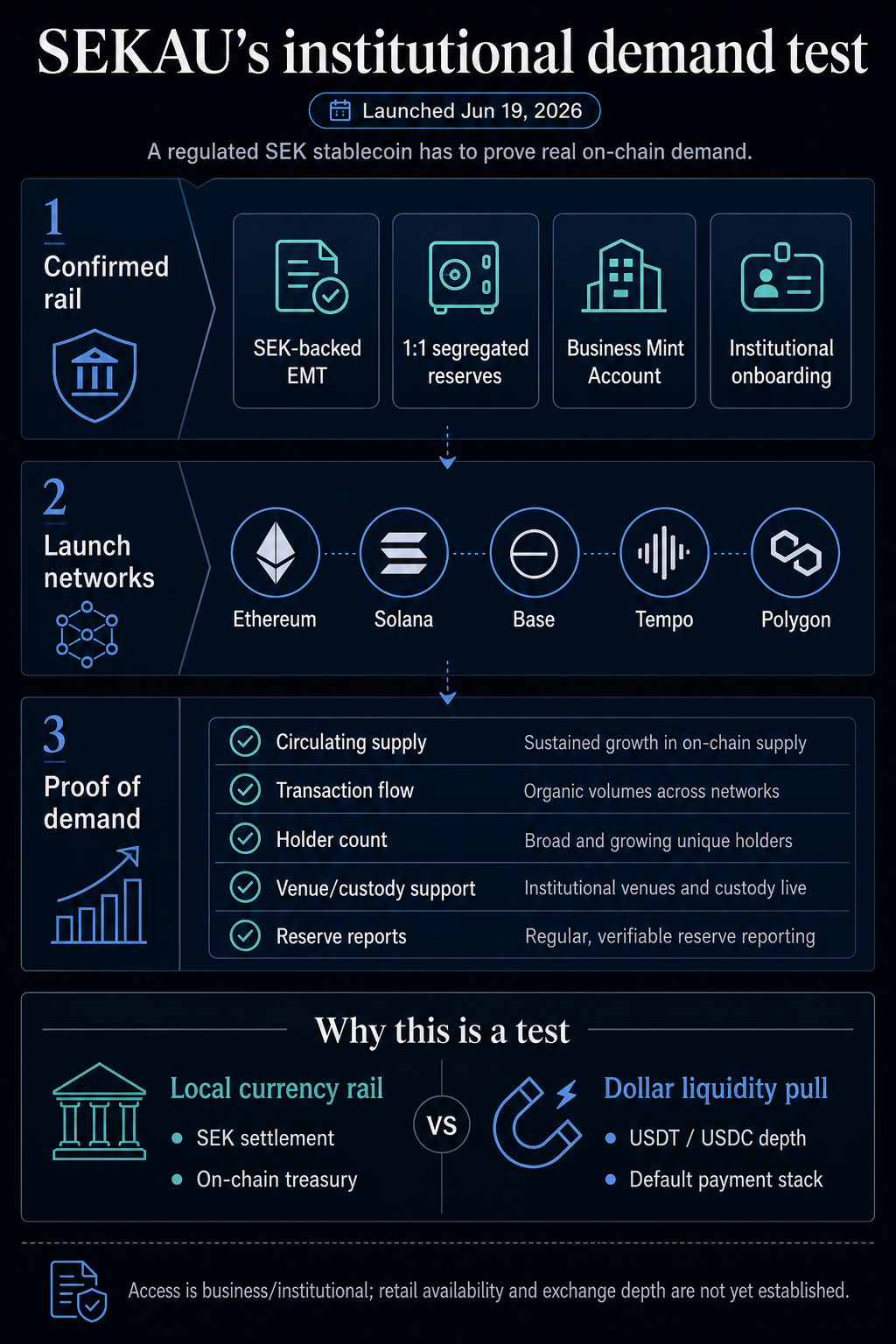
Demand test comes after compliance
MiCA provides SEKAU with a regulatory framework as a MiCA-compliant stablecoin, but adoption remains unresolved. ESMA’s MiCA materials explain the EU supervisory context, while EBA guidance shows that E-Money Token activity can still overlap with payment-service rules and transition questions.
For SEKAU, the legal wrapper answers only part of the operating problem.
The broader market backdrop is still heavily dollar-based. ECB analysis has described dollar-denominated stablecoins as dominant, with euro-denominated MiCAR-authorized stablecoins remaining small by comparison.
Artemis data on non-dollar stablecoins points in the same direction: local-currency products exist, but their supply base remains tiny next to the dollar market.
CryptoSlate market pages show the benchmark SEKAU has to work around. USDT and USDC remain the stablecoin names most crypto users and venues recognize, with large market caps and deep market coverage.
A SEK token will not match that global liquidity at launch. It has to find cases where being denominated in krona is more useful than using a dollar token and converting through banking rails.
That likely means use cases where currency, compliance, and settlement location all carry operational weight. Nordic corporate treasuries, tokenized securities, market-making between fiat and crypto venues, regional payment flows, and institutional collateral movements are all plausible areas to watch.
So far, AllUnity has confirmed the rail’s launch; adoption needs visible minting, redeeming, transfers, and balances.
AllUnity’s five-network rollout gives the token broad technical reach. It also places SEKAU across networks with very different stablecoin environments.
DefiLlama’s stablecoin chain data still shows Ethereum far ahead of Solana, Base, and Polygon in stablecoin depth, while CryptoSlate’s Ethereum and Solana pages add useful asset-level context for two of the launch networks.

AllUnity supports Tempo as a listed launch network, but current public chain liquidity data does not directly verify Tempo’s stablecoin depth.
That split changes things. Ethereum gives SEKAU access to the largest stablecoin ecosystem, but it also puts it alongside entrenched dollar liquidity.
Solana and Base may offer payments and application activity, but each still has to turn token availability into actual balances and transaction flow. Polygon has a history of enterprise and payment integrations, yet the same usage test applies.
A multi-chain launch can make a stablecoin easier to access, but it falls short of proving that institutions have a reason to hold it.
Sweden’s payment rails sharpen SEKAU’s adoption test
The krona aspect needs domestic context. Sveriges Riksbank’s 2026 payments report said there were no Swedish-krona stablecoins at that point, which gives SEKAU a clear local-currency peg.
Sweden also already has domestic instant payment infrastructure. Riksbank’s RIX-INST materials describe 24/7 instant settlement in central bank money for domestic instant payments.
That means SEKAU’s strongest argument is more specific than faster domestic payment settlement. Some institutions may need SEK in a form that can move inside crypto and tokenized-asset systems, across chains, and across counterparties that already use blockchain settlement.
That is a more demanding claim. A company paying another Swedish company through existing bank rails has a different needs profile from that of a trading firm, tokenized fund, wallet provider, payment processor, or cross-border treasury desk that wants SEK balances to settle on-chain and interact with crypto-native infrastructure.
The next signals are therefore concrete. Watch whether AllUnity discloses circulating supply, reserve reports, business users, supported custodians, exchange or venue access, and chain-level transaction data.
Will SEKAU appear in tokenized-asset workflows or treasury products, rather than only on product pages? Will EURAU and CHFAU provide evidence that AllUnity can move demand from regulated issuance into actual currency-specific usage?
Recent CryptoSlate coverage has already covered Europe’s broader euro-versus-dollar stablecoin race. SEKAU pushes that fight into a smaller currency zone with a clearer test: whether local-currency stablecoins can become useful infrastructure before dollar liquidity becomes too convenient to displace.
SEKAU gives Europe another local-currency rail before dollar stablecoins fully harden into the default on-chain cash stack. The launch proves the rail exists. Demand, distribution, and repeat institutional use remain the factors that would next change the conclusion.