


TLDR
- Brent crude fell more than 4% to below $84 a barrel after the US and Iran agreed to an interim peace deal
- The deal includes reopening the Strait of Hormuz, which handles roughly a fifth of global oil flows
- President Trump authorized the “toll free opening” of Hormuz and removal of the US naval blockade
- The agreement is set to be signed in Switzerland on Friday, with a 60-day ceasefire period to follow
- Analysts warn hurdles remain, including mines in the waterway and uncertainty over the deal’s fine print
Oil prices dropped sharply on Monday after the United States and Iran reached an interim agreement to end their months-long conflict and reopen the Strait of Hormuz.
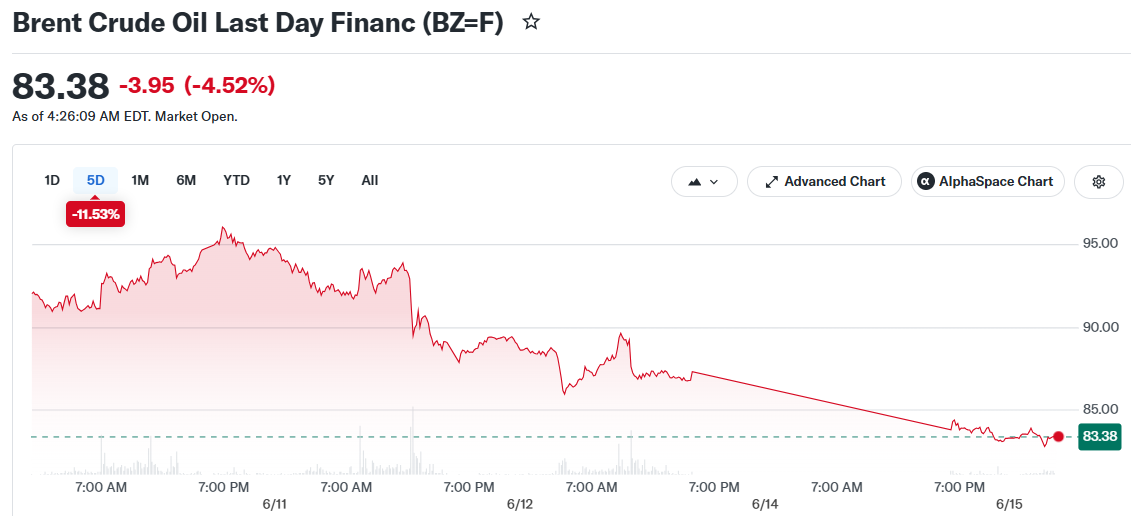
Brent crude fell more than 4% to around $83.79 a barrel. West Texas Intermediate dropped 4.6% to near $81. Both benchmarks hit their lowest levels since March 10.
President Donald Trump announced the deal on social media, saying he was authorizing the “toll free opening” of the Strait of Hormuz and the removal of the US naval blockade. “Ships of the World, start your engines. Let the oil flow!” he wrote.
“The Deal with Islamic Republic of Iran is now complete. Congratulations to all!” President Donald J. Trump 🇺🇸 pic.twitter.com/RdSwyEdEtO
— The White House (@WhiteHouse) June 14, 2026
Iran’s Deputy Foreign Minister Kazem Gharibabadi confirmed a deal was reached. He said the full text would only be published after the signing ceremony in Switzerland, expected on Friday.
The war began in late February when the US and Israel struck Iran over its nuclear program. Iran responded by shutting down the Strait of Hormuz and launching strikes across the Persian Gulf. The US then imposed its own naval blockade on Iranian-linked vessels.
At the peak of the crisis, Brent crude climbed above $120 a barrel. Shipping disruptions, high insurance costs, and fears of prolonged supply shortages all pushed prices higher.

Why Oil Prices Were Already Falling
Prices had been declining in recent weeks as signals grew that a deal was close. Some crude flows through the strait had reportedly resumed, and major developed economies tapped emergency oil reserves to ease the crunch.
China, one of the world’s leading oil importers, also scaled back purchases during the crisis.
What the Deal Includes
The framework agreement calls for halting hostilities and reopening Hormuz within 30 days under Iranian arrangements. It also reportedly includes sanctions relief, limits on Iran’s nuclear activities, and steps to normalize Iranian oil exports.
The deal sets up 60 days of further talks on Iran’s nuclear program. Trump told the New York Times that if no agreement is reached on that front, he could restart military action.
Despite the positive headlines, analysts urged caution. The waterway may still have mines that need clearing. Insurance providers could continue to charge elevated rates for ships using the route.
“We still need to understand what the deal means,” said Chris Weston of Pepperstone Group. “Even with the strait slated to open on Friday, there could be mines still.”
Producers also warned that restarting oil output from shut-in Persian Gulf fields could take months due to infrastructure damage and technical challenges.
Lower oil prices could reduce inflation pressures for central banks. The US Federal Reserve holds its policy meeting on June 16-17 and is expected to hold rates steady.
🚨 Our MAY Stock Picks Are Live!
A new month means new opportunities. Our analysts have just released their top stock picks for May, highlighting companies with strong momentum that rank highly on our KO Score algorithm. We’re also now sharing trade ideas for both long-term and short-term investors, giving you more ways to spot potential opportunities in the market.
Sign up to Knockout Stocks today and get 50% off to unlock the full list and see which stocks made the cut.
Use coupon code Special50 for your exclusive discount!