


X Layer and the OKB team have revealed Exchange OS, which is a permissionless protocol that is designed to bring institutional-grade exchange infrastructure on-chain. The system promises high throughput, low latency and a unified margin and account model so developers, institutions and trading teams can spin up spot, perpetual and outcome markets without rebuilding complex exchange systems from scratch.
Exchange OS moves core exchange functions, matching, margining, liquidation, settlement and risk management, into the protocol layer, creating a common execution environment where multiple trading venues can run side-by-side. This shared infrastructure is intended to solve what the teams call one of on-chain finance’s biggest pain points, fragmented trading rails that trap capital and force builders to choose between relying on centralized tech or re-implementing exchange logic themselves.
High Performance, Permissionless Deployment
Technically, Exchange OS is built on X Layer and claims institutional-grade performance comparable to OKX, with a quoted throughput of up to 300,000 TPS and millisecond-level matching latency. The design supports both CeDeFi (centralized custody models) and fully self-custodial markets in a single shared execution environment, enabling a wide range of operating models.
Crucially, the protocol is permissionless but gated by staking: partners must lock a specified amount of OKB in the X Layer staking contract to create their own trading venues on the Trade Zone. Deployers can choose assets, oracle providers, revenue models and compliance frameworks, allowing for everything from fully KYC-compliant, regulated venues to Web3-native permissionless marketplaces. The platform isolates risk across ” risk groups” so different venues can maintain distinct rules and controls while sharing the same underlying infrastructure.
Star Xu, founder and CEO of OKX with this development stated in an X post “This is a new chapter for on-chain finance”.
Moreover, before the announcement was made public, the price of the OKB token was hovering around the $83 mark, but after the announcement, the price of the token surged significantly. At press time, the price of the token stands at $94.09 with an uptick of 13% in the last 24-hours as per CoinGecko.
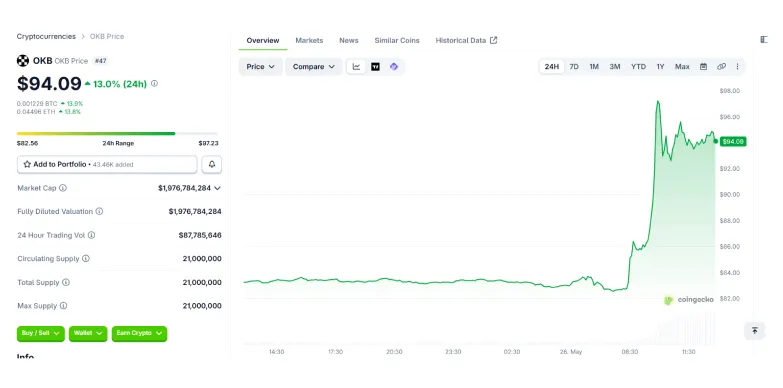
Unified Capital and Market Composition
For Traders, Exchange OS promises a simpler capital experience. A unified account and margin system lets liquidity and collateral move seamlessly across spot, derivatives and outcome markets, removing the need to split funds across separate platforms. This pooled capital model is intended to increase capital efficiency, simplify risk management and allow a single market thesis, for example an outlook on macro, AI, or a sports event – to be expressed through multiple instruments.
First Venue: Simulated World Cup Outcomes
To show how the platform works in the real world, X Layer and OKB plan to launch the first venue themselves this June. The launch will feature a simulated 2026 FIFA World Cup prediction market running on Exchange OS. So basically, users will be able to trade on possible World Cup outcomes in a test environment before the system opens up to more projects and developers.
The team says they decided to build and run the first venue in-house so they can properly test the platform under live conditions before allowing a huge adoption through the X Layer Improvement Proposal (XIP-Exchange OS).
What Happens Next?
The project’s whitepaper has been released alongside the announcement. The whitepaper explains how the platform will work, how governance decisions will be handled, and how the rollout will happen step by step.
According to the roadmap, Exchange OS will gradually open its infrastructure and deployment tools to the broader ecosystem through the XIP process.
Big Names Already Involved
Several major crypto and infrastructure firms are already listed as partners. These include trading firms, analytics companies, oracle providers and cloud infrastructure support. Some of the big names include GSR, Flowdesk, Volmex, Chainlink, Pyth Network, Glassnode, Nansen, Chainalysis, and Alibaba Cloud.
The announcement describes these partnerships as part of a larger effort to create shared and flexible market infrastructure that can support both regulated platforms and open decentralized systems.