
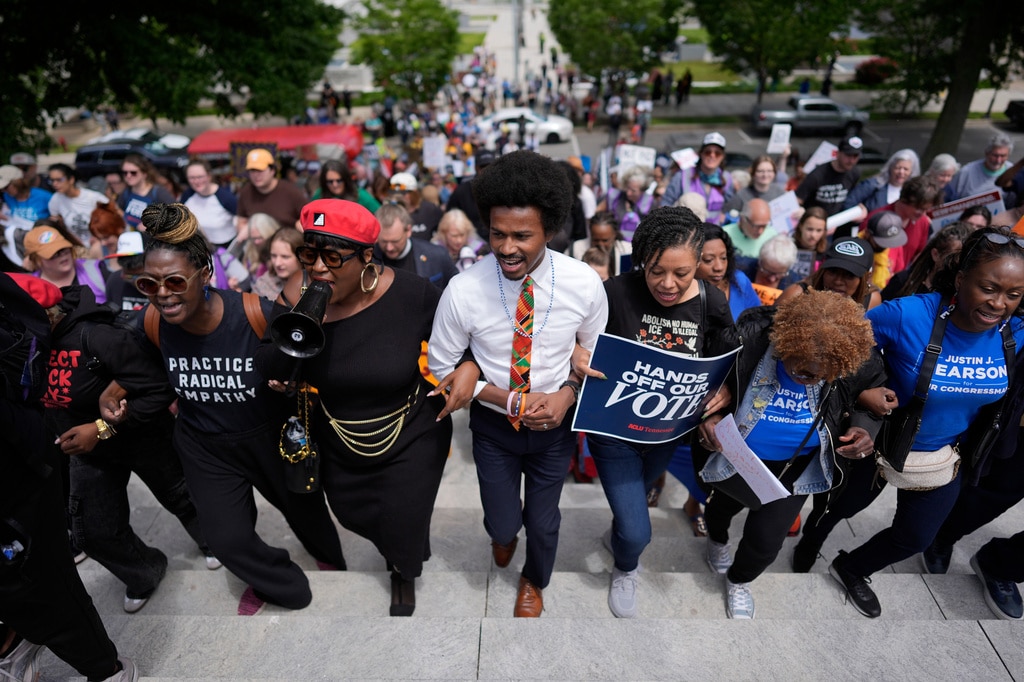
Two different lawsuits filed in federal district court in Tennessee assert that the redrawing of several districts in Tennessee violates the First Amendment. The complaints in Hale v. Lee and Sherman v. Hargett both contend that the redistricting changes violate the First Amendment.
The Hale complaint focuses on the freedom of association, asserting that the new law “burdens Plaintiffs’ right to associate by summarily breaking Plaintiffs’ already-formed associational bonds for the upcoming election.” Meanwhile, the Sherman complaint focuses on retaliation for associational activities, reading that “the Constitution forbids the government from redrawing electoral district lines in order to punish or suppress speech.”
Freedom of Association
Let’s first unpack the freedom of association and the claims asserted. The freedom of association is not textually listed in the First Amendment. The five textual-based freedoms in the First Amendment are religion, speech, press, assembly and petition. However, the U.S. Supreme Court recognized in NAACP v. Alabama ex. rel. Patterson (1958) that the First Amendment also protects the right of individuals to associate together for politically expressive purposes.
In that case, the state of Alabama sought to shut down the NAACP for its effective advocacy of civil rights and challenge to segregation laws in the state. It sought a court order forcing the NAACP to reveal its private membership lists. The idea was to publicly disclose the rank-and-file members and cause many to lose their jobs and suffer other hardships. The U.S. Supreme Court recognized that the NAACP and its members had a right to associate together for expressive purposes and that Alabama’s actions threatened those rights.
In the Hale case, the individual-plaintiffs, the four political candidates, and the Tennessee Democratic Party all assert that the gross redrawing of congressionally drawn lines places a severe and extreme burden on their already-formed associational bonds. For example, the four candidates (Steve Cohen, Charles Molder, Chaney Mosley and Justin Pearson) assert that before the gross redistricting they all have engaged in campaigning and associational activities with would-be voters. Now, the redistricting has thrown that up in the air.
Retaliation
The Sherman complaint also advances First Amendment associational claims though it adds a different spin. The plaintiffs here are Black voters and non-profit groups who raise voter awareness in the Memphis area. They contend that the redrawing of congressional district lines targets the Black vote.
They also assert a First Amendment retaliation claim – that the Republican-controlled legislature has targeted and retaliated against them “due to their speech activity and the speech of their associates” and thus “constitutes First Amendment retaliation.” The complaint quotes the U.S. Supreme Court in Hartman v. Moore (2006): “The First Amendment prohibits government officials from subjecting an individual to retaliatory actions” for protected speech.
The underlying concept of a First Amendment retaliation claim is that the government has retaliated against an individual or group because they don’t like their speech. Retaliation comes in all shapes and sizes. But the key element is that the plaintiffs must show that the allegedly unconstitutional governmental action is casually connected to the plaintiff’s First Amendment speech and expressive activities.
Conclusion
The bottom line is that both lawsuits assert serious First Amendment claims involving freedom of association and retaliation. It will be most interesting to see how the courts address these causes of action.
David Hudson Jr. is a law professor at Belmont University who publishes widely on First Amendment topics.