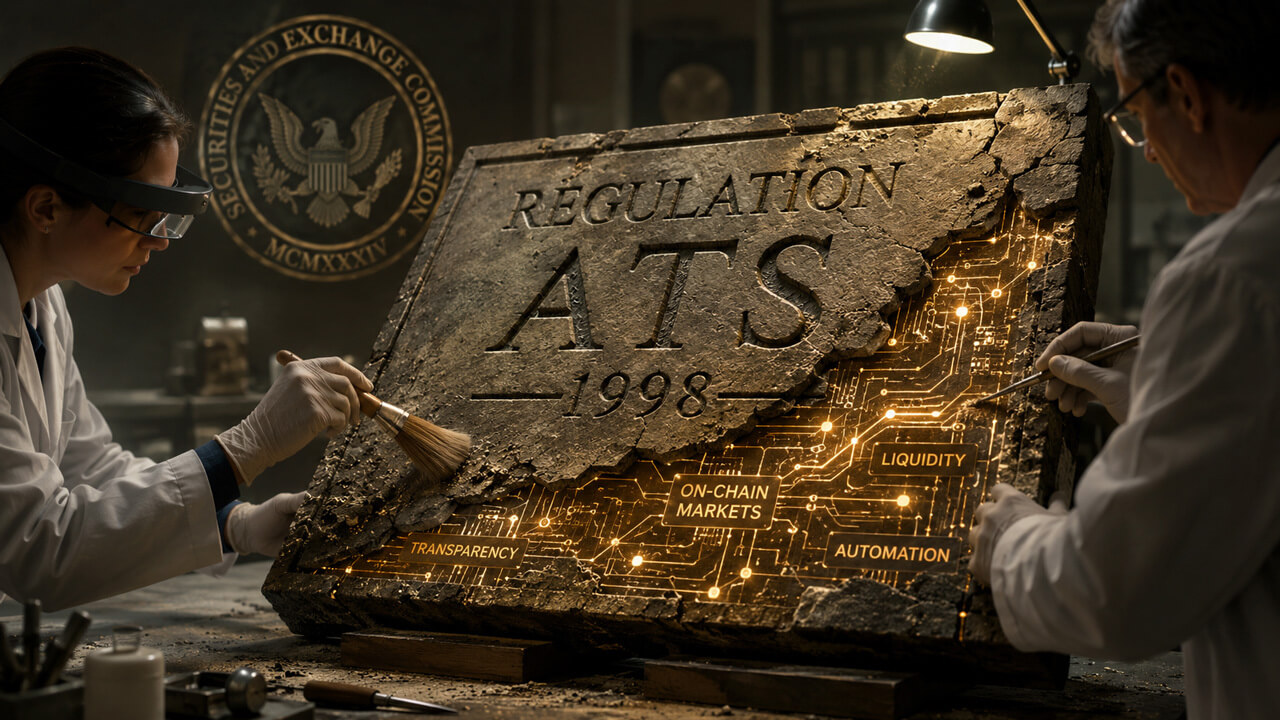



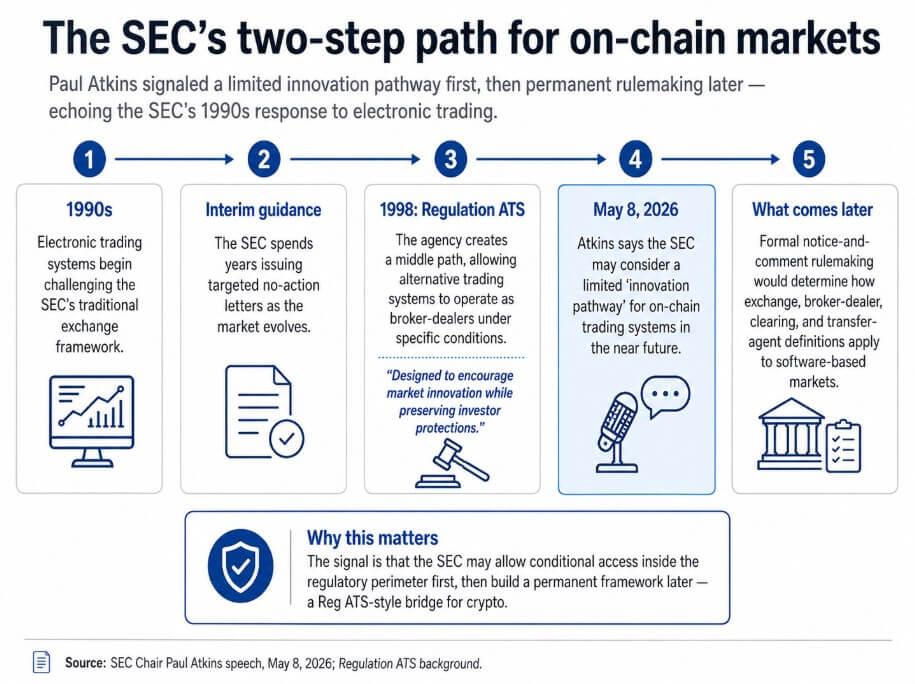
In a May 8 speech, SEC Chair Paul Atkins said the agency could consider a limited “innovation pathway” for on-chain trading systems in the near future.
Meanwhile, the agency will reserve formal notice-and-comment rulemaking to determine how crypto platforms fit inside the exchange definition. Atkins tied that idea directly to the SEC’s handling of electronic trading in the 1990s.
The SEC spent years issuing ad hoc no-action letters as electronic trading challenged the exchange framework, then built Regulation ATS in 1998. The rule was a middle path that allowed alternative trading systems to operate as broker-dealers under specific conditions as the market matured.
The original adopting release described the framework as designed to “encourage market innovation” while preserving investor protections. Atkins is pointing at that sequence of targeted guidance first, fit-for-purpose architecture second, as a template for on-chain finance.
The two-step reading makes the speech different from generic crypto-policy rhetoric.
Atkins appears to be preparing the SEC to allow certain on-chain trading systems to operate inside the regulatory perimeter under conditions, while a longer rulemaking process settles how exchange, broker-dealer, clearing, and transfer-agent definitions apply to software-based markets.
For crypto firms that spent years facing enforcement before rules existed, that sequence would represent a genuine departure from recent agency posture.
Why on-chain markets force a new architecture
Traditional SEC rules were built around separate actors performing separate regulated functions, such as exchanges matching orders, broker-dealers routing and executing them, clearing agencies settling them, and transfer agents recording ownership.
A single on-chain protocol can perform all of those functions automatically, often within seconds, without distinct intermediaries at each step.
Applying a rulebook designed for that separation to software that collapses it produces legal uncertainty that firms and regulators alike are trying to escape, and Atkins acknowledged that friction directly.
Clean compliance requires the SEC to do more than declare existing rules apply. Some functions that appear to be exchange activity in on-chain form also resemble broker-dealer or clearing activity, or both simultaneously.
A limited pathway is intended to address this problem by giving firms a route to operate inside the perimeter before the more difficult definitional rewrites are complete.
| Traditional SEC category | Traditional function | What an on-chain protocol can do |
|---|---|---|
| Exchange | Matches buy and sell orders | Executes trades automatically within the protocol |
| Broker-dealer | Routes and executes customer orders | Routes liquidity and executes transactions through software |
| Clearing agency | Clears and settles trades between parties | Settles transactions on-chain, often within seconds |
| Transfer agent | Maintains records of ownership | Updates ownership records directly on-chain |
This pathway could take the form of exemptive relief, conditional no-action letters, a pilot program, a tailored registration framework, or a registration-lite model for certain on-chain venues.
The sequence is near-term conditional access, then formal rulemaking to future-proof the framework.
The SEC has already been operating with temporary tools in this space. On Apr. 13, the Division of Trading and Markets issued a staff statement offering conditional relief to certain self-custodial crypto interfaces, calling it an “interim step” while broader regulatory questions are considered.
Between Mar. 17 and May 4, the SEC’s Crypto@SEC page recorded five market structure or tokenization actions, and Atkins’ speech serves as the policy frame that connects those operational moves into a coherent sequence.
Commissioner Hester Peirce pointed to specific design levers in December 2025, asking whether the SEC should tailor Form ATS for crypto alternative trading systems, revise public-versus-non-public disclosure requirements, and rethink ATS reporting in light of public blockchains.
The February FAQ clarified that pairs trading of securities and non-security crypto assets is permissible, confirmed that current ATS forms can accommodate crypto disclosures, and established that broker-dealer ATS operators may perform certain clearing and settlement functions under applicable law.
The pathway Atkins is hinting at appears to build on those components.
Bridge or funnel
The optimistic reading is that the SEC is preparing a true Reg ATS-style bridge, with formal conditional pathways for on-chain venues, purpose-built disclosure frameworks, and explicit recognition that some on-chain clearing and settlement can sit inside broker-dealer activity.
In that version, firms that have operated offshore or in legal ambiguity would have a practical route to register, disclose, and operate domestically.
The Nasdaq tokenized-securities approval, the NYSE tokenized-securities filing, and the HQLAx no-action relief are all operational evidence that the SEC can structure conditional accommodations without waiting for Congress.
Conditional accommodation and deregulation are distinct outcomes. The original Regulation ATS brought new trading venues inside the SEC’s perimeter and imposed conditions on their operation.
A crypto equivalent would impose requirements on disclosure, recordkeeping, custody standards, routing transparency, and conflict-of-interest controls, with a framework built around how on-chain protocols actually function.
The practical benefit to the industry would be a compliance route built on an on-chain architecture.
The pessimistic reading is that the pathway materializes primarily for intermediated or hybrid actors, leaving autonomous protocols and decentralized systems in the same legal uncertainty they face today.
The conditional relief it offers applies only to providers that hold no customer assets, take no orders, route no transactions, execute no trades, and solicit no specific user activity. That exclusion list covers most of what makes an automated market-maker or lending protocol function.
A pathway designed around those parameters would help firms closest to the traditional broker-dealer model while doing little for parts of on-chain finance that have no obvious broker-dealer analog.
| Optimistic reading | Pessimistic reading |
|---|---|
| Creates a workable compliance route for on-chain venues | Helps mainly hybrid or intermediated actors |
| Uses tailored disclosure and reporting requirements | Leaves autonomous protocols in legal limbo |
| Brings activity onshore instead of pushing it offshore | Becomes a funnel into tighter SEC control |
| Gives the SEC visibility without relying on enforcement first | Relief is too narrow to change much in practice |
| Recognizes that software-based markets do not map neatly onto legacy exchange rules | Mostly benefits firms closest to the broker-dealer model |
Atkins also used the speech to urge Congress to send the CLARITY Act to President Donald Trump’s desk, and the legislative backdrop helps explain why SEC action carries independent weight.
CLARITY Act faced a February stalemate over stablecoin rewards provisions, an April push from Treasury Secretary Scott Bessent, and a May 1 deal on a key provision that may restore Senate momentum.
That stop-start trajectory means the SEC must act with its own tools while Congress negotiates, and Atkins said in January that statute alone leaves operational questions for the agency to answer.
His FTX reference closed the political argument, noting that regulatory voids displace risk offshore, leaving American investors exposed.
FTX operated outside the US, yet American customers still lost money. A domestic pathway brings activity inside the system before the next structural failure makes the gaps undeniable.
The speech is best taken as a marker that the SEC appears to be moving from a classification argument about crypto fitting the old rulebook to a design exercise about what conditions a bridge for on-chain venues would actually require.