


Aleš Michl, governor of the Czech National Bank, said the institution’s early research suggests a small Bitcoin allocation could improve portfolio returns without materially increasing overall risk. Speaking at the Bitcoin 2026 conference in Las Vegas, Michl framed the finding not as a policy shift or ideological endorsement, but as part of a broader effort to rethink reserve management while maintaining strict monetary discipline.
Michl opened his remarks by acknowledging the unusual nature of the subject. “Today I want to talk about a strange combination, a central bank and Bitcoin,” he said. “Most people do not put these two things together. I do.”
Bitcoin Trial Puts Czech Central Bank In Uncharted Territory
The governor placed the Bitcoin discussion inside the Czech National Bank’s recent macroeconomic record. When he became governor in mid-2022, he said, Czech inflation was close to 20%. At the time, he pledged to bring inflation back to 2% within two years, a target he said the bank achieved through tighter policy rather than “magic.”
“Even before COVID, money was too cheap for too long,” Michl said. “For too long, the system promoted borrowing. For too long the currency, our currency, the Czech koruna, was weakened.”
That experience, he argued, defines his version of conservative central banking: tighter policy for longer, support for saving, and a stronger domestic currency. His rule, stated bluntly, was: “Stay hawkish forever.”
But Michl’s speech moved beyond interest-rate policy into the management of the Czech National Bank’s foreign exchange reserves. The bank oversees about $180 billion in reserves, equivalent to roughly 44% of Czech GDP, which Michl described as among the largest reserve positions in the world relative to the size of the economy. That scale, he said, forces the bank to think carefully about the long-term construction of its portfolio.
Over the past four years, the Czech National Bank increased the share of equities in its portfolio from 15% to 26%. It also raised gold exposure from almost zero to 6%. Michl said the aim was to build a portfolio with higher expected returns than before, lower risk than an all-stock allocation, and even lower risk than an all-bond portfolio.
The next question, he said, was whether the bank could go further. That led to Bitcoin. Michl recalled buying coffee with Bitcoin in Prague about a decade ago, joking that the purchase would now be worth roughly $350. “It was the most expensive coffee of my life,” he said.
Still, he did not minimize Bitcoin’s risk profile. Michl described the asset as highly volatile and said its price could rise substantially or fall to zero. But he argued that the same conceptual risk exists across other assets: stocks can collapse, and bonds can fail. For a reserve manager, the issue is not whether one asset is risky in isolation, but how it behaves inside a diversified portfolio.
That was the central finding of the bank’s new working paper, according to Michl. “This is our model portfolio with 1% in Bitcoin,” he said. “And here comes the interesting part. With 1% in Bitcoin, expected return goes up and overall risk stays about the same in our Czech currency.”
Michl attributed that result to Bitcoin’s low long-term correlation with many traditional assets. Because Bitcoin does not move in the same way as conventional portfolio components, he said, a small allocation may improve the overall risk-return profile. “Return can go up and risk stay about the same,” he said. “That is diversification.”
The Czech National Bank has now created a separate Bitcoin test portfolio. Michl was careful to define its scope: “A test portfolio. Not a revolution. Not a political statement. A test.”
The experiment will run for two years, after which the central bank plans to publish the results and decide what comes next.
At press time, Bitcoin traded at $77,269.
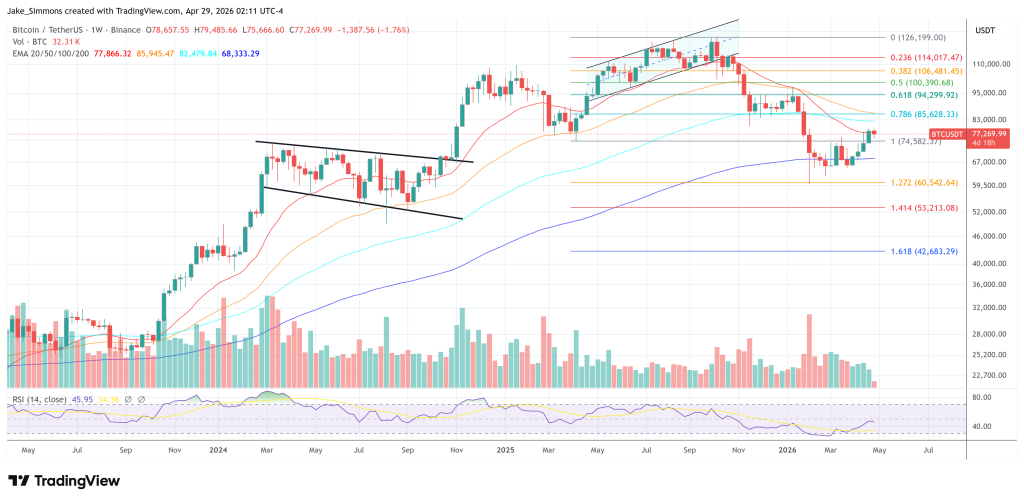
Featured image created with DALL.E, chart from TradingView.com
Editorial Process for bitcoinist is centered on delivering thoroughly researched, accurate, and unbiased content. We uphold strict sourcing standards, and each page undergoes diligent review by our team of top technology experts and seasoned editors. This process ensures the integrity, relevance, and value of our content for our readers.