


- Blockchain enables self-sovereign identity where users control their credentials without intermediaries.
- Technical tools like DIDs, VCs, and zero-knowledge proofs support privacy and trust in decentralized identity systems.
- Adoption challenges include scalability, usability, regulation, and key management, limiting widespread implementation.
Most people assume their digital identity is something handed to them, owned by a government database, a social media platform, or a corporate login system. That assumption is increasingly worth questioning. Centralized identity systems have repeatedly failed users, with data breaches exposing billions of records, platforms revoking access arbitrarily, and individuals holding little meaningful control over their own credentials. Blockchain technology is now offering a genuine alternative: a model where users hold cryptographic authority over their own identities, no intermediary required. This article covers the technical foundations, real-world performance, honest limitations, and the ongoing debate around blockchain-based digital identity.
Table of Contents
Key Takeaways
| Point | Details |
|---|---|
| User-controlled identity | Blockchain shifts digital identity from central authorities to user control using DIDs and verifiable credentials. |
| Security and privacy | Cryptography and smart contracts power secure, private, and fraud-resistant digital identity systems. |
| Adoption hurdles remain | Scalability, usability, and regulatory issues limit mainstream blockchain identity adoption today. |
| Real impact in niche areas | Best results come from focused sectors like IoT and immigration with high trust and specific needs. |
What is blockchain-based digital identity?
Traditional digital identity works through a hub-and-spoke model. A central authority, whether it is a government, a bank, or Google, issues your credentials, stores your data, and decides whether you can access services. You are, in effect, a guest in your own identity ecosystem. Blockchain flips this architecture.
Blockchain-based digital identity is built around self-sovereign identity (SSI), a model where individuals create, own, and present their credentials without depending on a central provider. The two core technical building blocks are Decentralized Identifiers (DIDs) and Verifiable Credentials (VCs).
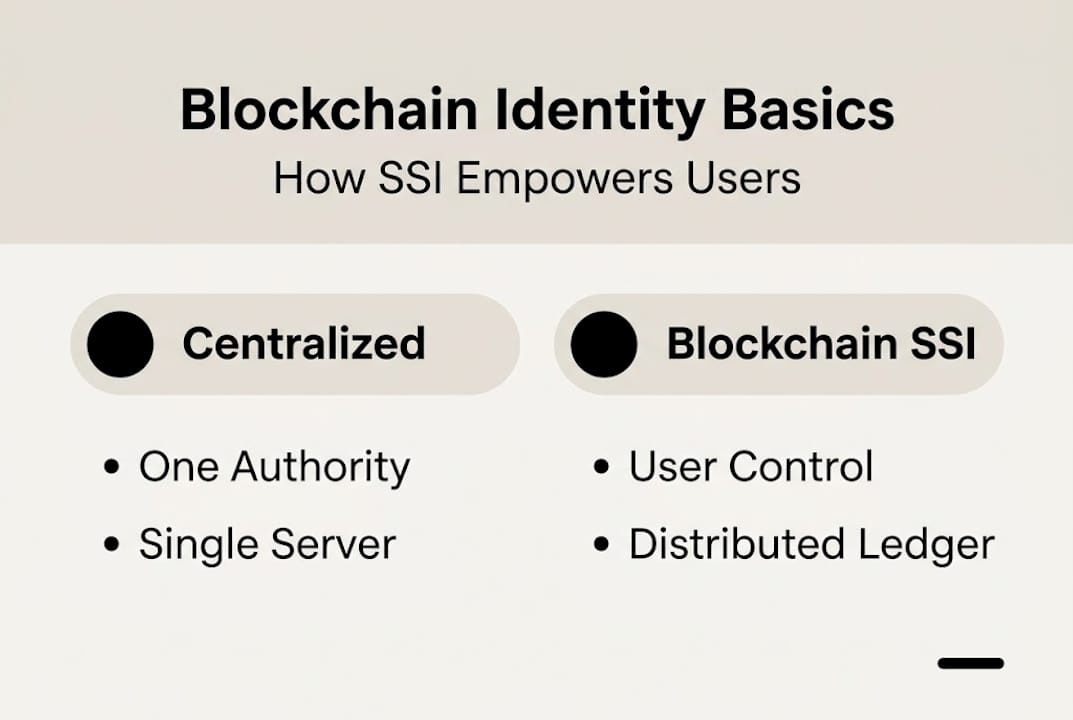
Decentralized Identifiers are globally unique strings anchored to a blockchain, generated and controlled by the user. They function like a permanent, portable address for your identity. VCs are cryptographically signed attestations, such as a university degree, a driver’s license, or an age confirmation, issued by a trusted party but stored and presented by the individual. Blockchain enables SSI through DIDs and VCs, allowing users to control their digital identities without centralized authorities. This is not a minor tweak to existing systems. It is a structural shift.
“Blockchain shifts identity from centralized silos to user-controlled systems, where trust is cryptographic rather than institutional.”
Consider practical scenarios: logging into a service by proving you are over 18 without revealing your birth date, crossing a border using a blockchain-verified travel credential, or accessing healthcare with a credential that no single hospital owns. These are not speculative visions. Pilots for each exist today.
| Feature | Centralized Identity | Blockchain-Based Identity |
|---|---|---|
| Data storage | Central server | User wallet / distributed ledger |
| Control | Institution | Individual |
| Privacy | Limited | Selective disclosure |
| Breach risk | High (single point) | Lower (no central honeypot) |
| Portability | Restricted | Cross-platform by design |
For anyone tracking blockchain use cases, identity management is emerging as one of the most consequential applications, not just for individual privacy but for enterprise compliance and cross-border trust frameworks.
Key mechanics: How does blockchain power decentralized identity?
With the basics of blockchain identity in mind, let us break down the core mechanics that make user-centric digital identity reliable.
SSI operates on a three-party trust model: Issuer, Holder, and Verifier. The Issuer (a university, government, or employer) signs a credential. The Holder (the individual) stores it in a digital wallet. The Verifier (an airline, a hospital, a platform) checks the cryptographic signature without contacting the issuer directly. No intermediary holds the session. No central database is queried.
Here is how the technical stack layers together:
- DIDs and DID documents anchor the identity on-chain. A DID document contains public keys, authentication methods, and service endpoints.
- Cryptographic signatures verify that a credential was genuinely issued by the stated party and has not been tampered with.
- Zero-knowledge proofs (ZKPs) allow a holder to prove a claim (“I am over 21”) without revealing the underlying data (actual birth date). This is privacy by math, not policy.
- Smart contracts automate access rules, credential revocation, and audit trail creation, enforcing logic that no single party can override.
Key mechanics include cryptographic primitives like zero-knowledge proofs, smart contracts for access control, and blockchain ledgers for immutable storage of DIDs and transaction logs.
| SSI Role | Function | Technical Tool |
|---|---|---|
| Issuer | Signs and issues credential | Cryptographic signature |
| Holder | Stores and presents credential | Digital wallet |
| Verifier | Validates without issuer contact | DID resolution, ZKP |
Blockchain transparency ensures that every DID registration and revocation event is auditable, which matters enormously for regulated industries. The verifiable credentials data model, maintained by the W3C, underpins most production implementations today.

Pro Tip: Smart contract code governing identity access must be audited by independent security firms before deployment. A flaw in an access-control contract is not a bug you can patch quietly. It is a systemic identity breach waiting to happen.
Performance benchmarks and real-world identity use cases
Knowing how blockchain mechanisms work, let us look at evidence-driven benchmarks and examples where these solutions are making a meaningful impact.
Scalability is the most cited concern, and the numbers tell a nuanced story. Public chains offer decentralization but suffer under transaction volume. Permissioned chains like Hyperledger Fabric offer higher throughput but trade off openness.
Empirical benchmarks show that Hyperledger Fabric BIMAS achieves optimal latency at 50 TPS with specific block sizes. YouGovern SSI deployed on Binance Smart Chain records 0.94 seconds for DID registration with a 12.5 TPS peak. An immigration-focused blockchain system demonstrated 47.8ms visa processing latency with 100% fraud detection across 23,000 applications. These are not lab conditions. These are production deployments.
Industries seeing measurable early traction:
- IoT device authentication: Machines need identities too, and blockchain provides tamper-resistant device credentials at scale.
- Healthcare: Patient record access using portable VCs reduces duplication errors and unauthorized access.
- Immigration and border control: Blockchain-verified travel documents cut fraud and processing time simultaneously.
- Fintech and KYC: Reusable KYC credentials reduce onboarding friction and compliance costs significantly.
- Education: Tamper-proof diploma verification is already live in several national systems.
Energy efficiency is also improving. Newer proof-of-stake and permissioned consensus models consume up to 62% less energy than earlier proof-of-work approaches, which strengthens the sustainability case for enterprise deployments. Understanding blockchain trust in 2026 means recognizing that performance is converging with practical requirements in specific high-value niches.
Pro Tip: For enterprise identity use cases, permissioned blockchains like Hyperledger Fabric often outperform public chains on latency and throughput. If your use case requires compliance controls and high transaction volumes, decentralization can be a secondary priority.
Limitations and challenges of blockchain identity
For every breakthrough, there are very real limitations. Let us clarify what is holding blockchain identity back from global dominance.
Challenges include scalability and cost on public blockchains, significant usability barriers, regulatory hurdles especially around GDPR liability, and low adoption due to complexity and the absence of clear killer applications.
The GDPR problem alone is structurally difficult. Blockchain’s immutability conflicts directly with the right to erasure. Writing personal data on-chain, even in encrypted or hashed form, creates potential compliance liability that legal teams at major enterprises are not willing to accept without regulatory clarity that has not arrived yet.
Top five obstacles to mainstream adoption:
- Key management: Losing your private key means losing your identity. There is no password reset.
- Revocation complexity: Revoking a credential on a decentralized system without a central registry is technically challenging.
- Interoperability: Competing DID methods and VC formats create fragmentation. A credential on one chain may not be recognized on another.
- UX barriers: JSON-LD schemas, wallet setup, and DID resolution are invisible to developers but opaque to end users.
- Quantum computing threats: Most current public-key cryptography underpinning DIDs is vulnerable to sufficiently advanced quantum attacks.
Adoption rates reflect these pressures. Industry estimates suggest 60 to 85% of blockchain identity projects stall or fail before reaching meaningful scale.
There is also a subtler problem. Many SSI implementations are becoming “SSI in name only,” where the issuer retains effective control over credentials, creating a centralization dynamic through the back door.
“True holder-centric control requires more than a DID. It requires the system to be architected so that neither the issuer nor the platform can unilaterally revoke access without the holder’s awareness and recourse.”
For context on how regulation shapes these risks, crypto regulations continue to evolve in ways that directly affect how blockchain identity solutions can legally operate across jurisdictions.
Contrasting perspectives: Promise vs. reality in blockchain identity
Any transformative technology comes with debate. Here is how insiders see the promises and the gaps in blockchain identity.
Proponents highlight privacy, user control, and a paradigm shift in trust, while critics argue that most SSI implementations re-centralize control via issuers and that technical overhead exceeds practical benefits for the majority of use cases.
The optimist case is real. For individuals in regions with unreliable government infrastructure, blockchain identity can provide verifiable credentials that travel across borders and systems. For enterprises managing compliance across multiple jurisdictions, portable and cryptographically verified credentials reduce friction meaningfully.
Key arguments on both sides:
Pro:
- Users gain selective disclosure: share only what is necessary, nothing more.
- Eliminates single points of failure in identity storage.
- Portable credentials reduce onboarding duplication across services.
- Cryptographic trust replaces institutional trust, which is more auditable.
Con:
- Issuer-centralized implementations hollow out the “sovereign” promise.
- Most users cannot manage private keys reliably without custodial support, reintroducing trust intermediaries.
- Regulatory patchwork creates cross-border deployment risk.
- Nuanced adoption data shows that the vast majority of SSI projects are stuck in pilot phase.
The honest read is that blockchain identity is not uniformly promising or uniformly overhyped. It is context-dependent. High-stakes, high-trust environments where fraud is expensive and identity verification is critical represent the real opportunity. Low-stakes consumer applications where convenience dominates have fewer clear advantages over existing federated login systems.
Blockchain’s real impact is most visible where institutional trust has historically been weakest and where the cost of identity fraud is highest.
Our take: Where blockchain identity works and where it doesn’t
After examining every angle, the pattern is clear: blockchain identity succeeds when the use case demands verifiable, portable trust in environments where no single institution can or should be the authority. Healthcare credential portability, IoT device authentication, and cross-border immigration verification are where the technology earns its keep.
The “SSI in name only” problem is spreading because product teams optimize for issuer convenience, not holder control. The fix is architectural: systems must be designed from the outset so that holders can present, revoke, and rotate credentials independently. Projects that do not build this in from day one rarely retrofit it.
UX is where most projects actually die. The technology can be cryptographically sound and still fail if a regular user cannot complete onboarding in under three minutes. Killer apps in identity will be defined by simplicity, not sophistication.
Pro Tip: When evaluating any blockchain identity project, ask one question: can the holder revoke or update their credential without the issuer’s permission? If the answer is no, the project is centralized regardless of what the whitepaper claims.
The future belongs to projects where open standards, genuine holder control, and ruthless UX simplicity converge. Decentralized infrastructure movements are building the substrate that could finally make this scalable. Demand more than buzzwords from the projects you back or build on.
Explore more blockchain and crypto insights
Blockchain identity is one piece of a rapidly shifting digital landscape where trust, ownership, and verification are all being renegotiated in real time. Staying ahead means tracking not just the technology but the regulatory shifts, adoption curves, and market dynamics shaping it.

Crypto Daily covers the full spectrum of blockchain innovation, from foundational explainers to breaking industry developments. Whether you are unlocking trust in blockchain or tracking crypto trends in 2026, the analysis you need is updated daily. Visit Crypto Daily for expert coverage that bridges the gap between technology and practical decision-making.
Frequently asked questions
What is a decentralized identifier (DID)?
A DID is a globally unique, user-created digital identity stored on a blockchain and controlled directly by the user, not a central provider. Unlike traditional usernames, DIDs and VCs give users cryptographic proof of ownership that no platform can revoke.
How does blockchain improve digital identity security?
Blockchain makes identities more secure by using cryptographic verification, smart contracts, and immutable transaction records to resist fraud and data breaches. Cryptographic primitives and immutable storage remove the single-server vulnerabilities that define centralized identity systems.
Are blockchain identity solutions widely adopted today?
Adoption remains limited, with most projects stalled by regulation, poor UX, and technical complexity, though niches like IoT and immigration are seeing genuine deployment. Adoption is constrained by the absence of killer applications that make the UX barrier worth crossing for mainstream users.
What are the biggest risks with blockchain-based identity?
Main risks include key management failures, interoperability gaps, potential re-centralization by issuers, and future threats from quantum computing. Key management and quantum threats represent structural vulnerabilities that current implementations have not fully resolved.
What is self-sovereign identity (SSI) in blockchain?
SSI is a model where users fully own and control their digital identity using blockchain technology, avoiding reliance on centralized authorities. When implemented correctly, SSI through DIDs and VCs means institutions can verify your credentials without ever owning your data.
Recommended
Disclaimer: This article is provided for informational purposes only. It is not offered or intended to be used as legal, tax, investment, financial, or other advice.