


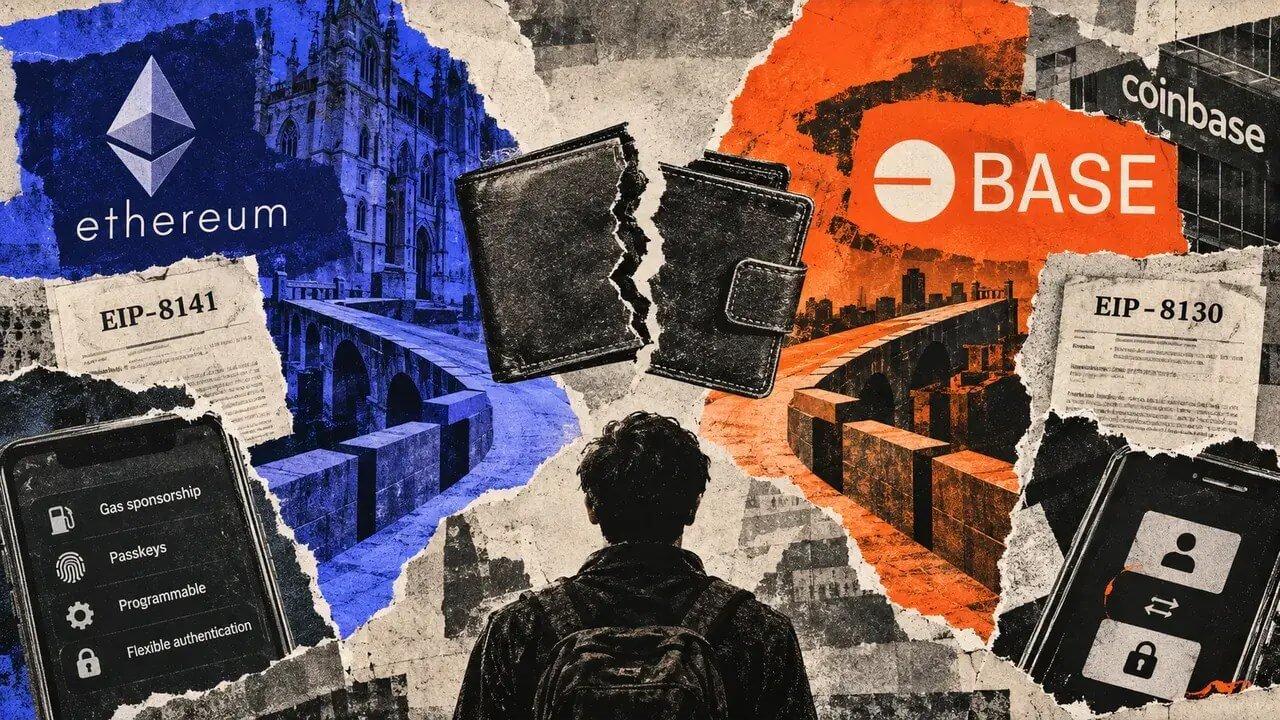
Ethereum and Coinbase-backed layer-2 network Base have abandoned an effort to agree on how the next generation of crypto wallets should work.
On Sept. 14, Ethlabs researcher Derek Chiang said collaboration between developers working on Ethereum’s EIP-8141 Frame Transactions and Base’s EIP-8130 broke down last week after attempts to produce a shared account-abstraction standard failed to reconcile the chains’ different requirements.
The split leaves Ethereum advancing Frames while Base pursues a separate design for native account abstraction, potentially forcing wallets to accommodate different transaction architectures across networks that have historically shared much of the same account and transaction experience.
Both proposals seek to make wallets more programmable, supporting features such as gas sponsorship, passkeys, and flexible authentication. The disagreement emerged over how much freedom the protocol should give accounts and how much structure chains should impose on transactions before they execute.
Chiang said:
“Ethereum wanted to be the best version of Ethereum, and Base wanted to be the best version of Base.”
The breakdown came only weeks after the projects were still trying to bridge those differences. Ethlabs said in late August that developers had held dedicated discussions around Frames and ideas from EIP-8130, even after Ethereum core developers gave EIP-8141 a strong signal toward inclusion in the Hegotá upgrade.
L2 competition pushes protocols in different directions
The failure exposes a structural problem that could become harder to contain as Ethereum’s layer-2 (L2) blockchains mature into networks with their own users, commercial priorities, and development schedules.
Ethereum core developer Matt Garnett said divergence among L2s was inevitable because market competition forces them to introduce features more rapidly than Ethereum L1 can.
Garnett added:
“Market pressure forces them to ship features at a pace that L1 cannot match, so incompatibilities accumulate. Time will tell whether that is a strength or weakness.”
That pressure shows up in competing account-abstraction designs.
EIP-8141 introduces Frame Transactions, which break a transaction into programmable calls that can handle validation, execution, and gas payment.
The proposal is designed to detach accounts from the elliptic-curve keys that dominate Ethereum today, enable key rotation, and provide a path toward post-quantum authentication. Its stated goal is to allow an account to become an address whose behavior is defined by code.
EIP-8130 takes a more structured approach. Written by Coinbase engineer Chris Hunter, it requires transactions to identify their authenticator so nodes can determine the validation work required before executing arbitrary wallet code. Its current draft describes that structure as a way to make validation predictable and allow nodes to reject unknown authenticators before execution.
For Ethereum mainnet, Chiang said the priority is what he calls “CROPS”: censorship and capture resistance, open-source software, privacy, and security.
Those requirements favor an account model developers can extend without seeking permission from the chain and transaction designs that can support privacy systems and future post-quantum signatures.
High-throughput layer-2 networks like Base face different pressures. Chiang said they need account-abstraction systems that can scale while remaining sufficiently legible for chains to determine which authentication methods and transactions they will permit.
EIP-8130’s current draft reflects that divide through separate adoption profiles. Its L1 profile permits authenticators outside a canonical set within defined limits, while its layer-2 profile allows high-throughput chains to restrict the native transaction path to approved canonical authenticators.
The proposal still seeks cross-chain portability, with a common authenticator set and ERC-4337 available as an alternative transport on networks that do not support the 8130 transaction type.
That leaves room for compatibility even if Ethereum and Base adopt different native systems, but more of the work required to preserve it could move away from the protocol itself.
The split reopens Ethereum’s L2 bargain
As technical differences between Ethereum and its layer-2 networks accumulate, the dispute over account abstraction is feeding a broader debate over whether L2 growth automatically strengthens Ethereum itself.
Crypto lawyer Gabriel Shapiro said the split between Ethereum’s EIP-8141 and Base’s EIP-8130 could make the case for layer-2 networks as an inherently beneficial strategy for Ethereum harder to sustain. He said:
“L2s are great — for the crypto industry and for people who own the sequencer. For Ethereum, they are just kinda like ‘less bad’ than competing L1s.”
His argument centers on where value and control ultimately accrue. Networks such as Base can attract users, applications, and transaction activity while capturing sequencing economics and making product decisions around their own competitive priorities.
Ethereum continues to provide settlement and security infrastructure, but that relationship does not ensure that every feature or commercial success on an L2 directly strengthens the L1’s product or economics.
Shapiro said Ethereum may need to rely less on the “halo effects” of businesses such as Base and Robinhood and make a clearer case for the attributes the base layer uniquely provides.
He linked that shift to Vitalik Buterin’s increased emphasis on censorship resistance, privacy and security, arguing that Ethereum is placing greater weight on qualities that distinguish the L1 even as activity continues to move onto rollups.
Layer-2 networks can still generate settlement demand, consume Ethereum data availability, and keep applications within the broader Ethereum ecosystem instead of losing them to rival blockchains. EIP-8130 also includes mechanisms intended to preserve account portability across EVM chains, showing that Base is not designing for isolation.
The account-abstraction dispute nonetheless provides a concrete example of how those interests can diverge.