


Key highlights:
- Progmat migrated at least $2.7 billion in tokenized assets to Avalanche
- Rights transfers are now three to five times faster than they used to be
- The platform is now EVM-compatible, opening access for developers to Ethereum tools
Progmat, one of Japan’s largest security-token platforms, shared that it had completed the migration of all its security-token projects to the Avalanche layer 1 blockchain.
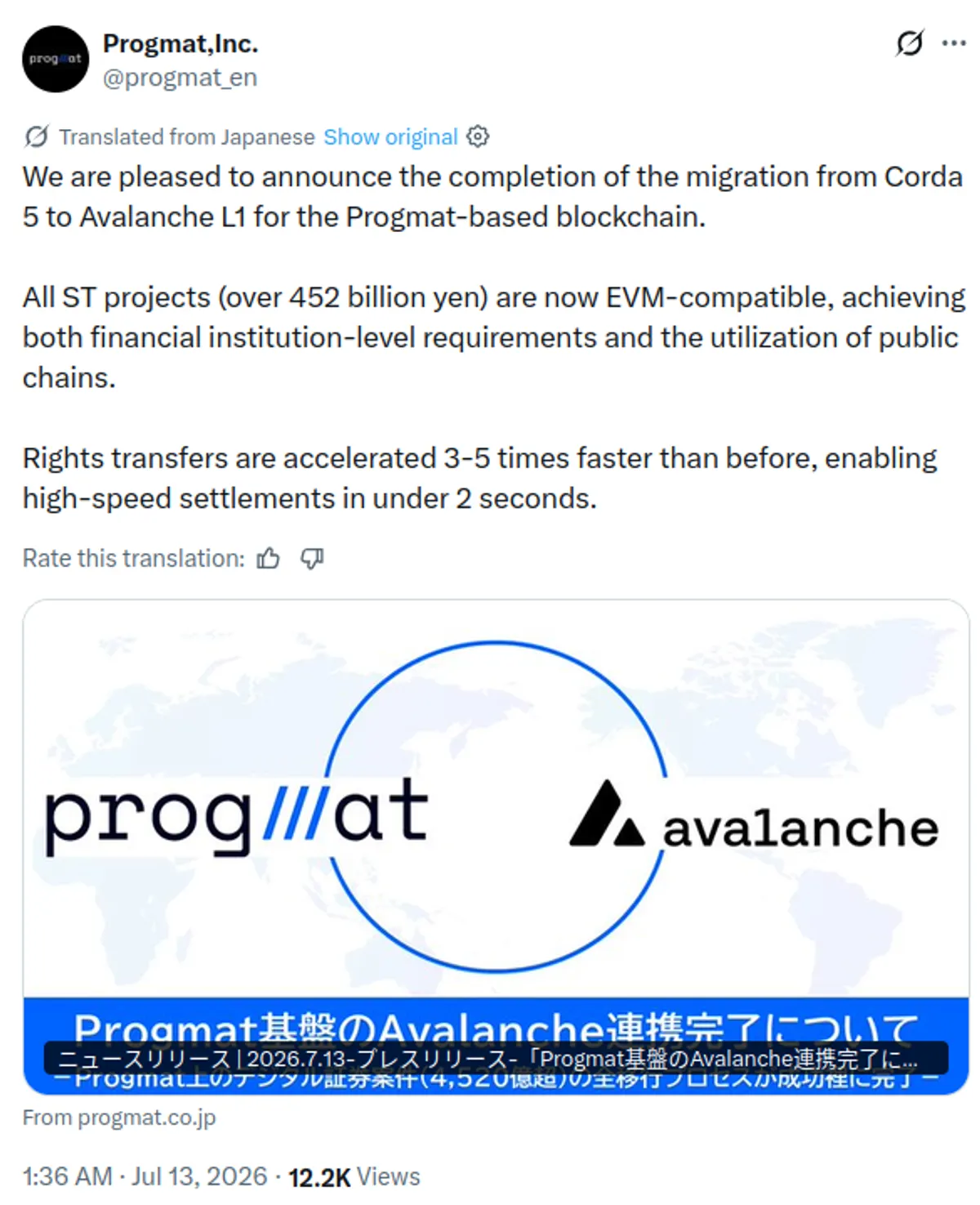
Source: Progmat via X (automatically translated from Japanese)
The firm transferred $2.7 billion in assets and issued securities on a new infrastructure. The upgrade comes just as financial institutions are actively taking steps to use blockchain technology to change traditional markets.
Progmat migration brings faster transactions
The company shared in its press release that every active security-token project on its platform has been successfully moved from Corda 5 to a new = Avalanche network. They also mentioned that the platform preserved its existing issuance, ownership, and transfer functions, which reduces disruption for current users.
This migration changes how fast transactions are conducted. A test was done by Progmat to see how much speed had improved. It showed that rights transfers can now be completed three to five times faster than before. Avalanche transactions also done in less than two seconds.
This allows transactions to be confirmed faster on the network. Justin Kim, head of Avalanche in Asia, also attested to the new development.
Progmat, Japan’s largest STO platform, is now live on @avax
“All ST projects (over 452 billion yen) are now EVM-compatible, achieving both financial institution-level requirements and the utilization of public chains.
Rights transfers are accelerated 3-5 times faster than… https://t.co/xeMVc8EM8e
— Justin Kim (@justinkim415) July 13, 2026
The Japanese firm changed its system so that its business applications are not attached to just one blockchain. A mediator layer is between applications and the ledger. This makes it easier to connect to other networks.
Another new change was compatibility with the EV. Developers can use a range of Ethereum tools by moving smart contracts from Java-based Corda code to Solidity-based contracts. However, the company said that EVM compatibility does not mean regulated securities can move to public wallets.
Looking ahead to tokenized government bonds
The migration is a part of the new developments seen with the firm. In May, Progmat announced a working group that would focus on tokenized Japanese Government Bonds (JGBs).
The group includes banks, asset managers, and securities firms that are studying how blockchain technology would change one of Japan’s largest financial markets.
They are looking into features like 24/7 trading and same-day, or T+0, settlement. Government bonds play a role in collateral management, liquidity operations, among others. This could change how institutions settle transactions.
Progmat is also preparing for cross-chain settlement systems for security tokens, stablecoins, and tokenized bank deposits. This system could allow for delivery-versus-payment and payment-versus-payment transactions in blockchain networks.
Avalanche network supports institutional requirements
The new blockchain is powered by AvaCloud, which provides the dedicated Avalanche infrastructure and operational support.
The network meets SOC 1 and SOC 2 Type II assurance standards, which are popular with regulated financial institutions. The partners also developed systems to respond to outages during off days.
These features are key because tokenized securities operate under stricter rules than traditional crypto assets. Nick Mussallem, CEO of AvaCloud, called the migration an important test of institutional blockchain infrastructure.
This move adds to Avalanche’s importance for blockchain in the tokenized asset sector. Data shows Avalanche currently hosts at least $2 billion in tokenized real-world assets.