
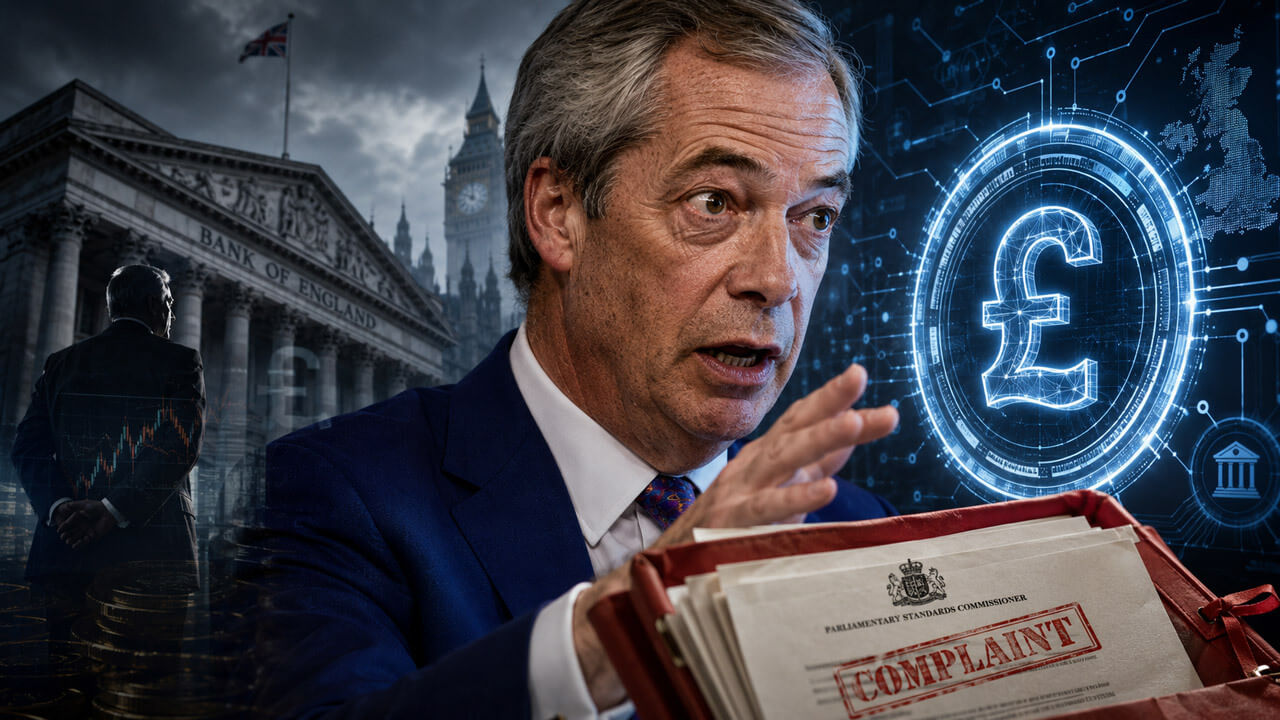
A request for the UK standards watchdog to examine Nigel Farage’s reported interactions with the Bank of England has turned the UK’s digital-pound fight into an access fight: who gets to shape public payment infrastructure while donations from a major crypto-linked backer face fresh scrutiny.
A July 2 Guardian report said Labour MP Phil Brickell asked the Parliamentary Commissioner for Standards to investigate Farage’s reported interactions with the Bank. The request followed the Guardian’s earlier reporting that Farage told a crypto event he had challenged Bank of England Governor Andrew Bailey over the central bank’s digital-pound work.
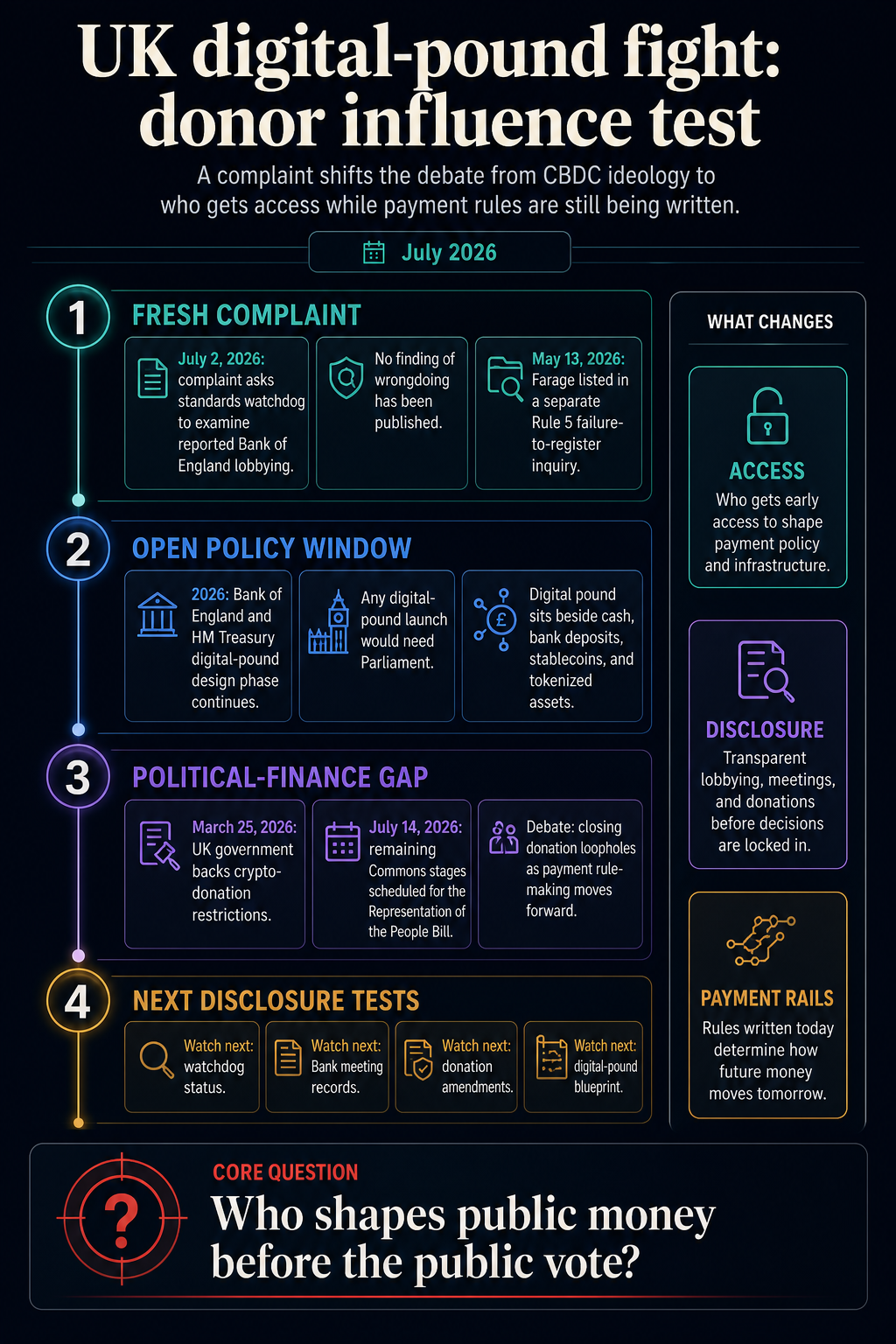
No finding of wrongdoing has been published yet. The commissioner’s current investigations page describes inquiries as currently in the fact-finding stage before any decision is made.
It currently lists Farage under a Rule 5 failure-to-register inquiry opened on May 13, 2026, while the July 2 request remains a complaint rather than a published lobbying-rule case.
The complaint pulls three live policy fronts into one public flashpoint: the Bank’s digital-pound design work, stablecoin regulation, and the rules governing crypto-linked political finance.

Why the complaint changes the digital-pound debate
The digital pound is still only a potential future form of public money. The Bank of England says no decision has been made on whether to introduce it, and that any launch would leave cash in place and would involve central-bank money rather than a cryptocurrency.
Its October 2025 update says the Bank and HM Treasury are continuing a design phase through 2026, with a blueprint and evidence-based assessment due before any decision on further development. If ministers and the Bank later chose to build one, Parliament would still need to pass primary legislation.
That makes the current period unusually important. The UK’s digital-pound project remains a live design process in which the Bank is collecting evidence, testing technology, running the Digital Pound Lab, and engaging with industry, academia, civil society, and other stakeholders.
The complaint lands directly inside that consultation window. According to earlier reporting, Farage and Reform MP Richard Tice met Bailey in September 2025, and Farage later described challenging the Bank’s digital-pound work at a crypto event.
The Bank was reported as saying that the meeting was part of its engagement with political representatives and that it acknowledged Farage’s different view.
That response has wider implications, but routine engagement can still become politically charged when the person raising the issue leads a party that has received large donations from a backer with crypto interests and when the policy at issue could affect the balance between private stablecoins and public digital money.
Earlier public arguments often centered on surveillance, privacy, cash, and whether a central bank digital currency would give the state too much reach into personal payments. Those questions remain. The access question now sits beside them: who gets privileged input while the design is still being shaped?
The Bank’s own digital-pound update frames the issue as a broader “multi-money” system in which households and businesses may use cash, commercial bank deposits, stablecoins, tokenized assets, and potentially a digital pound at equal value.
The Farage complaint shifts the focus from the digital pound itself to who gets a voice, even as the UK is still deciding what public money should look like in a digital economy.
A digital pound would be public money issued by the central bank. Stablecoins are private instruments that can function as payment and settlement rails when confidence, reserves, redemption, and regulation are in place.
The more public money is designed to operate in digital commerce, the more policymakers must decide how much room private stablecoins should have, what limits should apply, and whether public infrastructure should act as a backstop or a competitor.
CryptoSlate has already covered Reform UK’s criticism of proposed stablecoin limits and the broader political-finance backdrop around a Tether-linked Reform donor. The new accountability test is whether private crypto wealth, political donations, and central-bank access can be separated clearly enough for the public to trust the design process.

That is a harder standard than ordinary policy disagreement. Farage can oppose a digital pound on ideological or economic grounds. Reform can argue that stablecoins are better for innovation than central-bank money.
Crypto investors can lobby against caps or rules they consider anti-growth. The pressure point arises when those positions overlap with concentrated financial support and direct access to officials who design payment infrastructure.
Political-finance rules are still catching up
The UK is already trying to adapt its political-finance rules to crypto. The Electoral Commission’s cryptoassets guidance says cryptoassets are treated as property rather than currency, that cryptoasset donations are currently permitted under electoral law, and that parties must still identify donors, check permissibility, value donations in pounds, and report where required.
The guidance also warns that crypto presents particular challenges for identifying donors and ensuring funds are permissible.
Ministers have since moved toward stronger restrictions. A March 25 government announcement said the UK would cap donations from registered overseas electors and ban cryptocurrency donations until sufficient regulation is in place to prevent the use of untraceable funds in politics.
The government linked that position to the Rycroft Review on foreign financial interference.
The legal position is still in flux, as the House of Commons Library briefing published on July 2 says the government accepted Rycroft’s recommendations on overseas-elector caps and a crypto-donation moratorium, but both required retroactive legislative provisions, and the government had not brought those amendments forward at committee stage.
The remaining Commons stages of the Representation of the People Bill are scheduled for July 14, 2026.
That gap turns the Farage complaint into more than a Westminster standards dispute. Even if crypto donations are restricted, influence around policy design remains harder to police.
That may cover campaign finance, but it does little to address who gets private access to policymakers while digital-pound rules are still being written. Separate expectations may be needed for how central banks, regulators, or ministries disclose meetings when politically connected crypto interests are trying to shape the future of payment rails.
The difference matters for every crypto business that wants a voice in UK policy. A transparent submission to a consultation is one thing.
A private meeting by a political figure whose party has received large donations from a backer with major crypto interests creates a different kind of public-confidence problem, even before a watchdog reaches any conclusion.
The next test is disclosure
The immediate watchdog question is procedural: whether the commissioner opens a separate lobbying-rule inquiry and what, if anything, it finds.
The current public record supports a careful conclusion: a complaint has been made, an existing registration inquiry is already listed, and no finding on the new lobbying allegation has been published.
The policy question is broader and more durable. The Bank and HM Treasury are moving toward a 2026 decision point on the digital-pound blueprint. Parliament is moving toward further debate on political donations and crypto.
Stablecoin regulation remains a contested piece of the UK’s digital-asset strategy. All three will determine how much private crypto infrastructure can influence the design of public money.
For the crypto industry, the lesson is mixed. Political access can help push digital assets into mainstream policy, but it also increases scrutiny when policy positions advanced through that access overlap with the interests of wealthy donors or investors.
A pro-innovation argument is easier to sustain when the process is transparent, the interests are visible, and the public can see which meetings, submissions, and policy changes mattered.
For the digital pound, the next credibility milestone may be less about the technology than about governance. If the Bank wants the project to be judged as a public-money design exercise rather than a political fight over who benefits from private payment rails, it will need to keep stakeholder engagement visible enough to withstand pressure from both CBDC opponents and stablecoin advocates.
That is why the Farage complaint changes the shape of the debate even before the watchdog acts. It turns the digital pound from a question about what kind of money Britain might build into a question about who gets to shape the monetary infrastructure before the public gets a final say.