
Most crypto investors still obsess over price charts. But in 2026, a growing share of attention is shifting back to improving the fundamentals of the protocols.
Ethereum, Solana and Avalanche are preparing some of their largest protocol upgrades in years, while Coinbase’s Base network rolled out its Beryl hard fork last Friday in a bid to streamline the network, with a native token standard and shorter withdrawal windows.
Bitcoin development however, remains frozen, with developers still arguing over controversial covenant proposals and post-quantum computing upgrades.
Tim Sun, a senior researcher at Hong Kong-based asset manager HashKey Group, told Cointelegraph that protocol upgrades have historically focused on adding features, speed and throughput.
However, in 2026, he said the emphasis is shifting toward reliability, predictable governance, and institutional-grade infrastructure that can support large-scale financial use cases.
Here are the top five major blockchain upgrades to watch in the second half of 2026.
Ethereum: Glamsterdam
Glamsterdam is arguably the most consequential upgrade this year, and its already being tested on devnets. According to Ethereum’s public roadmap, Glamsterdam is designed to improve scalability, harden the layer-1, and make the network easier to use, with a mainnet launch expected sometime in the second half of 2026.
Sun said the upgrade should improve processing speeds by allowing more transactions to be processed simultaneously, expand capacity so Ethereum can handle more data at higher throughput, and reduce database bloat. Those changes should make the chain better suited for stablecoin settlement and real-world asset use cases, he said.
Related: Ethereum’s much-hated staking ‘tax’ may already be obsolete
Holly Atkinson, chief product and technology officer at 1inch, told Cointelegraph that Glamsterdam is viewed by many as Ethereum’s most significant upgrade since The Merge in September 2022, which transitioned the blockchain from proof-of-work to proof-of-stake.
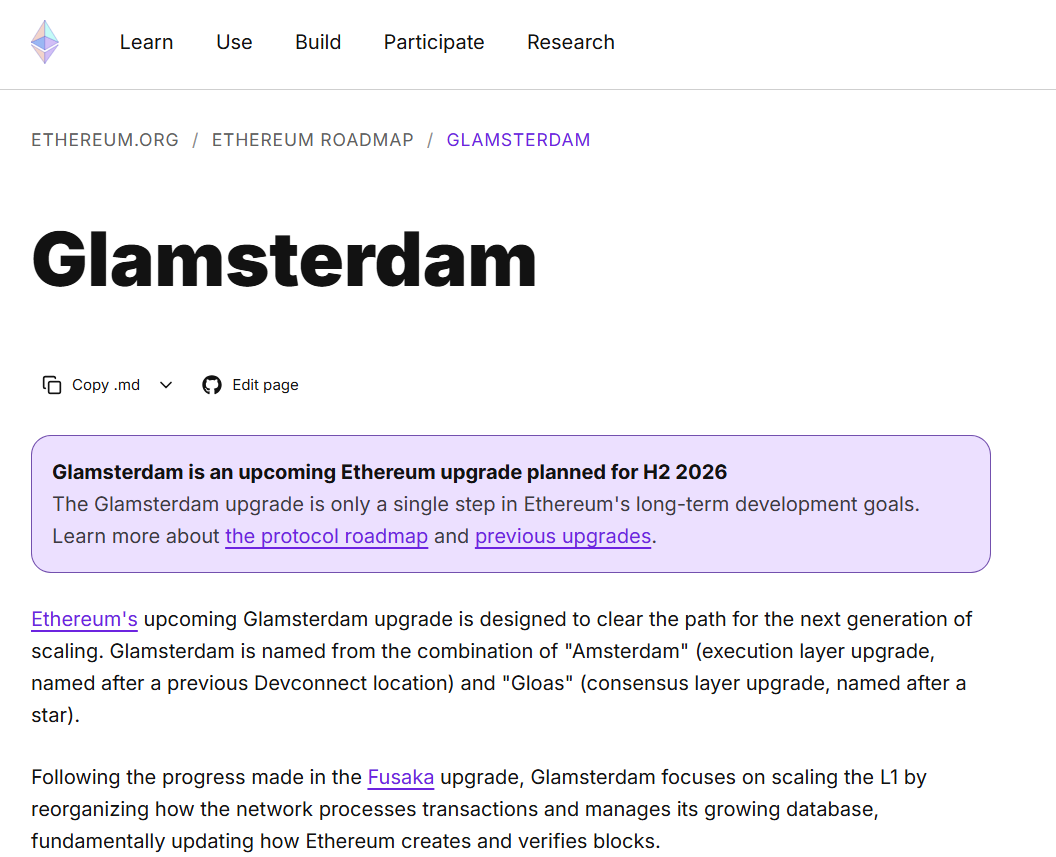
Glamsterdam. Source: Ethereum.org
She said enshrined proposer-builder separation (ePBS) is a key change because most validators still depend on a small set of specialized builders and relays, which concentrates control over transaction ordering.
That setup amplifies maximal extractable value (MEV), censorship and centralization risks, she said. ePBS is designed to pull block building and proposing back into the protocol and make the process more transparent and accountable.
Pavan Kaur is a Solana Foundation judge and founder of RuleSpark, a compliance engine for digital asset marketing. She told Cointelegraph that ePBS is better understood as one step in Ethereum’s broader roadmap and does not eliminate MEV or fully solve builder centralization. “Practices like sandwich attacks may therefore migrate rather than disappear,” she said.
Solana: Alpenglow
Solana’s biggest change this year is Alpenglow, a consensus upgrade that reworks the network’s core protocol. Alpenglow has been billed by many, including Solana ecosystem lead David Liang, as the chain’s “most significant consensus upgrade yet.”
After being overwhelmingly approved through a governance process in September 2025, Alpenglow remains under development but is expected to ship alongside the Agave 4.1 validator client release later in 2026.
Arun Krishnakumar, vice president of institutional capital at R3 enterprise software firm, told Cointelegraph that Alpenglow will be a major tailwind that will reinforce the ‘internet capital markets’ thesis even more strongly.
Solana Network Updrades. Source: Solana
At its core, Alpenglow is designed to dramatically speed up how quickly the network reaches finality. Instead of relying on Solana’s existing TowerBFT-based consensus mechanism, it introduces a redesigned system built around a new voting component called Votor.
Related: Solana treasury firms resist Forward Industries’ consolidation push
The practical impact is a major reduction in confirmation times, with finality targeted at roughly 100-150 milliseconds in optimal conditions, compared to around 12.8 seconds today.
Beyond speed, the upgrade also removes onchain vote transactions, which currently account for a significant portion of network activity. By streamlining how validators communicate and agree on the state of the chain, Alpenglow is intended to make Solana both lighter and more efficient under load.
Hadley Stern, board director, DeFi Development Corp, told Cointelegraph that removing onchain vote transactions is the “real story” for institutional allocators because it “cleans up validator economics and gives you honest telemetry, which matters when you’re underwriting SOL as a treasury asset.”
He said that a network that can migrate its consensus layer as cleanly as is planned, would show the kind of “governed adaptability legacy financial infrastructure can’t match.”
Base: Beryl
Base’s Beryl hard fork went live on Friday, following a short sequencer-related outage, when block production stalled for around two hours following an invalid block that triggered a temporary consensus failure.
Base co-founder Jesse Pollak said user funds were unaffected during the incident. While he stressed that “all funds are safe,” he added that “a halt is not okay” and said that lessons learned from the episode will be used to further strengthen Base as a platform for “global, 24/7 finance.”
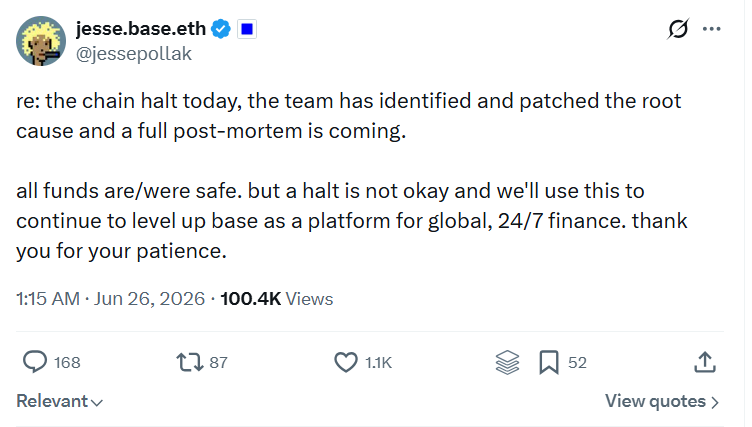
Jesse Pollak speaks about the chain halt. Source: Jesse Pollak
According to Base’s documentation, Beryl introduces a set of changes aimed at tightening the network’s performance and reducing friction at the edges. These include the B20 native token standard, a shortening of withdrawal finality from seven days to five, and integration with Reth V2, which is expected to reduce node storage requirements while improving execution efficiency.
Related: Coinbase’s Base resumes block production after 2-hour outage
Sun said Base has been moving toward a more unified “stack” approach, giving it greater control over how the network is built and upgraded, and allowing changes to ship more quickly than under the earlier Optimism Superchain model.
The trade-off, he said, is that liquidity, which once moved more freely across the broader Superchain ecosystem, may become more fragmented, even as Base deepens its integration with Coinbase’s wider user base.
Avalanche: Octane
Avalanche’s next chapter is less about a single branded hard fork than a broader push to improve performance while courting institutions and tokenized asset issuers.
Sun told Cointelegraph that Avalanche’s recent Etna hard fork replaced the old subnet model with sovereign Avalanche L1s, cutting the cost of launching a dedicated blockchain by more than 99% and making the network more attractive to institutional players.
It’s already seen success in this regard. Sun pointed to Progmat, which he said accounts for roughly 63% of Japan’s national security token market, which migrated more than $2 billion in tokenized assets to a dedicated Avalanche L1, as well as the Avalanche Payments Collective backed by firms including Franklin Templeton, VanEck and WisdomTree.
Progmat Migrates $2B+ of its Tokenized Securities to Avalanche. Source: Avalanche
Atkinson said Avalanche is also pushing two upgrades aimed at making its C-Chain one of the fastest Ethereum Virtual Machine (EVM) environments.
Related: Avalanche Treasury falls 16% as it debuts on Nasdaq
She described Streaming Asynchronous Execution as a way to separate transaction execution from consensus so the chain can run more continuously and size capacity closer to normal demand. For users, she said, the practical effect should be higher throughput and lower, steadier fees during periods of heavy activity.
Bitcoin: OP_CAT
Bitcoin is the outlier here because its biggest developments in 2026 are not scheduled upgrades but a continuation of passionate debates over whether the protocol should become more programmable and how urgently it should be hardened against quantum threats.
Bitcoin has not activated a major soft fork since Taproot in 2020, which upgraded Bitcoin’s scripting to make transactions more flexible and improve privacy.
Since then, discussion around covenant-related proposals such as OP_CAT, CheckTemplateVerify (CTV) and Lightning-focused ideas like LNHANCE has intensified. None of these changes has an agreed path to activation.
Researchers have also been debating BIP-360 and related proposals as ways to make it easier to migrate coins into quantum-resistant spending paths, if and when the quantum computing threat becomes real.
Atkinson described Bitcoin as the wildcard of the group. She said covenant proposals could unlock safer storage and richer scripting, but the subject remains divisive and subject to much debate.
Sun said those proposals could improve self-custody security, fee management and protocols such as Lightning and Ark, while giving institutions more programmable custody logic directly on the L1.
Bitcoin development is infamously slow, and any change to the protocol is pored over from every angle. There is general agreement that no covenant opcode is on track for activation this year, and reaching consensus on proposals like OP_CAT or CTV is still some distance away.
On the post-quantum side, BIP-360’s authors estimate that a full migration to quantum-resistant addresses and signatures would take years even under optimistic assumptions. It seems unlikely at this point that a quantum-resistance upgrade will be implemented before the end of 2026.
Magazine: How AI just dramatically sped up the quantum risk for Bitcoin