



TLDR
- A probability-weighted price target puts SOL at around $485 by 2031
- The base case forecast is $350–$500, assuming Solana holds its position as a top blockchain
- The bull case reaches $900–$1,200 if Solana wins big in payments, stablecoins, and ETF adoption
- The bear case sits at $70–$120 if competition from Ethereum and Layer 2s slows growth
- Key risks include regulation, competition, and the need to prove long-term value beyond meme coins
Solana started as a fast, cheap alternative to Ethereum. Today it has grown into one of the largest blockchain ecosystems in crypto, supporting decentralized exchanges, stablecoins, payments, and consumer apps.
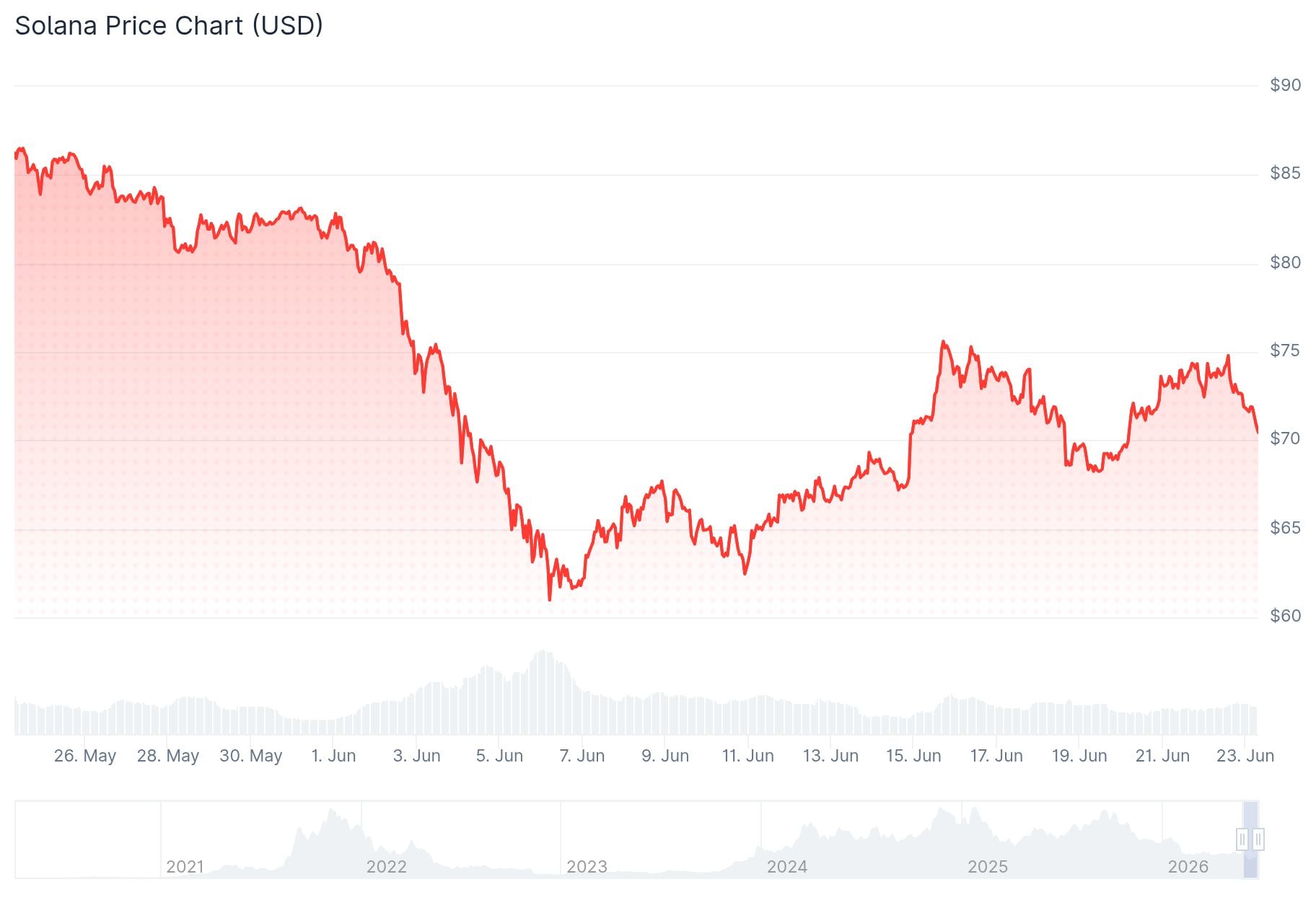
The big question now is: where does SOL go from here?
A five-year forecast lays out three scenarios — bear, base, and bull — with a probability-weighted target of around $485 by 2031.
The base case is assigned a 50% probability. In this scenario, the broader crypto market keeps growing, Bitcoin stays dominant, Ethereum holds its ground, and Solana locks in its role as the leading high-performance blockchain.
With a circulating supply estimated around 700 million SOL, a market cap in the $250–$350 billion range would put the price between $350 and $500.
This outcome does not require Solana to overtake Ethereum. It just requires steady growth in users, apps, and adoption.
The Bull Case
The bullish scenario gives a 25% probability and a target of $900–$1,200.

To hit that range, Solana would need to win across several fronts — consumer apps with millions of users, large-scale stablecoin activity, and meaningful tokenized asset volume.
A spot Solana ETF could also play a role. Institutional capital flowing in through an ETF would add buying pressure and help establish SOL alongside Bitcoin and Ethereum as a mainstream asset.
In that case, Solana’s market cap could reach $700–$850 billion, supporting prices at the top end of the forecast.
The Bear Case and Key Risks
The bear case also carries a 25% probability and puts SOL at $70–$120 by 2031.
This scenario assumes competition wins. Ethereum Layer 2 networks have been scaling fast, and new Layer 1 projects keep entering the market.
Regulation is another factor. Changes in crypto policy could hit institutional demand and limit trading activity.
Solana also needs to show that its ecosystem can generate lasting value beyond speculative activity. Meme coin trading has been a big part of its recent volume — and that’s a fragile foundation.
Even in the bear case, Solana would likely remain one of the larger networks in the industry.
The probability-weighted price target across all three scenarios comes out to approximately $485 by 2031, based on a 50/25/25 split between base, bull, and bear cases.