


Bitcoin reclaimed $64,000 on June 12 and touched an intraday high of $64,301 in the same session that spot ETF flows finally flipped positive after four straight sessions of institutional selling, and oil prices fell as peace deal momentum built between Washington and Tehran.
On June 13, Bitcoin fights to stay close to the $64,000 level, with a setup that looks better than it did 24 hours ago, and every piece is fragile enough to unwind before Monday’s open.
The cushion above $64,000 is thin enough that a hold into Monday separates a genuine repair phase from a relief bounce that exhausts itself at resistance.
A rejection opens the question of whether the sub-$60,000 panic low from earlier in the week becomes the reference point again.
| BTC level | Meaning | What it signals into Monday |
|---|---|---|
| $65,500–$66,000 | Bounce confirmation zone | Bulls can argue the reclaim is becoming structural |
| $64,000–$64,300 | Immediate battleground | Reclaim is real, but still fragile |
| $63,000 | Short-term support | Losing it makes the $64K move look like a trap |
| $59,000–$60,000 | Panic-low zone | Retest would erase the weekend repair setup |
ETF outflows and macro conditions ease
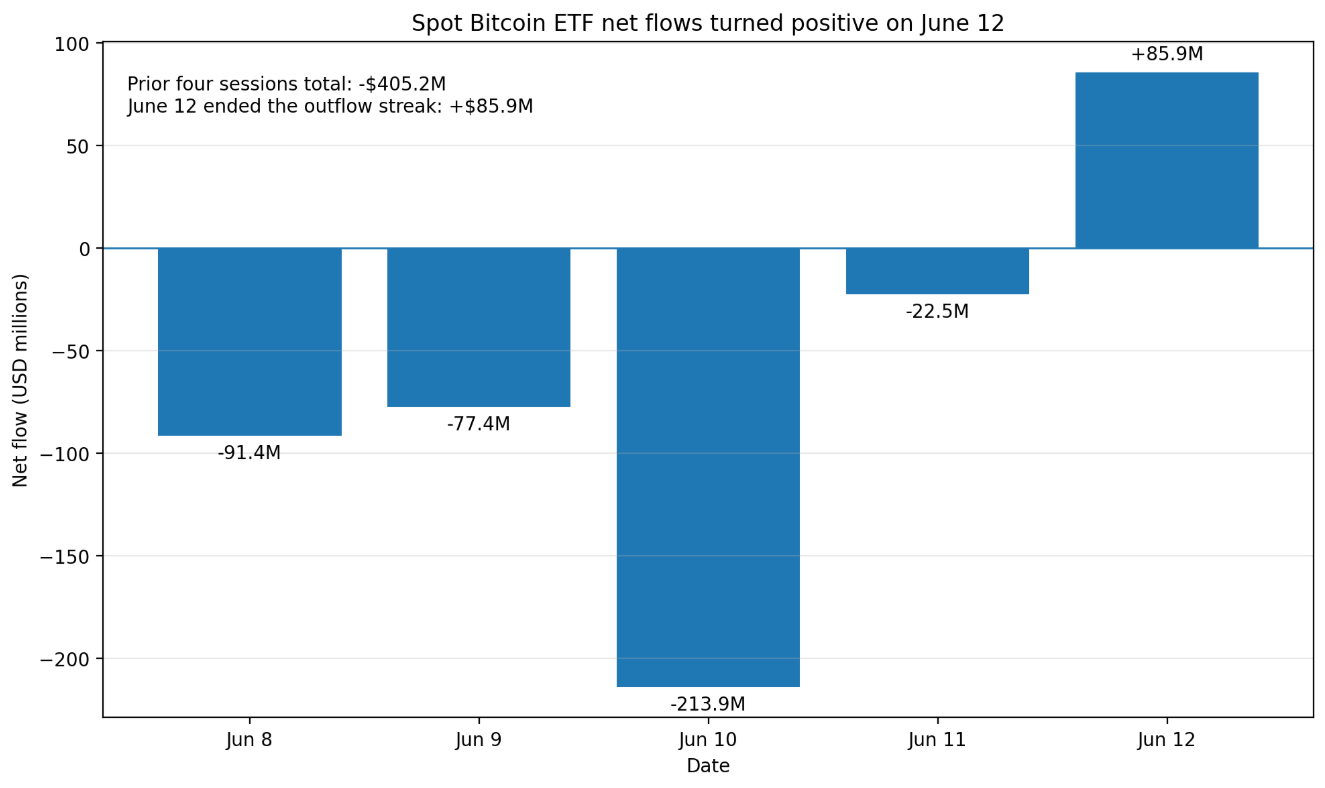
Farside Investors data shows spot Bitcoin ETFs recorded $85.9 million in net inflows on June 12, ending a streak of four consecutive negative sessions that resulted in over $405.2 million in net withdrawals.
The June 12 print is the last institutional flow signal before Monday, so whatever the macro weekend delivers, bulls will be absorbing it without a fresh demand signal from the ETF channel.
BTC’s move back to $64,000 coincided with falling oil prices and accumulating optimism around a US-Iran peace framework.
Brent dropped toward $88 per barrel on June 12, its lowest in nearly two months, as both Washington and Tehran described an agreement as close.
Pakistan’s prime minister said a signing was expected within 24 hours, and a Western source reported that Vice President JD Vance and Iran’s parliament speaker could sign an initial deal as early as June 14 in Geneva.
US forces shot down multiple Iranian one-way attack drones heading toward the Strait of Hormuz.
CENTCOM confirmed that all drones were intercepted and that commercial traffic through the strait continued to flow, though the episode put the peace trade’s durability on display: a deal that both sides describe as imminent can still produce military exchanges hours after optimism peaks.
A clean peace signing on June 14, with oil prices dropping further and risk sentiment improving, puts BTC in a position to test $65,500-$66,000 Monday morning, the zone where the bounce starts to look more structural.
A military flare-up, a breakdown in the deal text, or a statement by President Donald Trump walking back the timeline would reverse the oil trade and hit risk assets before ETFs open.
Brent’s open interest has fallen nearly 17% this year, according to LSEG data, as investors exit a market they now consider too volatile and unpredictable to hold.
Thin positioning means oil-driven macro moves arrive faster and with less cushion, and BTC, trading as a risk asset in this environment, absorbs those moves in real time on a 24/7 market while equities and commodity futures sit closed.
The Fed wall is waiting on Monday’s other side
The Fed has kept rates at 3.50%-3.75% since March and is widely expected to hold again at the June 16-17 meeting, where the real move is the expected removal of its easing bias, stressing that the next rate adjustment would be a cut.
Headline CPI came in at 4.2% year-over-year in May, with one-year inflation expectations sitting at 4.6%. Consumer sentiment improved in June as gasoline prices eased, but the inflation read keeps the Fed from softening its tone.
Bitcoin’s bounce from sub-$60,000 lows has been partly a risk-sentiment trade, the same macro relief that came from peace optimism and falling energy prices.
If the Fed meeting reinforces a higher-for-longer message and strips out the easing signal, BTC will need sustained ETF creations to hold $64,000 and clear the resistance zone above it.
Bull and bear cases going into Monday
If a US-Iran deal gets signed this weekend, oil falls further, risk appetite opens Monday morning on a genuine macro positive, and ETF desks that held back on June 12 put capital to work.
Bitcoin clears $65,500, and the ETF reversal starts to look like the opening of a sustained institutional re-entry. The $64,000 zone converts from contested resistance to established support.
| Scenario | Weekend trigger | BTC reaction zone | Monday implication |
|---|---|---|---|
| Bull case | US-Iran deal signed, oil falls, risk appetite improves | $65,500–$66,000 | ETF reversal starts to look like sustained re-entry |
| Base case | No major escalation, but no clean macro relief either | $63,000–$65,500 | $64K remains contested |
| Bear case | Deal breaks down, Hormuz flare-up, oil returns above $90 | ~$63,000 | Bulls must defend failed support |
| Stress case | Major geopolitical shock before markets reopen | $59,000–$60,000 | Panic-low zone becomes active again |
The bear case opens the moment a headline breaks the peace trade: a breakdown in deal talks, a fresh Hormuz exchange, or Trump walking back the signing timeline sends oil back above $90, compresses risk appetite, and returns BTC to the $63,000 area before Monday’s ETF session begins.
At $63,000, bulls are defending a level that already failed once this week. A daily close below it would make the $64,000 reclaim look like a liquidity trap, and the next reference point becomes $59,000-$60,000, where the panic low sits.
Holding $64,000 until Monday’s ETF market opens is the weekend’s only requirement, as ETF inflows on June 12 showed a blip in desks’ conviction.
Whether the macro backdrop gives them cover to sustain the Bitcoin price determines whether the bounce has a floor or just a ledge.