


CryptoQuant’s founder and CEO Ki Young Ju posted on social media platform X today, June 4, 2026, and stated that Bitcoin’s market structure looks markedly different from the previous cycles. There seems to be some sort of divergence because there has been massive institutional accumulation and ETF absorption that has removed more than a million Bitcoin from circulation since early 2023, yet prices have slid back toward levels seen in 2024. The unusual dynamic suggests a strong distribution phase and growing selling pressure even as long-term ownership increases.
Institutional Buyers and ETFs Gobbled up Supply
Data compiled from on-chain trackers show that MicroStrategy (MSTR) has been an aggressive buyer because since January 2023. The company acquired roughly 711,206 BTC and reportedly sold only 32 BTC, effectively taking about 711,174 BTC off the open market. Meanwhile, spot BTC ETFs and other large institutions absorbed roughly 509,102 BTC by March 2024, based on reported inflows.
When you combine these figures, the amount comes to about 1.24 million BTC, which are absorbed into long-term holders’ balance sheets, a volume larger than estimated Satoshi holdings and nearly half the amount currently sitting in exchange reserves.
Yet, despite that apparent reduction in available supply, BTC‘s price has retracted to levels seen earlier in the cycle.
Price Revisiting Realized-Price Territory
A metric here is that investors’ average cost basis, or realized price, sits around $53,000. Historically, bear markets tended to only end after price dipped below the realized price, triggering capitulation and redistribution of coins to long-term holders.
Given heavy institutional buying and minimal selling from major holders like MicroStrategy, many expected the realized-price level would be difficult for the market to revisit. The current price action challenges that assumption.
CryptoQuant Founder Flags Structural Change
Ki Young Ju, founder of on-chain analytics firm CryptoQuant, said that the current price resembles levels from two years ago, but the on-chain structure has “clearly changed.” The founder also highlighted that holders who bought during this cycle and have kept coins for six months to two years now represent about 53% of Bitcoin’s realized market cap, which is up roughly 15% two years ago.
Ju also told his followers that in the prior cycle the same ratio rising to about 68% coincided with the market bottom, implying that continued conversion of short-term holders into mid-term holders could be a sign of maturation even if prices remain depressed.
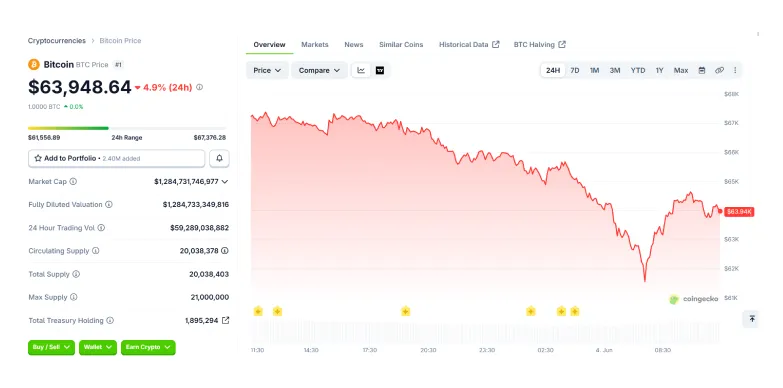
At press time, the price of the Bitcoin token stands at $63,948.64 with a drop of 4.9% in the last 24-hours as per CoinGecko.
Why Prices Fell Even Though There is Significant Accumulation?
The market for Bitcoin is not behaving the way it usually does right now. There are institutions that are buying more and more Bitcoin, however there is a lot of selling that is also taking place at the same time which is affecting the price of the token. When large investors move coins off exchanges, coins available on the exchanges decrease, which can support the prices. However, if a small number of holders control a large share of the supply, prices can become more volatile if they decide to sell during market rallies.
On top of that, some institutions and private investors might be selling to lock in profits or move funds around, while bigger corporations hold steady.
Adding to these issues, derivatives markets are making things worse. They create more pressure through stuff like futures liquidations, negative funding rates, and heavy leverage, which pushes prices down harder. Also, let’s not forget about broader economic stuff. Expectations of higher interest rates, a stronger dollar, and less appetite for risks globally continue to hit Bitcoin and other speculatory assets pretty hard.
Investors are closely monitoring exchange reserves, ETF flows, holder cohort data, and derivatives metrics for clues about the next market direction. Declining exchange balances would suggest continued accumulation, while sudden inflows could signal renewed selling.
CryptoQuant CEO Ki Young Ju believes the growing share of six-month-to-two-year holders reflects a structural market shift, but volatility may persist until exchange flow stabilizes and long-term holder dominance strengthens further.