


Blue‑chip DeFi doesn’t erase liquidation risk. On Aave, tight health‑factor buffers, correlated collateral, and cross‑chain plumbing still price a real risk premium into borrowing. This piece shows where that premium comes from and how to manage it.
Events in Q2 2026 clarified the picture: concentrated e‑mode leverage on liquid staking derivatives, governance reactions to an rsETH exploit, and fast‑filling stablecoin caps all strained collateral assumptions. We translate those signals into concrete steps borrowers and treasuries can use today.
This is a practical framework, not financial advice. Always test your own assumptions and size conservatively.
| Aspect | What to Know |
|---|---|
| Leverage density | As of May 2026, Aave V3 carried $10.7B in loans vs $17.37B collateral; e‑mode alone had $6.3B debt vs $7.05B collateral (~89.4% D/C), with a debt‑weighted health factor near 1.05 (Galaxy Research). |
| Collateral standards | After the April KelpDAO/LayerZero exploit that minted ~116,500 unbacked rsETH (~$293M), Aave moved to expand collateral/listing standards (CoinDesk). |
| Exploit recovery status | Attacker positions on Aave V3 (Ethereum Core and Arbitrum) were liquidated May 6; 106,993 rsETH was recovered in total across Aave and Compound out of ~112,103 rsETH unbacked on affected L2s (Aave Governance (LlamaRisk post)). |
| Stablecoin cap pressure | USDe on Aave V3 MegaETH hit 99.5% of its 400M supply cap; the Risk Steward process doubled the cap to $800M after reserves refilled within three days (Aave Governance / LlamaRisk). |
| Liquidation buffers | Thin buffers amplify slippage and oracle lag risks—especially in e‑mode loops where assets are tightly correlated and spreads can widen under stress. |
| Network differences | Risk varies by chain: liquidity depth, oracle coverage, bridges, and governance syncs can diverge between mainnet and L2s. |
| Takeaway | “Blue‑chip” status doesn’t eliminate collateral stress. Borrowers should price a risk premium, size smaller on newer assets, and keep measurable headroom. |
Core Concepts
Editor’s note: On my own positions, I added buffer and tested exits on the actual chains I use—bridges and DEX depth felt very different from models. The USDe cap episodes were a reminder that utilization and governance timing can change your carry overnight. Blue‑chip rails worked, but collateral felt more path‑dependent than many assumed. — Karim Daniels
Aave’s risk premium reflects the compensation lenders require—and the caution borrowers must keep—because liquidation engines rely on market liquidity, oracle accuracy, and counterparty incentives. When collateral and debt assets become highly correlated or liquidity thins, even robust protocols can experience sharp liquidation cascades.
Two design choices concentrate risk. First, e‑mode encourages looping among closely related assets (e.g., ETH, LSTs, LRTs) to unlock higher LTVs. Second, cross‑chain deployments fragment liquidity and add bridge/oracle dependencies. In quiet markets, both deliver efficiency; in stress, both translate into narrow health‑factor buffers.
Governance is a safety valve—listing standards, supply caps, and isolation modes can cordon contagion. But governance is reactive by design. The April rsETH incident and subsequent liquidations and recoveries illustrate how controls evolve after shocks, not before them.
Glossary
- Risk premium: Extra yield lenders demand—or caution borrowers price in—because liquidation, oracle, and liquidity risks are not zero.
- Health Factor (HF): Aave’s solvency metric; values closer to 1 increase liquidation risk. A higher HF buffer offers more room for adverse moves.
- Liquidation Threshold (LT): The collateralization level at which positions can be liquidated. Different assets and modes have different LTs.
- Efficiency Mode (e‑mode): A mode granting higher LTVs for tightly correlated assets, which can also amplify correlated liquidation risk.
- Isolation Mode: A setting that limits how a newly listed or riskier asset can be used as collateral to contain contagion.
- Supply Cap: A governance‑set ceiling on how much of a given asset can be supplied, used to control concentration and liquidity risk.
Step-by-Step Playbook
- Quantify your HF buffer. Model a 5–10% adverse price move or a modest stablecoin depeg and check the resulting HF. If a small move threatens liquidation, you’re under‑buffered.
- Audit on‑chain liquidity for both legs. Check DEX depth and CEX availability for your collateral and borrow asset on the specific chain you use. In stress, assume wider slippage and slower fills.
- Track governance and caps in real time. Subscribe to Aave forum/Risk Steward updates. Fast‑filling caps—like the USDe ceiling that was doubled after hitting 99.5%—can change utilization and rates quickly.
- Limit reflexive e‑mode loops. Loops magnify both yield and drawdowns. Keep loop counts conservative and use incremental adds, not all‑at‑once leverage.
- Prefer seasoned assets and venues for size. Deep‑liquidity collateral on mainnet generally liquidates cleaner than thinly traded L2 assets. Treat new listings and smaller L2 markets as size‑restricted.
- Automate alerts and map exits. Set HF and utilization alerts, pre‑fund gas, and plan multiple unwind paths (repay, swap, bridge). Practice with dry‑run simulations before size.
- Stress variable rates and fees. When utilization spikes, borrow APRs can jump and liquidations incur penalties. Make sure cash‑flow models cover worst‑case rate moves.
Why Blue‑Chip Protocols Still Carry Collateral Stress
Blue‑chip status reflects battle‑tested code and process maturity, not immunity from correlated selloffs. In Aave’s case, recent data shows leverage concentrated in tightly related assets: e‑mode debt carried a debt‑weighted LTV near 90% and a debt‑weighted HF around 1.05, leaving very slim cushions during volatility (Galaxy Research).
Composability cuts both ways. LSTs and LRTs improve capital efficiency but hard‑link repay capacity to staked ETH performance and secondary market liquidity. Oracle and bridge dependencies add more moving parts on L2s. When any one link weakens, the system prices a premium for liquidity—and borrowers feel it as higher carry costs and stricter headroom needs.
Governance can harden the surface after incidents. Following the KelpDAO/LayerZero exploit, Aave signalled tighter listing/collateral criteria (CoinDesk). Meanwhile, liquidations of attacker positions and partial rsETH recovery showed the protocol’s defenses working, but not without interim impairment risk (Aave Governance (LlamaRisk post)).

Collateral Choices on Aave V3: Trade-offs in Practice
Collateral quality is contextual: depth where you borrow, the borrow asset you choose, and the unwind routes you can realistically execute. Below is a qualitative comparison to frame decisions.
| Collateral Type | Typical Use | Key Risks | Liquidity Profile | Notes |
|---|---|---|---|---|
| ETH / WETH | Base collateral for broad borrowing | Market volatility; gas spikes during stress | Deep on mainnet; varies on L2s | Cleanest liquidations; still vulnerable to rapid drawdowns |
| LSTs (e.g., wstETH) | Yield‑bearing ETH exposure with e‑mode benefits | Depeg/discount vs ETH under stress; correlation with debt legs | Strong on mainnet; fragmented across L2s | Attractive carry; model discount risk in volatile windows |
| LRTs (e.g., rsETH, weETH) | Boosted yield strategies | Bridge/oracle/process risk; newer market structure | Thinner books; varies by network | Recent incidents prompted tighter collateral reviews |
| Stablecoins (e.g., USDC, DAI, USDe) | Stable collateral or borrow leg for basis trades | Peg risk; issuer/architecture risk; cap constraints | USDC/DAI deepest; emerging stables can face cap pressure | USDe saw rapid cap usage and subsequent cap raises on MegaETH via Risk Stewards |
| E‑mode loops (LST↔ETH) | Capital‑efficient leverage | Correlated liquidations; thin HF buffers | Depends on pair liquidity and oracle responsiveness | Use conservative loop counts and explicit HF targets |
Stress Scenarios to Model Before You Borrow
Scenario testing clarifies how much risk premium you’re implicitly paying. Focus on correlation, funding, and execution.
- Correlated drawdown: Model a simultaneous hit to collateral and a discount to any derivative (LST/LRT). Even a few percent gap can erase HF headroom quickly in e‑mode.
- Rate shock: If a popular cap fills and utilization spikes, variable APRs can jump. Check cash‑flow break‑evens and liquidation penalties.
- Oracle lag/volatility: Rapid moves can widen liquidation spreads. Assume worse fills than spot charts suggest.
- Network/bridge friction: If your unwind path needs a bridge, budget time and fees; in incidents, bridges can pause or congest.
- Liquidity migration: Incentives can pull depth between pools/chains. Re‑check depth before sizing or rolling positions.
Pro tip: Track debt‑weighted health factor across your book, not just position‑by‑position. One thinly buffered loop can dominate liquidation risk when spreads widen.
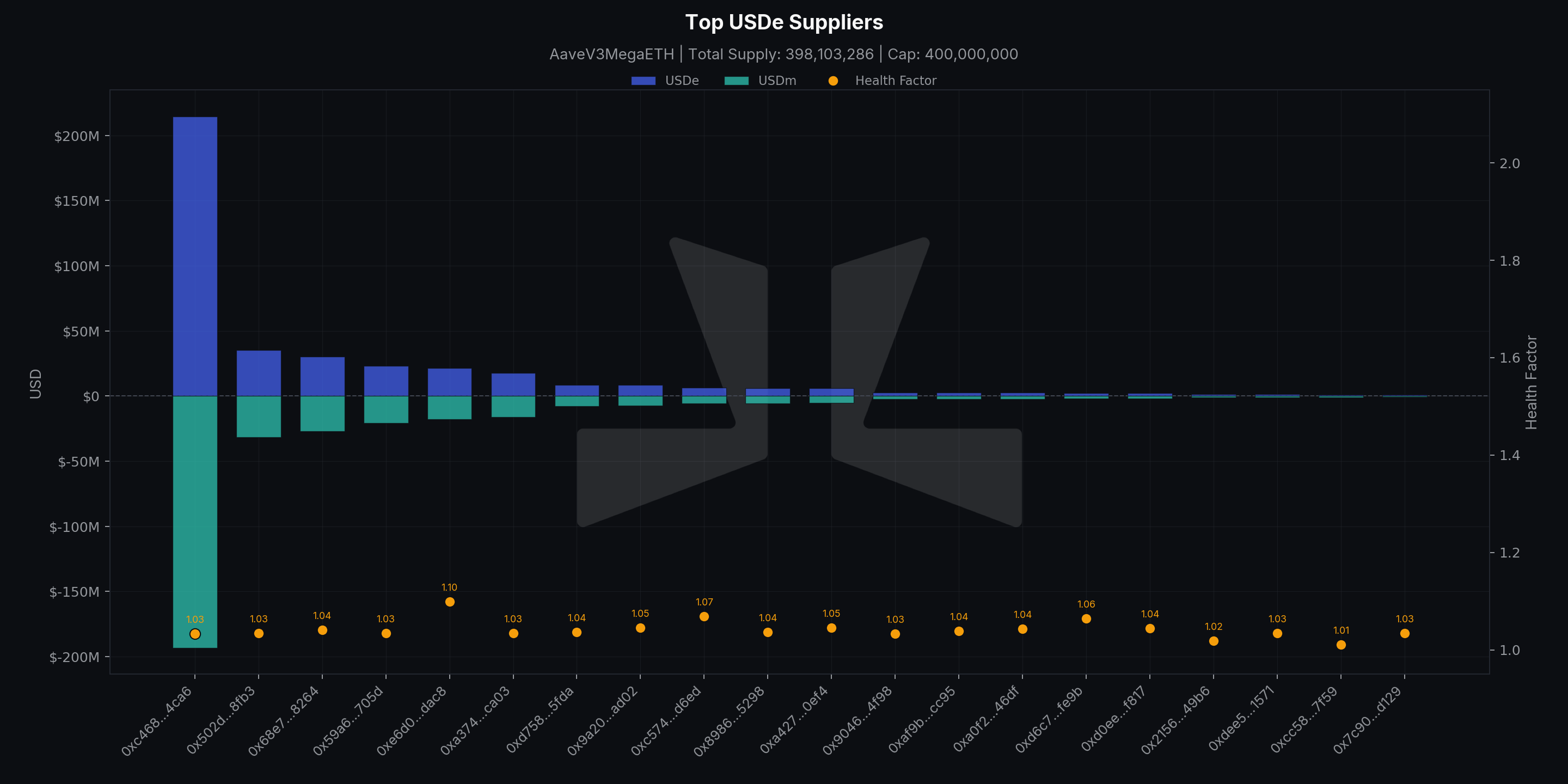
Bar chart of the top USDe suppliers on Aave V3 MegaETH showing one supplier providing >$200M (chart = Top USDe Suppliers); highlights extreme concentration and tight health factors that motivated the May 9–10 supply‑cap increase. — Source: Aave Governance (LlamaRisk)
Pitfalls & Red Flags
- HF drift toward 1.0: Small adverse moves or fee accruals can tip you into liquidation if you rely on thin buffers.
- Cap‑constrained markets: Near‑full supply caps can create rate spikes and scramble refinancing paths when ceilings are raised or reached.
- Phantom liquidity: Incentivized pools may look deep but shrink in stress; sanity‑check organic volume and historical depth.
- Newly listed or cross‑chain assets: Treat fresh listings and thinner L2 books as size‑limited until they prove resilience under volatility.
- Operational dependencies: If your unwind depends on a single bridge, oracle, or keeper, consider that a single point of failure.
- Reflexive loops: High e‑mode loop counts can magnify depegs and rate shocks; keep leverage simple and reversible.
If you want ongoing coverage of Aave governance changes, risk parameters, and cross‑chain market structure, follow analysis and briefings at Crypto Daily.
Frequently Asked Questions
Why does Aave carry a risk premium if it’s battle‑tested?
Protocol maturity helps, but liquidation is still a market process. When collateral and debt are tightly correlated, or liquidity thins on the chain you use, the odds of adverse liquidation outcomes rise. Lenders price that through yields; borrowers feel it as the need for more headroom and conservative sizing.
How safe is e‑mode for LST/LRT loops?
E‑mode increases capital efficiency by assuming correlation, but that also raises liquidation correlation. In May 2026, e‑mode debt showed debt‑weighted LTV near 90% and HF around 1.05—thin cushions that can vanish in volatility (Galaxy Research). Use conservative leverage and explicit HF targets.
What changed after the rsETH exploit?
Aave signalled tighter collateral and listing standards after an attacker minted ~116,500 unbacked rsETH, leaving impaired debt that governance had to address (CoinDesk). By May 6, attacker positions were liquidated and 106,993 rsETH was recovered across Aave and Compound on affected networks (Aave Governance (LlamaRisk post)).
Does USDe growth on Aave increase risk?
Growth itself isn’t inherently risky, but cap pressure can change dynamics. USDe on Aave V3 MegaETH reached 99.5% of its 400M cap before the Risk Steward doubled it to $800M after rapid reserve refill (Aave Governance / LlamaRisk). Monitor cap usage, utilization, and available liquidity for unwinds.
How big should my health‑factor buffer be?
There’s no universal number. Many teams model several adverse scenarios—price drawdowns, derivative discounts, rate shocks—and choose a buffer that keeps liquidation probability acceptably low for their mandate. The key is to quantify and revisit it as market structure changes.
Is borrowing on L2 safer or riskier than mainnet?
It depends on the asset and venue. L2s can offer lower fees and novel markets, but liquidity is more fragmented and unwind paths can depend on bridges and specific oracle feeds. Treat size and buffers accordingly, and test execution routes in advance.
What’s the single most actionable safeguard?
Instrument your positions: live HF alerts, cap‑usage monitoring, and a pre‑planned unwind path. The earlier you act, the cheaper your liquidation prevention becomes.
Disclaimer: This article is provided for informational purposes only. It is not offered or intended to be used as legal, tax, investment, financial, or other advice.