


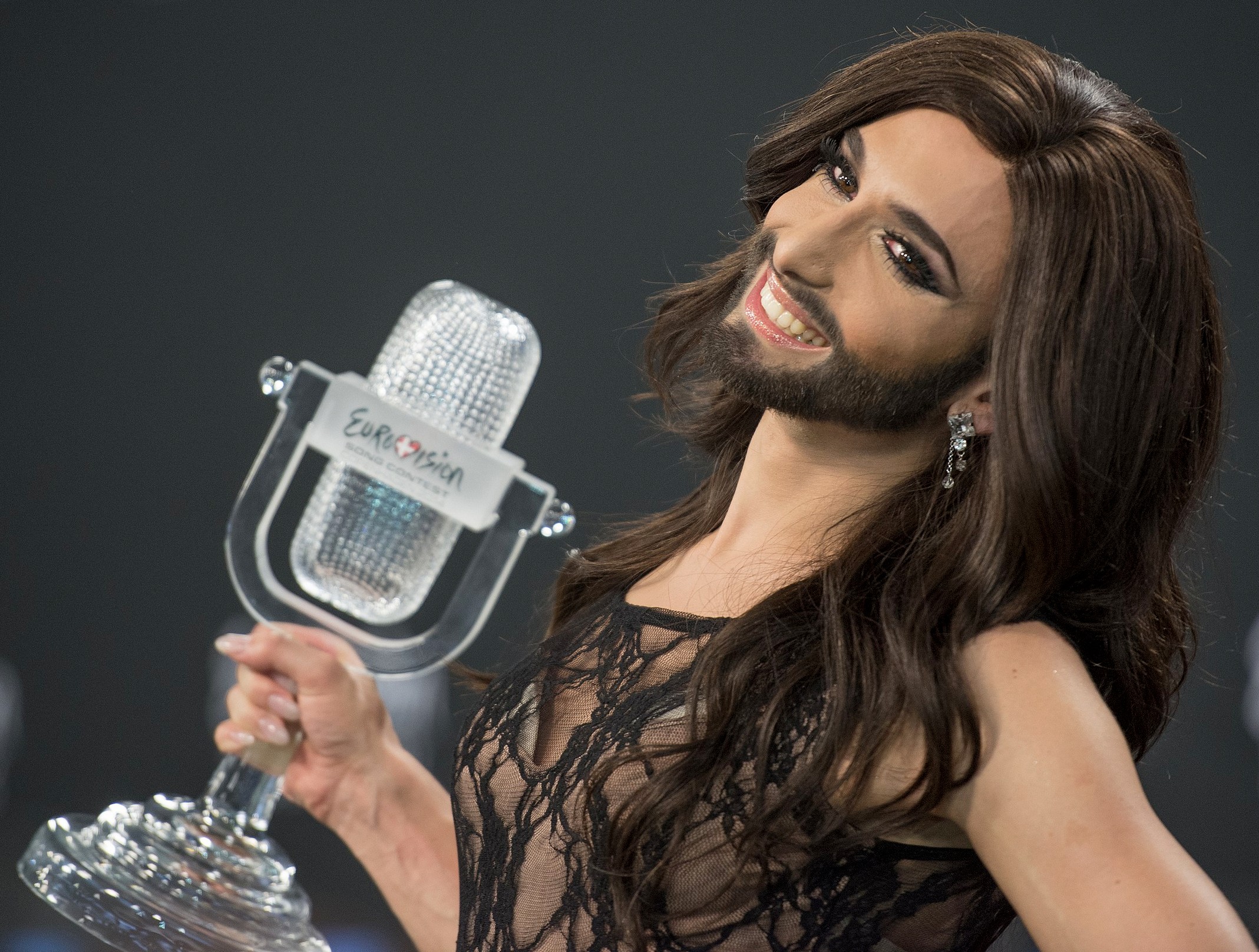
 Critics of the three-step process laid out in RA24 argue that the proportionality test needs to inform each step and not just the final one. Such critics include Wonkhe, Professor Naomi-Waltham Smith of Oxford University and James Murray, legal director at Doyle Clayton solicitors. In order to illustrate why this is necessary in order to comply fully with the HRA they draw on a recent case occasioned by the Austrian drag artist Conchita Wurst winning the 2014 Eurovision Song Contest.
Enter the “International Homosexual Lobby”
As the European Human Rights Advocacy Centre has recounted, a few days after the contest, two members of the Armenian jury gave a press conference in which they stated that they had given Conchita the fewest points because of their “internal revulsion” at her appearance. After a number of Armenian LGBTI and women’s rights activists, journalists and researchers publicly protested at these remarks, the Armenian newspaper Iravunk published an article by its editor-in-chief headed “They Serve the Interests of International Gay Lobby: the Black List of Enemies of the Nation and the State”. This described the protestors as members of an “International Homosexual Lobby” intent on reducing the birth rate, weakening the military and seeking to intimidate those who “oppose their efforts to make perversion the norm in Armenia”. The article provided links to the protestors’ Facebook profiles and called on the government, media companies and educators to deny them work, media coverage and “the opportunity to educate the younger generations”. The targets of the article asked the paper to retract it, but this resulted only in a further attack, and they thus launched civil proceedings against the paper and its editor. Meanwhile the attacks continued. The District Court found against the applicants’ on the grounds that while the article contained “an element of exaggeration and provocation”, the journalist was simply exercising their right to free speech. Over the next few months, Iravunk continued to target the applicants with further articles containing insults and false accusations. The following March, the Supreme Court rejected the applicants’ appeal.
They then took their case to the European Court of Human Rights (ECtHR) on the grounds that the articles amounted to harassment and hate speech and had interfered with their private life; they also claimed that the Armenian state had failed to provide protection against this, thus breaching Article 3 (prohibition of torture and ill-treatment) and Article 8 (the right to respect for private and family life) of the Convention. They also argued that the state had failed to acknowledge and provide protection from the discriminatory motives of the author, including the incitement to discrimination on the grounds of the applicants’ LGBTI-related activism and their perceived sexual orientation, in breach of Article 14 (prohibition of discrimination).
In January 2025, in Minasyan and Others v Armenia, the ECtHR found that the article had violated both Articles 8 and 14, in that the author had attacked the applicants because of their support for the LGBTI community and had expressly incited the public to discriminate against them. Furthermore the domestic courts had failed to protect the applicants from speech advocating intolerance and harmful acts.
Competing rights
The reason why this is so important for the Sussex case is that the ECtHR argued that when it comes to whether speech is “within the law”, this is not simply a matter of limiting the process to examining a domestic statute book’s explicit offences: what also has to be taken into account are the limits to freedom of expression listed in Article 10(2) – which, as already noted, allows “such formalities, conditions, restrictions or penalties as are prescribed by law and are necessary in a democratic society” in order to protect the rights and freedoms of others. Thus once it has been established that there is indeed an explicit law that restricts certain forms of speech, 10(2) then raises the issue of whether the speech in question infringes any other rights in the Convention – in this case privacy or dignity under Article 8 the right not to be discriminated against under Article 14. As Jim Dickinson points out: “Competing rights – in the Armenia case, of freedom of speech on the one hand, and privacy and equality on the other – have to be seen through the lens of necessity and proportionality, but it’s the two stage process taken together that sets out what is ‘within the law’”.
As we have seen, the OfS’s processes treat Article 10(2) considerations as a final backstop – something reached only after exhausting all practical options. But according to Strasbourg case law, and the Conchita Wurst case in particular, these considerations should infuse the entire analysis right from the start. It was the Armenian courts’ failure to balance competing rights which led to a breach of the Convention.
Thus, as things stand, as Murray and Waltham-Smith have argued, the three-step procedure laid down by the OfS Guidance arguably puts universities in a position in which “they will be obliged to take an analytical approach expressly struck down as not Convention compliant in Minasyan (and therefore unlawful under the HRA)”. This means that universities now face an impossible choice – follow the OfS Guidance and risk breaching the HRA, or properly apply Article 10 and risk regulatory action on the part of the OfS.
A further problem with the OfS Guidance is that universities trying to adhere to its terms may think that they’re obliged to host speakers who, while not technically breaking any actual laws, are using their platform to stir up discrimination of one kind or another. The three-step process could lead institutions to conclude that they must exhaust all “reasonably practicable steps” before even considering whether the speech itself has already lost its Article 10 protection under the terms of Article 10(2). As Jim Dickinson has warned, the real danger is posed by content that “specifically designed to stay just within legal boundaries while maximising harm – exactly the kind of speech that requires the full Article 10 balancing act from the start, not as an afterthought”.
Julian Petley is the Honorary and Emeritus Professor of Journalism, Brunel University London