
Home » News analysis »
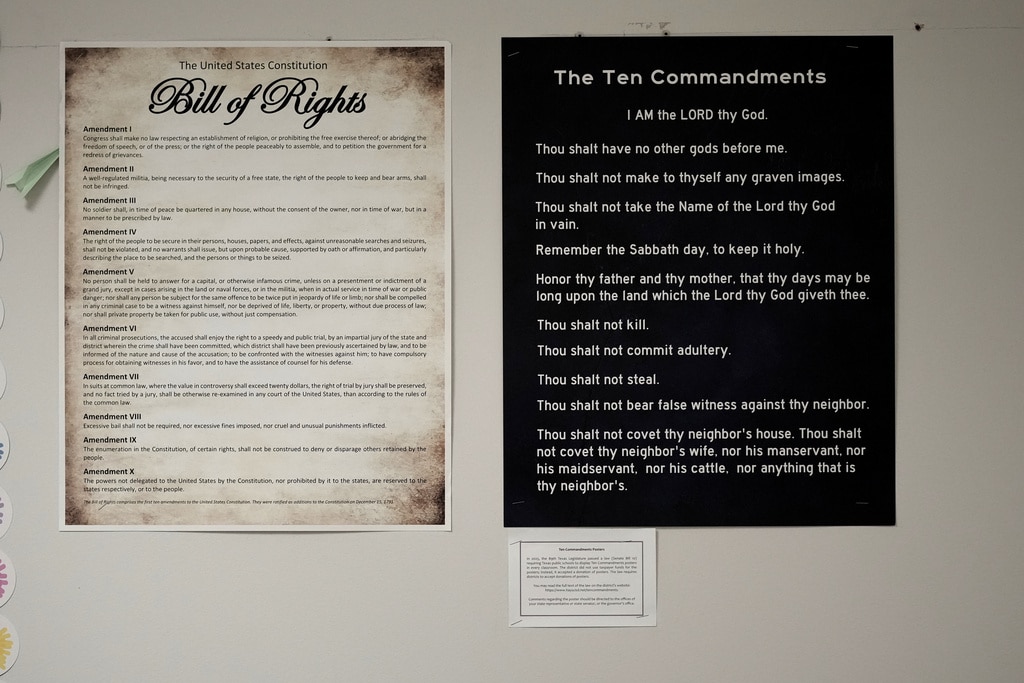
A federal appellate court in Texas recently upheld a state law requiring the posting of the Ten Commandments in public school classrooms. By a 9-8 vote, the 5th U.S. Circuit Court of Appeals concluded that the law did not violate the First Amendment.
Five questions about this decision:
1. Why is this appeals court decision important to those who don’t live in Texas?
The decision is at odds with other federal appellate court rulings and is inconsistent with Stone v. Graham, a 1980 Supreme Court decision that barred the Ten Commandments from classrooms. It will almost certainly be taken up by the U.S. Supreme Court, whose ruling could dramatically alter the presence of religious messaging in public schools all over the country.
2. What does the First Amendment say about government and religion?
The two religion clauses guarantee the free exercise of religion and also provide that the government may not engage in the “establishment” of religion, which essentially means promoting or favoring a particular faith.
3. How did the appellate court reach its conclusion?
The 5th Circuit based its decision in large part on a recent shift in the Supreme Court’s thinking.
The background: The 1980 Supreme Court decision finding the posting of the Ten commandments in public classrooms unconstitutional was based on a three-prong analysis from a 1971 ruling that came to be called “the Lemon test.” The test essentially said that a law would violate the First Amendment if it didn’t have a non-religious purpose, promoted or hampered religion, or entangled government in religion.
In 2022, however, the Supreme Court ruled in Kennedy v. Bremerton School District in favor of a football coach who wanted to pray on the school football field after games. In concluding that this was a personal act of faith that could not be limited by government, the Court also said the Lemon test had outlived its usefulness and that a different standard should be applied to religion-clause cases.
Instead of Lemon, the Court said, the test should be one of “history and tradition,” assessing whether the Founding Fathers would have seen the government action as a violation of the First Amendment.
It’s hard to know how this new test will be applied, but the 5th Circuit seized on it as a basis for permitting the posting of the Ten Commandments. The majority said having a poster on the wall was not coercive. “No child is made to recite the Commandments, believe them, or affirm their divine origin,” the appellate court said.
4. What did the dissent say?
The dissent pointed out that Stone v. Graham, in which the Supreme Court concluded the posting the Ten Commandments was a violation of the First Amendment, has never been overruled.
In his dissent, Judge Stephen A. Higginson argued that the mandatory posting of the Ten Commandments violates both the establishment and free-exercise clauses.
“The Framers intended disestablishment of religion, above all to prevent large religious sects from using political power to impose their religion on others. Yet Texas, like Louisiana, seeks to do just that, legislating that specific, politically chosen scripture be installed in every public-school classroom,” he argued. “The majority defies foundational First Amendment concepts, ignores the harms students will face, and usurps parents’ rights to determine the religious beliefs they wish to instill in their own children.”
Key to the dissenting arguments is that children are required to attend school. They can’t opt out or move to another classroom. The Texas law requires that the Ten Commandments be posted prominently where the document can be seen from every angle in the classroom. There is no escaping this government message.
5. What is the potential impact of a Supreme Court ruling on this case?
If the high court upholds the 5th Circuit decision, the impact will be dramatic. States with conservative legislatures are likely to make the Ten Commandments the norm in classrooms. If a document that begins with “You shall have no other gods before me” can be classified as non-religious and non-coercive for students in grades kindergarten through 12th grade, the floodgates will open for other government messaging.
See also: Video: Can the Ten Commandments be posted in public schools?
Ken Paulson is director of the Free Speech Center at Middle Tennessee State University.
The Free Speech Center newsletter offers a digest of First Amendment and news-media news every other week. Subscribe for free here: https://bit.ly/3kG9uiJ