

Exhaustion rather than recovery is a great way to characterize the current state of the cryptocurrency market. The back-and-forth that we are witnessing nowadays is draining liquidity, pushing retails away and making institutional investors choose more stable assets. Unfortunately, the market could not find a footing that would allow it to recover in a proper fashion.
Shiba Inu’s momentum cannot be maintained
With SHIB continuously failing to reach higher highs or maintain any significant bullish momentum, recent price action clearly demonstrates the continuation of the larger downtrend. In theory, it is hard to overlook the situation.
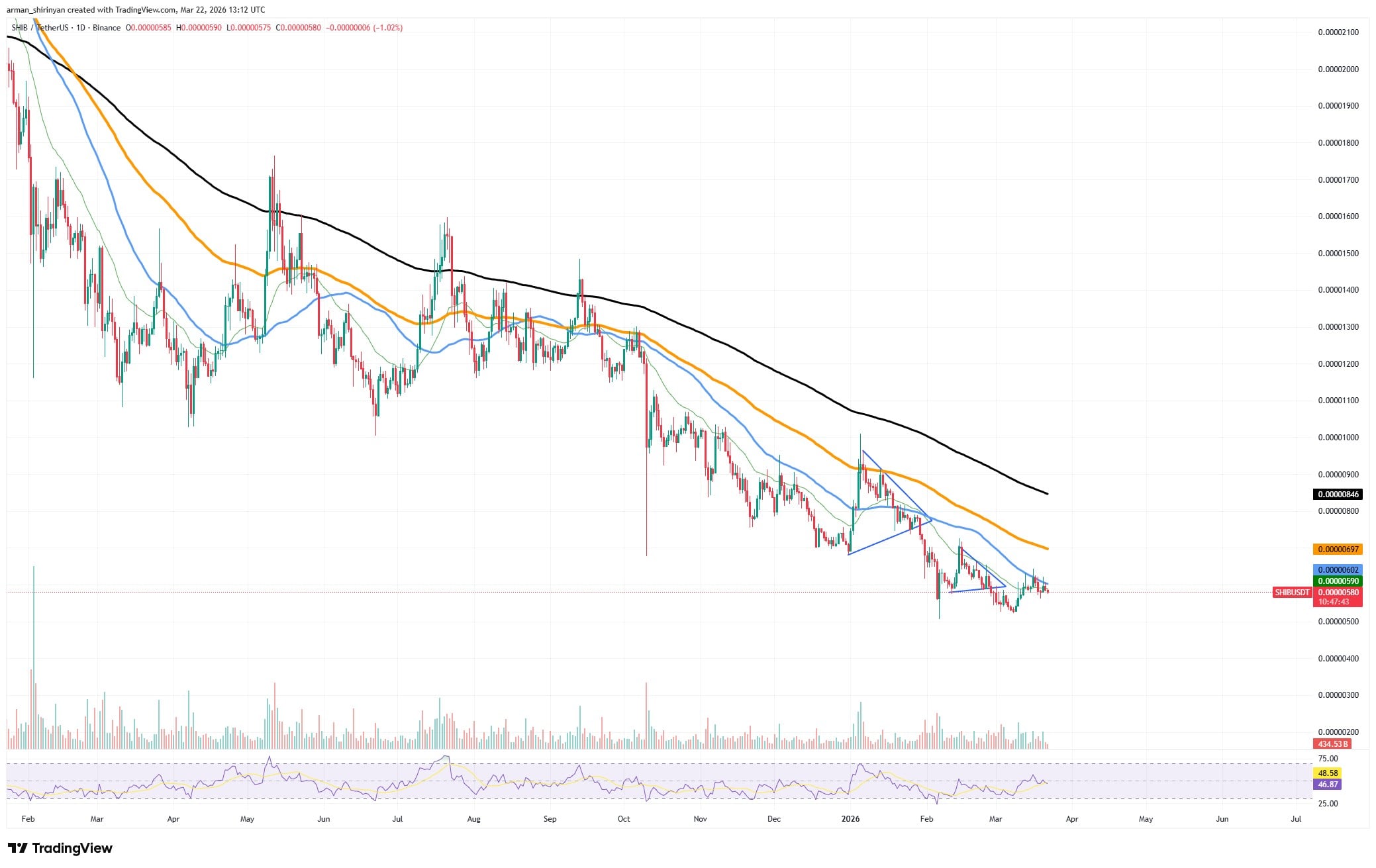
SHIB is still well below important moving averages, such as the 50 EMA, which is still serving as dynamic resistance. It is clear that sellers are still in charge, because every attempt to regain this level has been turned down. Descending triangles and weak consolidation phases, which usually resolve to the downside when they appear within a bearish trend, are what define the structure itself.
Crypto Market Review: Did Shiba Inu (SHIB) Finally Hit Price Top? Bitcoin’s Catastrophic Tumbling Might Not Be Over, Can XRP Realistically Lose $1?
SEC: Shiba Inu (SHIB) Not Security, Ripple’s Chris Larsen Injects 261 Million XRP Into $1 Billion Evernorth, BTC Price Reacts to Fed’s Decision — Top Weekly Crypto News
Volumes are unhealthy
Additionally unhelpful is volume behavior. Although there have been sporadic increases during brief recoveries, overall participation seems erratic and lacks the expansion usually necessary for a trend reversal. Rather than being true accumulation phases, rallies resemble relief bounces.
From a wider angle, the case for a fresh push higher is considerably undermined by SHIB’s incapacity to overcome even fundamental resistance levels. Short-term moving averages are typically swiftly recovered by assets that are still in a strong uptrend following corrections. Conversely, SHIB is spending long stretches of time below them, which is indicative of ongoing selling pressure and weak demand.
You Might Also Like

This makes it plausible that, at least for the current cycle, the price top has already been reached. It implies that, unless there is a significant change in market conditions or a spike in demand, upside potential may remain constrained, even though it does not necessarily imply a total collapse.
Investors ought to think about the bigger picture as well. Sentiment and liquidity cycles have a significant impact on meme assets like SHIB. The price usually follows when both start to decline. As of right now, neither participation metrics nor technical structure point to a significant reversal forming.
Will Bitcoin recover?
Concerns about Bitcoin’s current market structure persist as recent price movement indicates that the current downward trend may not be over.
The asset is still under constant selling pressure after losing important support levels and failing to sustain upward momentum. Technical indicators point to ongoing weakness rather than a confirmed recovery.
From a structural perspective, Bitcoin is steadily trading below significant moving averages, such as the 50 and 200-day levels, which are currently sloping lower. A strong bearish regime, in which rallies are sold into rather than prolonged, is usually reflected in this alignment. Short-lived attempts at recovery in recent times have created lower highs and strengthened the overall downward trend.
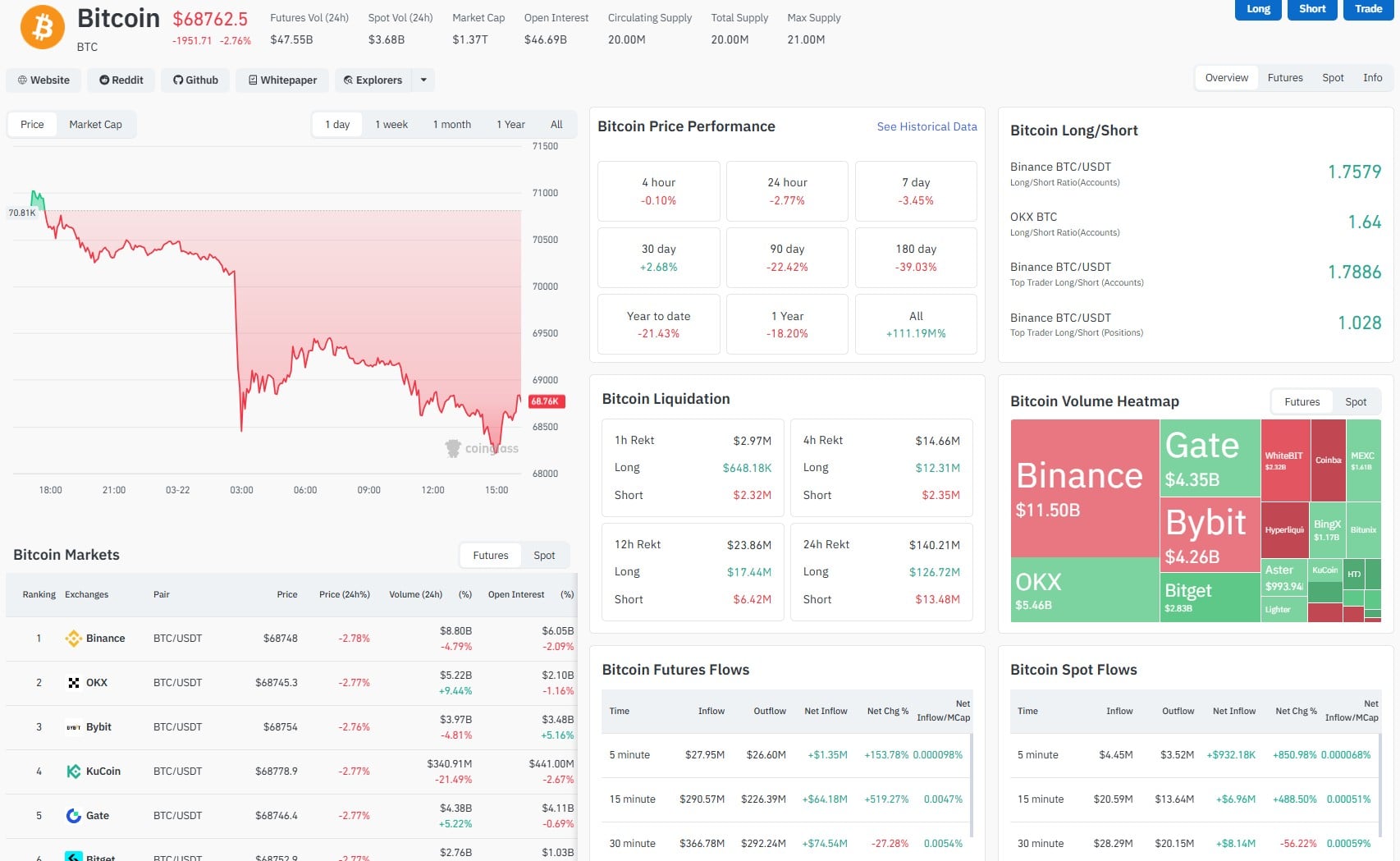
Persistent market pressure is also actively driving the asset down. Selling volume has accompanied every bounce, indicating that market players are taking advantage of strength to sell rather than build. This behavior is in line with distribution phases, in which the bid side’s liquidity progressively disappears.
This view is further supported by volume dynamics. Although there have been spikes during abrupt changes, overall participation does not demonstrate the kind of consistent inflows required to buck the trend. Rather than being driven by organic demand, the market seems reactive, driven more by short-term positioning and liquidations.
Nevertheless, there is some balance in the situation. Zones that previously served as support for Bitcoin are getting closer, which may draw opportunistic buyers hoping for a comeback. Furthermore, people’s mood is growing more cautious, which has historically led to short-term relief rallies.
Any possible recovery is still contingent, though. Bitcoin would need to recover important resistance levels and hold above them with significant volume confirmation in order for a significant reversal to occur. In the absence of that, the current structure favors prolonged consolidation, or at most, further declines.
XRP’s price drop is not simple
Although XRP’s current market structure allows for more declines, a more nuanced perspective is needed to determine whether it can actually fall below the $1 level.
You Might Also Like

Although a decline toward $1 is not yet the worst-case scenario, it is undoubtedly possible given the overall bearish trend. Technically speaking, XRP is still in a prolonged downward trend, with price action continuously forming lower highs and faltering below important moving averages. The 50 EMA still serves as dynamic resistance, thwarting attempts to move higher and bolstering bearish control.
More significantly, XRP has been using an upward trendline as short-term support. This stage is crucial. The structure changes from a weak consolidation to a continuation of the downtrend if that trendline breaks decisively. Lower support zones would be the next logical targets in that case, and psychologically significant levels like $1 begin to take center stage.
XRP might tumble even lower
Theoretically, there is a way for XRP to lose $1. Round numbers are not respected by markets as hard floors unless there is a high level of demand. XRP may test much lower levels if selling pressure continues, liquidity declines and overall market sentiment deteriorates. This is more likely if the market as a whole, and Bitcoin, continue to decline.
You Might Also Like

But context counts. Buyers are likely to intervene forcefully before the price reaches the $1 level, because it is not only psychologically significant but also historically significant for XRP. Furthermore, despite recent volatility, on-chain activity and network usage still offer a baseline level of demand that may mitigate or slow downward movements.
XRP is not currently in a free fall. It is in a delicate, strained structure that could collapse in either direction based on the state of the market as a whole. The likelihood of a move toward $1 would rise with a prolonged breakdown below current support levels, but this would probably require a combination of technical failure and external market weakness.
To put it briefly, losing $1 is not inevitable, but it is also not out of the question. The likelihood is largely dependent on XRP’s ability to maintain its current support structure.