

Choosing where to publish content has become more complex than creating the content itself. Hundreds of media outlets compete for attention across every niche. Some offer high traffic, others promise strong SEO value, while smaller publications claim niche influence. On the surface, all of them appear viable.
The difficulty lies in distinguishing which platform actually aligns with your goals. Most teams approach this decision with a mix of:
-
traffic estimates
-
domain authority
-
past experience
-
brand familiarity
These signals provide partial insight, but they rarely form a complete or consistent basis for selection. As a result, media choices are often driven by approximation rather than clear evaluation.
Start with the objective, not the outlet
The first step in selecting the right media platform is defining what the placement is expected to achieve.
Different outlets deliver different outcomes:
-
some maximize reach
-
others improve search visibility
-
others influence how narratives spread across the industry
Without a clear objective, it is impossible to understand whether a platform is suitable.
For example, a campaign focused on brand awareness will prioritize reach, while a campaign aimed at long-term discoverability will rely more on SEO and syndication effects. A project seeking industry credibility may benefit more from outlets that are frequently cited rather than widely read.
Look beyond traffic
Traffic is often treated as the primary selection metric. It is easy to understand and widely available. However, traffic alone does not reflect audience relevance or engagement quality. A high-traffic outlet may generate visibility without producing meaningful interaction or downstream impact. At the same time, smaller outlets can contribute disproportionately to narrative formation or search visibility.
Benchmarking platforms requires a broader view that includes how audiences interact with content and how that content circulates beyond the initial publication.
Consider how visibility actually works today
Media visibility is no longer limited to direct readership.
Content now spreads through multiple layers:
-
search engines
-
aggregators
-
syndication networks
-
AI-generated responses
This means that the value of a media placement depends not only on who reads it directly, but also on how it is redistributed and referenced.
Some outlets act as primary sources for wider information flows. Others remain isolated, regardless of their traffic.
Selecting the right platform requires understanding this distinction.
Outset Media Index introduces a structured approach to media selection
Outset Media Index (OMI) introduces a more systematic way to select media platforms.
Instead of reviewing outlets through separate tools, OMI provides a unified framework that analyzes media performance across more than 37 metrics. These include audience reach, engagement, editorial flexibility, syndication patterns, and LLM visibility.
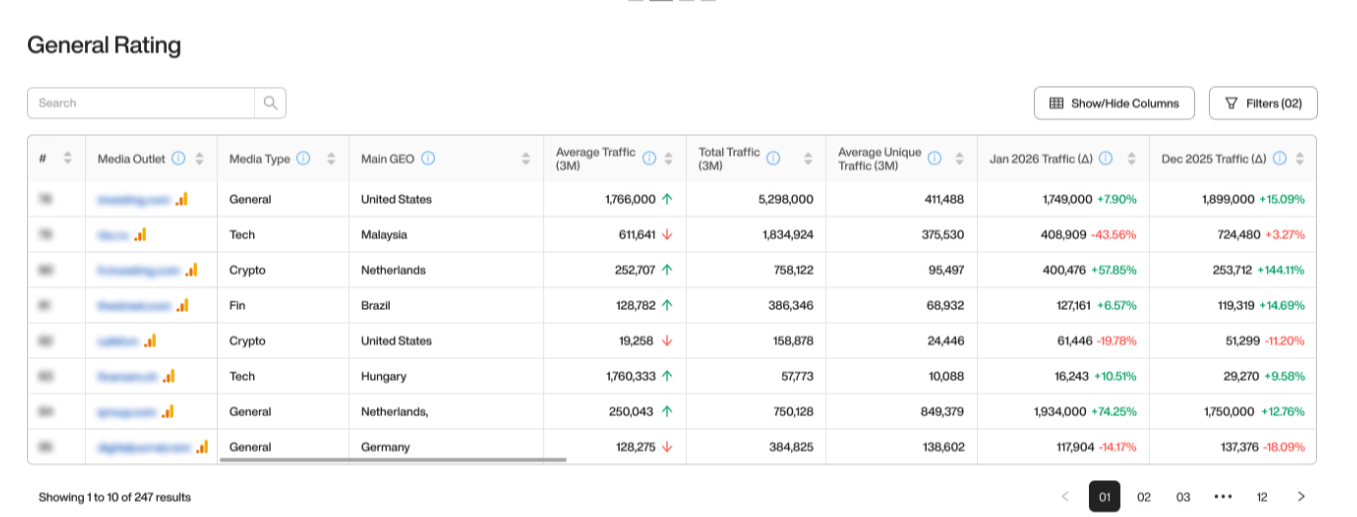
By combining these signals into a single system, OMI allows teams to compare media outlets on equal terms.
Rather than asking:
-
Which outlet has more traffic?
-
Which domain has higher authority?
Teams can ask:
-
Which outlet aligns with the goal of this campaign?
-
Which platform is likely to produce the desired outcome?
which would help them identify platforms that match specific objectives, distinguish between reach-driven and influence-driven outlets, and avoid over-reliance on brand recognition or outdated lists.
OMI also reduces the need to reconcile conflicting metrics manually. Data is normalized and presented within a consistent methodology, allowing for direct comparison between outlets.
Why this matters for budget and outcomes
Media selection directly affects how efficiently budgets are used.
Placing content in the wrong outlet can result in:
-
limited visibility
-
weak engagement
-
minimal long-term impact
Over time, these inefficiencies accumulate.
A structured approach helps allocate resources where they are most likely to generate results. It also makes decisions easier to justify, as they are based on comparable data rather than subjective judgment.
Conclusion
Choosing the right media platform requires more than checking traffic or domain metrics. It involves understanding how different outlets contribute to visibility, engagement, and influence.
As the media landscape becomes more complex, informal selection methods become less reliable.
Outset Media Index provides a structured alternative by standardizing how media performance is measured and compared. This allows teams to move from fragmented evaluation to a consistent selection process aligned with their objectives.
FAQ
How do I choose the right media platform for my project?
Start by defining your goal—reach, SEO, or influence—then analyze platforms based on how they perform across those dimensions. Avoid relying on a single metric such as traffic.
Is traffic the most important factor in media selection?
No. Traffic indicates potential reach but does not reflect engagement, audience quality, or influence. A balanced analysis requires multiple metrics.
What is Outset Media Index?
Outset Media Index (OMI) is a media intelligence platform that analyzes and ranks media outlets using a standardized framework based on 37+ performance metrics.
How does OMI help in choosing media platforms?
OMI allows teams to compare outlets side by side within a unified system. It shows how each platform performs across reach, engagement, SEO, and influence, making selection more objective.
Can OMI be used for crypto and Web3 projects?
Yes. OMI currently includes a large dataset of crypto and Web3 media outlets, making it particularly relevant for projects operating in these sectors.
Why is media selection important for PR campaigns?
Media selection determines how content is distributed and perceived. The same story can produce different outcomes depending on the platform, affecting visibility, engagement, and long-term impact.