


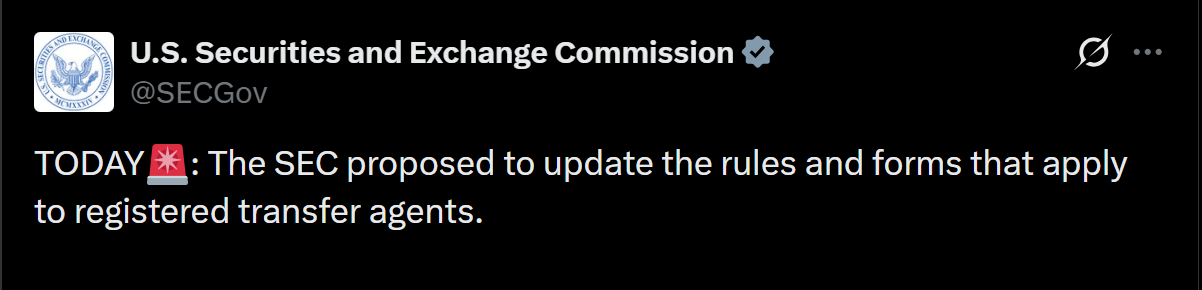
The Securities and Exchange Commission (SEC) has proposed a major overhaul of U.S. transfer agent regulations. This is an area that has experienced little regulatory change in nearly four decades.
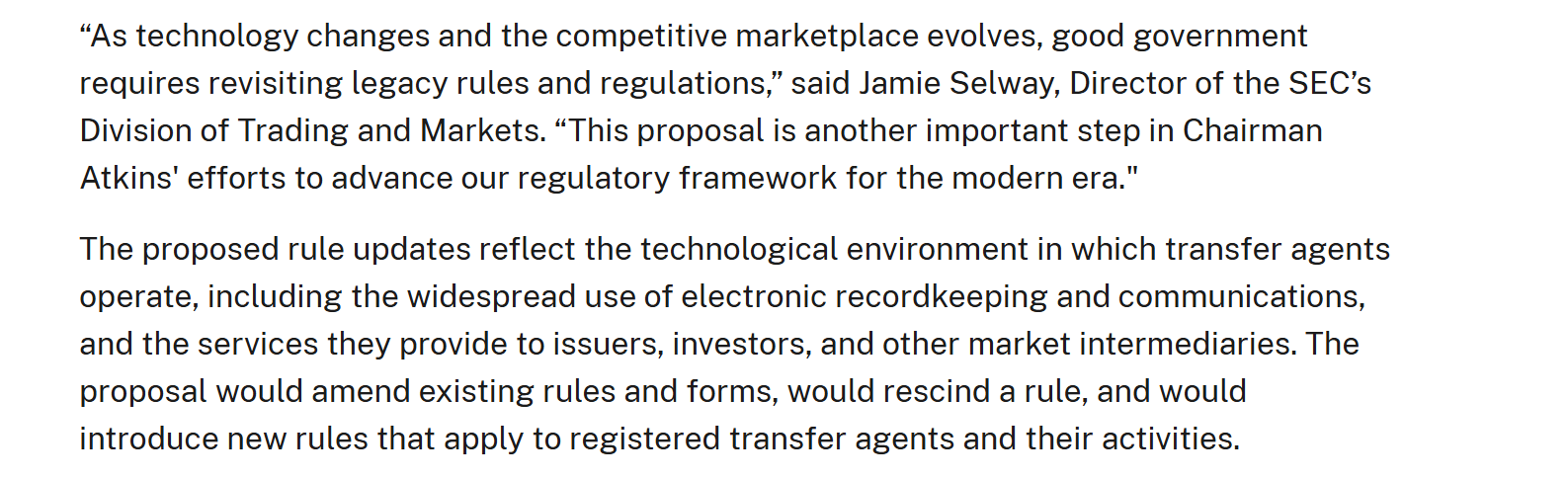
The proposal updates registration, reporting, recordkeeping, asset safeguarding, transfer processing, and restrictive-legend requirements across securities markets.
Importantly, this regulatory reform recognizes new technology such as electronic records and security tokens represented using blockchain.
As securities markets continue to evolve to accommodate faster transaction processing, including same-day settlement and potentially same-day or real-time transactions, this represents a significant change from the current regulatory structure.
Historically, all of the current regulatory requirements were based upon paper stock certificates and slower settlement processes.
Additionally, establishing common standards for processing related to T+1 settlement could also help prevent operational slowdowns and enhance investor protection.
Instead of reducing the level of regulation regarding transfer agents’ responsibilities, the SEC is seeking to modernize the way they operate.
Together, these changes could give transfer agents clearer operating standards while creating more defined infrastructure for tokenized securities.
Blockchain enters regulated securities infrastructure
More importantly, for tokenized security, the SEC outlines how blockchain can be applied in a practical way within the regulatory framework of the exchange.
Transfer agents could maintain ownership files and process transfers through distributed ledgers. This removes the need for blockchain to have its own distinct framework.
However, using new technology would not remove existing obligations around safeguarding, compliance, registration, or transaction processing.
As such, digital ownership records must also be replicable and must provide evidence of authorized modification. This requirement addresses one major concern associated with the concept of tokenization.
Specifically, it provides assurance that proof of ownership remains valid when moving a security through multiple layers of digital intermediaries.
By applying consistent standards across conventional and blockchain records, the SEC could reduce uncertainty around their operational use. That will provide a clear path for tokenized securities to enter into regulated markets.
SEC brings securities transfers into the T+1 era
Once digital records are accepted, the next challenge is ensuring securities move efficiently through that infrastructure. Today, transfer agents must complete 90% of routine items within three business days.
The proposal shifts attention toward execution, raising the expansion-limitation threshold from 75% to 95%.
This means that transfer agents will now have to develop written policies and procedures related to the timely registration and cancellation and processing of all transactions under all operating systems.
This matters because it is pointless to have rapid technology if there are still operational bottlenecks. In turn, it continues to slow down the time of changing ownership.
Therefore, blockchain-based transfers will be expected to perform at the same speed as traditional methods. Furthermore, they cannot be used as an excuse for less efficient execution.
The SEC is effectively pairing infrastructure flexibility with tougher accountability for how securities actually move.
Final Summary
- The SEC proposal gives blockchain-based securities clearer regulatory footing while preserving core transfer-agent safeguards.
- Modernized processing standards could bring tokenized securities deeper into regulated U.S. market infrastructure.