


Ethena Pay launched its beta on September 1 as a self-custodial payments and money app built exclusively on Avalanche, putting Ethena’s USDe stablecoin at the centre of a consumer spending product. The app pairs a dollar-denominated USDe balance with daily rewards and AVAX-denominated cashback, although the highest advertised benefits are limited by account tier and qualifying spending.
The rollout is an effort to give USDe a payments use case beyond holding or trading. Ethena Pay says the app supports transfers, bank withdrawals and virtual Visa card payments, while users retain custody of their assets.
USDe becomes the balance behind Ethena Pay’s Avalanche beta
USDe serves as Ethena Pay’s dollar balance, with the company saying in its FAQ that users can make transfers, withdraw funds to a bank and pay through a virtual Visa card while retaining custody of their assets.
The beta combines that balance with card payments and a rewards programme. According to Ethena Pay, it is self-custodial and built exclusively on Avalanche, so those payment and rewards functions initially run on one network rather than several. The company does not provide further technical detail on how bank withdrawals operate.
The 6% USDe reward is capped by account tier
Ethena Pay advertises total rewards of up to 6% annually, paid daily in USDe. The headline rate should be read alongside the balance limits attached to the programme: Standard accounts can qualify on up to $5,000, Pro accounts on up to $15,000 and VIP accounts on up to $50,000.
Although a VIP customer has a higher qualifying ceiling than a Standard customer, the caps still determine which portion of the balance can receive the advertised rewards; the material supplied by Ethena Pay does not indicate that balances above the relevant limit receive the same rate.
Those limits are central to the launch’s economics: the maximum annual figure is tied to the tier structure and qualifying balance thresholds published in the FAQ, rather than described as an uncapped return on every USDe balance held in the app.
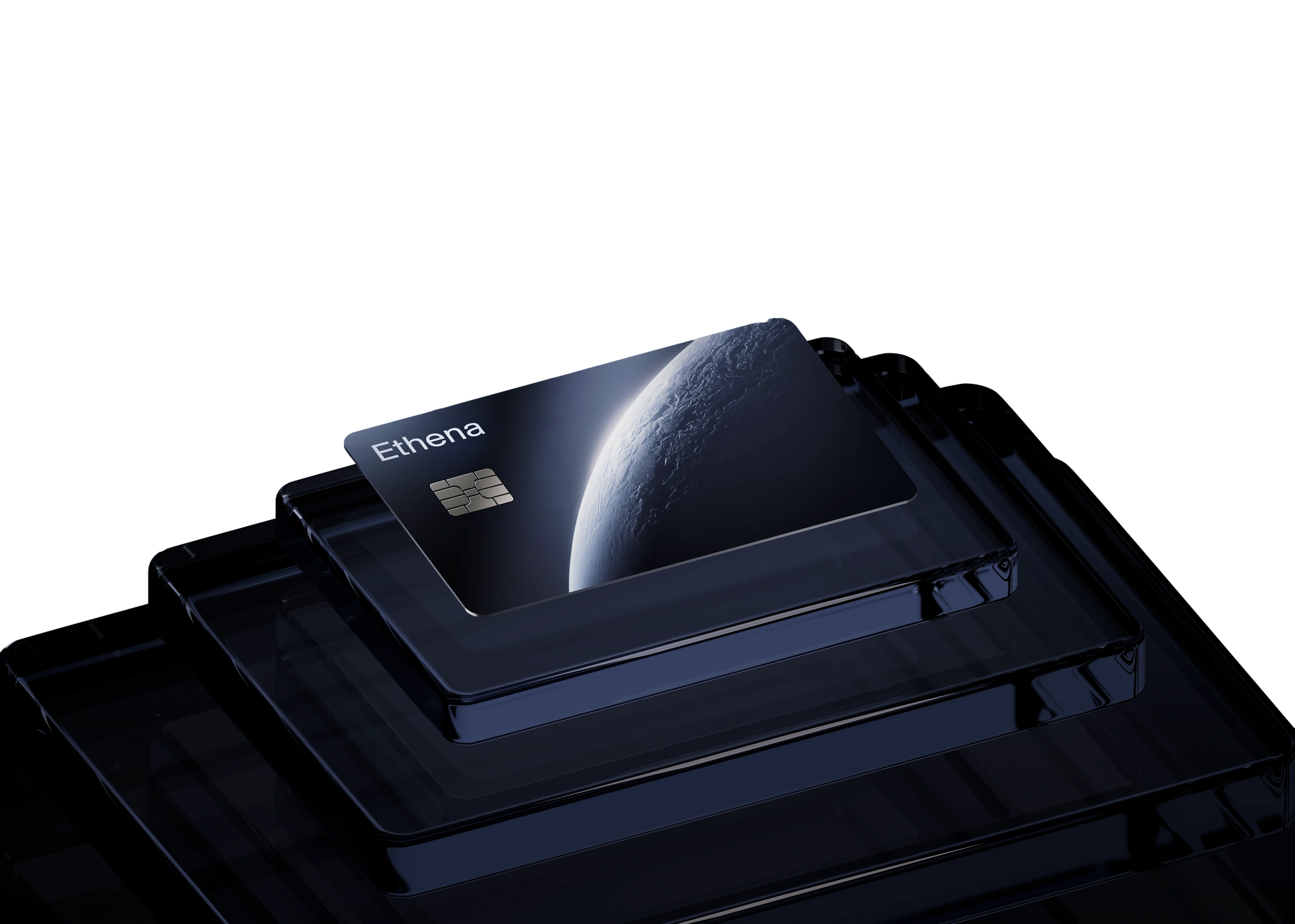
Official Ethena Pay card visual. — Source: Ethena Pay
AVAX cashback combines base tiers with merchant promotions
Card cashback is distinct from the USDe rewards. Ethena Pay says cashback on qualifying spending is paid in AVAX and ranges from 4% for Standard users to 5% for VIP users, with tiered monthly spending bands and exclusions listed in its FAQ.
That distinction matters because the 5% ceiling applies to the base card programme. The company’s terms identify qualifying expenditure and exclusions, so the stated percentages should not be treated as applying to every card transaction.
Separate reporting by The Block said VIP users could receive up to 10% cashback at selected brands. Those merchant-specific offers are higher than the standard VIP cashback rate, rather than a replacement for the 5% base cap across general qualifying spend.
The choice to pay card rewards in AVAX also gives the product a direct connection to the network on which it is exclusively built. By contrast, both the spending balance and the daily rewards are denominated in USDe.
A consumer-payments push as USDe circulation sits below its 2025 peak
The beta initially covered 48 countries, according to The Block, but excluded the United States and the European Union. That leaves Ethena Pay’s first market footprint broad in country count while omitting two major regions for consumer financial products.
For Ethena, the launch expands a consumer-payments strategy around USDe at a time when its reported circulation was about $4 billion. The Block reported that figure was down from an approximately $15 billion peak in September 2025.
The app therefore gives Ethena another channel through which USDe can be held and used: as the balance funding transfers, bank withdrawals and virtual card purchases. Its early proposition rests on combining that utility with tier-limited daily USDe rewards and AVAX cashback, while access remains restricted to the beta’s supported jurisdictions.
Disclaimer: This article is provided for informational purposes only. It is not offered or intended to be used as legal, tax, investment, financial, or other advice.