


An on-chain tracker flagged the movement of 30 million World Liberty Financial USD (USD1) from Fireblocks’ custody wallet to Binance in the last 15 hours, ending August 31. This continues the trend, which has already moved most Trump-related stablecoins to a single offshore exchange.
In the context of the global cryptocurrency market, which increasingly relies on stablecoins to settle trades, this concentration is a key point. It implies that a large portion of the money behind a leading dollar stablecoin is available on just one platform.
One wallet, one exchange, tens of millions at a time
The latest transfer was not an isolated move. The same custody address, 9Rycov…4xfCxk, sent 28 million USD1 to Binance across three transfers of 10 million, 15 million, and 3 million within 21 hours on August 25, according to Onchain Lens.
The next day, the tracker disclosed that there had been an extra 10 million USD1 in deposits and transfers over the week, making a total of 66 million USD1. All flows were directed to Binance, the leading crypto exchange in the world, which already had over 300 million total customers and achieved $7.1 trillion in spot trading volume in 2025, according to the exchange’s year-end report.
TRUMP-BACKED solana:USD1ttGY1N17NEEHLmELoaybftRBUSErhqYiQzvEmuB KEEPS FLOWING TO BINANCE
Fireblocks Custody sent another 30M solana:USD1ttGY1N17NEEHLmELoaybftRBUSErhqYiQzvEmuB to Binance over the past 15 hours.
Address: 9Rycov3U4efJf5HiqZYGjN7qJJHEtMsj4vbmkG4xfCxk pic.twitter.com/w5n2RzlKWE
— Onchain Lens (@OnchainLens) August 31, 2026
From all of the data put together, in recent events, the tracker reveals exactly $96 million being transferred from the Fireblocks custody wallet to Binance between the dates of August 20 and 31.
According to the update provided on August 26, the total amount of seven-day transfers reached $66 million, of which $28 million took place in the last 21 hours, and $10 million was the latest deposit. Therefore, the $28 million accounts for what happened in the earlier part of the rolling window. The further $30 million reported on August 31 brought the total minimum amount of these transactions to $96 million.
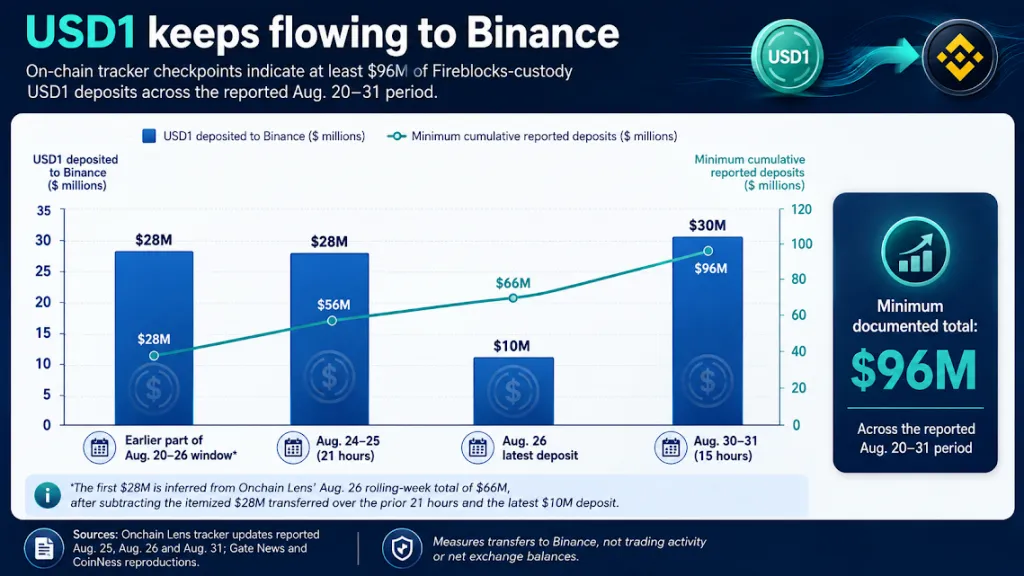
The graph indicates the gross transfers received by Binance without taking into account the net exchanges or ownership of the tokens, since the tracker does not indicate if the tokens have since left the exchange.
According to DefiLlama, USD1 is the fifth-largest stablecoin, boasting a market cap of $4.17 billion and a gain of 4.1% over the past week, trailing behind Tether, USD Coin, Sky Dollar, and Dai, but ahead of USDe by Ethena.
BitGo Bank & Trust, National Association, an OCC-licensed national trust bank, is responsible for issuing and redeeming the token, while the brand USD1 belongs to World Liberty Financial. The reserve report issued after an audit by KPMG revealed that as of July 31, there were 3,996,528,668 tokens in circulation backed by funds amounting to $4,000,867,230 in redemption assets.
Why should the market care about the concentration
Binance had been promoting USD1 well before its concentration became apparent. It waived fees on selected USD1 trading pairs in December 2025, then followed with a January campaign offering $40 million WLFI rewards to eligible users who held USD1 on the exchange.
By February 9, Binance held roughly 87% of USD1’s supply, or about $4.7 billion of the $5.4 billion then in circulation, according to a Forbes analysis of Arkham Intelligence data. Binance US held just $1,119, leaving nearly all of that exchange concentration offshore.
The rewards are ongoing. Binance’s fresh USD1 campaign that runs until September 4 allows eligible customers to get a portion of 170 million WLFI tokens for buying and trading USD1 as well as a variable boosted yield.
That is why the continuing inflows matter beyond USD1 itself. Bank for International Settlements (BIS) research shows stablecoin flows can spill into traditional currency markets. A March BIS working paper estimated that a 1% rise in net stablecoin inflows widens the gap between buying dollars through stablecoins and through spot foreign exchange by about 40 basis points while putting depreciation pressure on local currencies.
When one stablecoin’s liquidity is heavily concentrated on one exchange, disruption at that venue can travel through the market more quickly.
The political thread that flows can’t be shaken
USD1’s political ties remain impossible to separate from its market story. World Liberty Financial lists President Donald Trump as a co-founder alongside Donald Trump Jr., Eric Trump and Barron Trump, while an affiliated LLC owns about 38% of the company. Trump reported $57.4 million in income from the venture in a financial disclosure.
The token drew scrutiny in May 2025 after co-founder Zach Witkoff said at a Dubai conference that USD1 had been “selected as the official stablecoin to close” Abu Dhabi firm MGX’s $2 billion investment in Binance.
Lawmakers, including Senator Elizabeth Warren, have raised conflict-of-interest concerns because Trump benefits from the business while also overseeing US crypto policy. Binance remains barred from its main US platform, while founder Changpeng Zhao, pardoned by Trump last year, retains majority ownership.
The latest deposits therefore do more than deepen USD1’s liquidity on Binance. They keep a politically sensitive stablecoin concentrated on the exchange already at the center of the controversy.
Don’t just read crypto news. Understand it. Subscribe to our newsletter. It’s free.