


While the crypto industry is flooding regulators with applications for new funds, BlackRock is keeping its distance. Other major players are already actively dividing up the spot XRP ETF market, but the financial giant remains firmly committed to Bitcoin and Ethereum.
Nate Geraci, president of the consulting firm The ETF Store, called this position “highly risky.” In his latest outlook, a firm managing nearly 500 traditional funds is effectively making an unambiguous market prediction with its behavior — “that no other crypto assets have enough value.”
You Might Also Like

Bitcoin Lightning Users Face Urgent Warning Over Core Flaw
Hyperliquid (HYPE), Ethereum (ETH), Chainlink (LINK) and Stellar (XLM): Next Steps of Bullish Market
Behind this apparent passivity lies a cold calculation supported by fresh on-chain data. While experts debate the prospects of altcoins, BlackRock is buying BTC and ETH on an industrial scale. In the past day alone, wallets linked to the company withdrew $312 million from Coinbase Prime.
Of that amount, $282 million went to wallets associated with its flagship Bitcoin fund IBIT, while the remaining $30.6 million was distributed between the ETHA and ETHB funds.
For the giant, these two assets remain a clear, highly liquid, and predictable business that generates enormous revenue here and now. Nevertheless, Geraci stands by his original scenario: “They capitulate at some point & launch addn’l spot crypto ETFs.”
Two reasons why BlackRock does not need altcoins like XRP right now
While competitors are reaping the first rewards from XRP ETFs and major banks such as Goldman Sachs are beginning to cautiously buy stakes in such funds, BlackRock has not even filed an application with the SEC.
The first reason comes down to simple scale. The XRP ETF market is still too small for BlackRock. The total net assets of U.S. XRP funds currently stand at just $1.40 billion. By comparison, Bitcoin ETFs now manage $98.63 billion, while Ethereum ETFs have accumulated $15.13 billion.
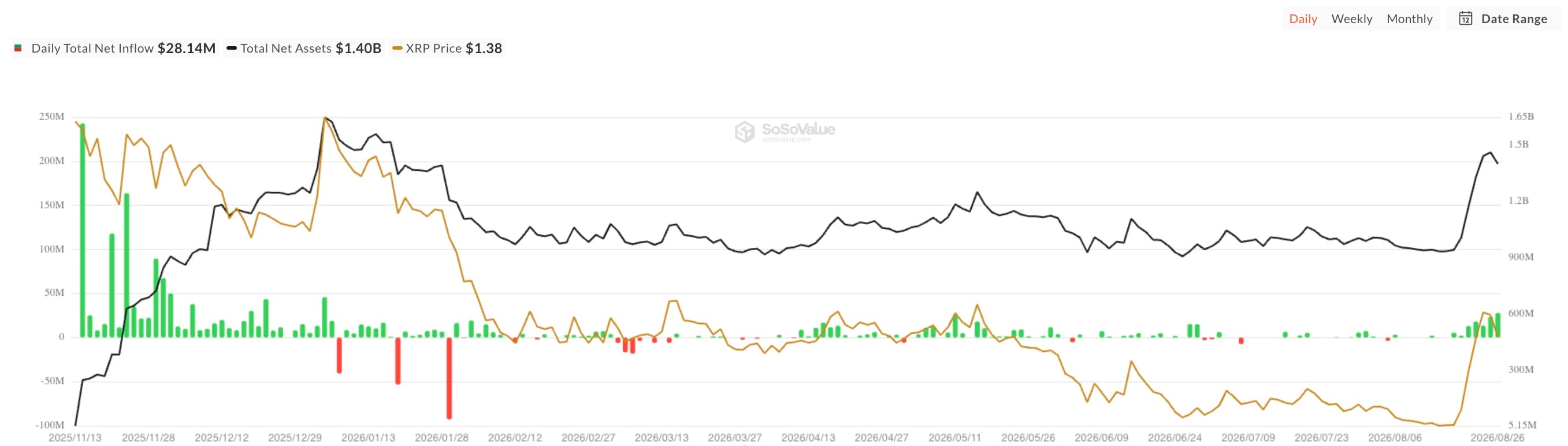
Canary Capital CEO Steven McClurg notes that the giant is unlikely to pay attention to the asset until the net assets of existing funds launched by competitors reach a stable $3 billion. Only that figure would prove that there is systemic demand from major institutional investors.
You Might Also Like

The second reason is a strategy of going deeper rather than broader. The rest of the altcoin sector remains niche: Solana funds hold $1.26 billion in net assets, multi-asset HYPE ETFs hold $419.48 million, and DOGE ETFs hold a modest $12.37 million.
BlackRock’s digital asset executives have repeatedly stated that their goal is not to accumulate hundreds of altcoins, but to help conservative investors gain exposure to Bitcoin and Ethereum. Most of its traditional clients have not even started buying crypto, and diluting their attention with new products would be economically counterproductive at this stage.
BlackRock is behaving like a classic heavyweight — allowing competitors to test demand, absorb the initial regulatory risks, and make the first mistakes.
If the XRP ETF market proves its financial maturity and liquidity, BlackRock can enter it at any time — and use its name to take the lead within weeks. Until then, the company prefers to move hundreds of millions of dollars into the more familiar BTC and ETH.