


On-chain lending and yield strategies, commonly known as vaults, could be the next crypto innovation ripe for massive public adoption. According to Grayscale’s Head of Research Zach Pandl, the products could follow the steps of stablecoins, tokenized assets, and perpetual futures. These were niche crypto experiments, but are being embraced by traditional finance (tradFi) firms right now.
Vaults, a structure for onchain asset management, may be the next crypto innovation to break through to the mainstream.
He compared the on-chain vault market to collateralized loan obligations (CLOs). For the unfamiliar, CLOs track a pool of individual corporate loans handled by asset managers and allow investors to share the interest earned.
Instead of asset managers and custodians, these third parties are replaced by smart contracts and curators like Steakhouse or Gauntlet.
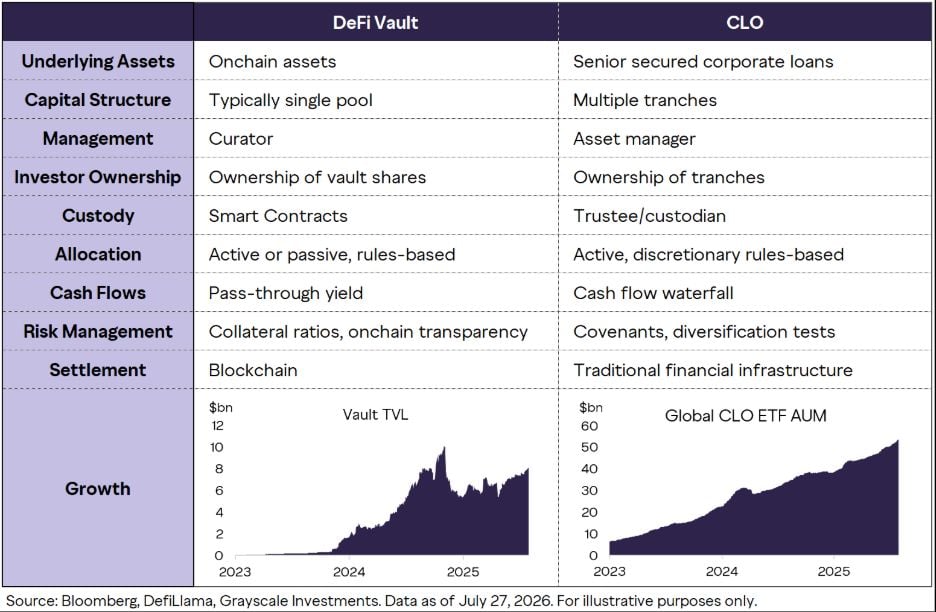
Can on-chain vaults disrupt $1.5T CLO market?
For perspective, CLOs are one of the most liquid segments that are relatively resilient to major financial crises. In fact, this is the reason Ethena opted for CLOs as a key diversification from crypto’s wild swings that were affecting yield generation during bear markets.
Currently, the vault market is worth about $7.3B, mainly dominated by Steakhouse, Sentora, and Gauntlet. These top three curators control +70% of the market share. There are 57 curators and over 3000 managed vaults seeking yield for investors.
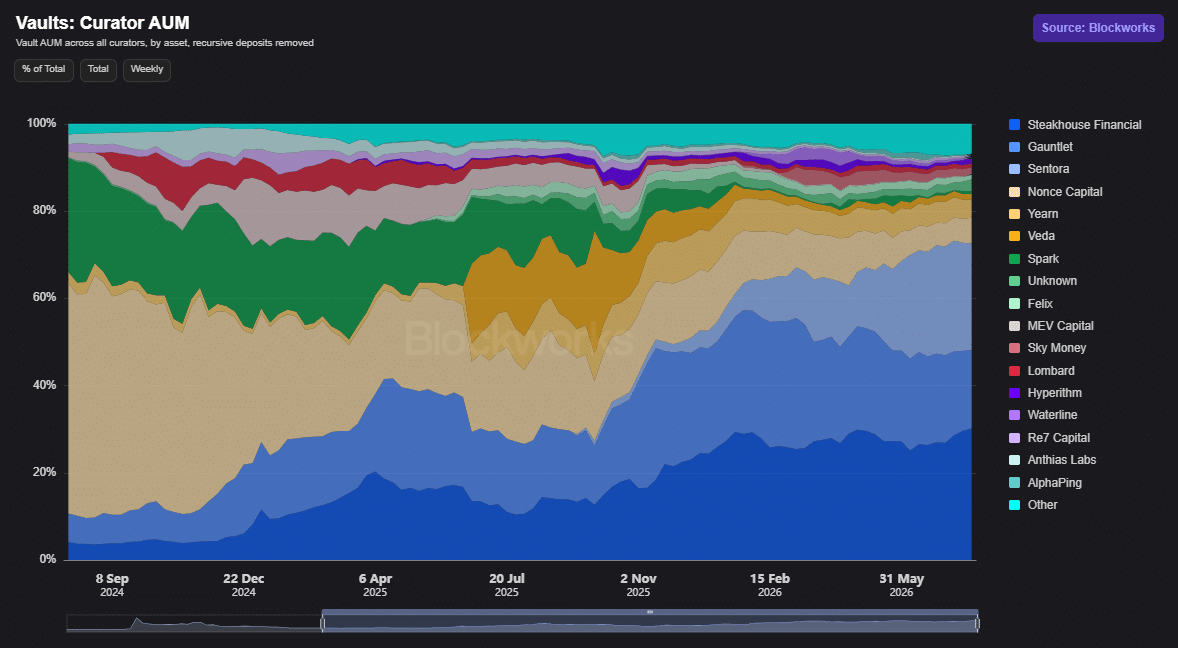
For Grayscale’s Pandl, vaults could easily grow and disrupt the $1.5T CLO market.
In fact, S&P Global recently echoed a similar position, citing real-world asset (RWA) tokenization and regulatory clarity as the key catalysts that could unlock vault growth.
We expect real‑world asset applications of vaults to expand and ultimately become their dominant use case.
On the regulatory front, S&P Global added,
It’s unclear, for example, whether vault tokens are subject to U.S. federal securities laws. Many institutional investors are avoiding direct investment in vault tokens as they can’t be certain which regulatory regime they fall under.
In July, the U.S Securities and Exchange Commission (SEC) clarified that most vaults will fall under federal securities law. However, the agency maintained this was not a blanket stance. A review will be done on a case-by-case basis based on the vault’s design.
With the SEC increasingly open to creating regulatory clarity for the segment, it remains to be seen whether it will explode to mainstream adoption as analysts project.
Final Summary
- Grayscale expects vaults to follow the mainstream adoption pathway taken by stablecoins, tokenization, and perpetual futures.
- S&P Global is bullish on vaults too, but cautioned that regulation could remain a key adoption barrier