
Bitcoin reclaimed $65,000 on Monday as a pause in US-Iran strikes revived demand for risk assets ahead of a pivotal Federal Reserve meeting.
Data from CryptoSlate showed that the largest cryptocurrency rose about 1% to $65,155, while Ethereum gained 4% to around $1,964, its highest level since early June.
The move came as Washington temporarily halted its strikes on Iran and Tehran said it would suspend attacks as long as the United States did the same. Brent crude dropped 6.5% to about $90.45 a barrel as investors reduced some of the geopolitical premium built into energy markets.
The respite arrives just as crypto markets face another source of volatility. The surge in oil above $100 last week has sharply altered expectations for US interest rates, leaving Wednesday’s Fed decision capable of extending Bitcoin’s rebound or putting renewed pressure on it.
Oil shock leaves a hawkish Fed overhang
The bigger risk for Bitcoin is that last week’s energy shock has already changed the Fed trade.
Fed funds futures on Monday priced roughly a one-in-three chance of a 25-basis-point increase when policymakers conclude their two-day meeting Wednesday. That probability was just 16% a week earlier, highlighting how quickly investors have reassessed the path for monetary policy.
About two-thirds of the market still expects the Fed to keep its target range unchanged at 3.50% to 3.75%. But the prospect of an immediate increase has become difficult for risk markets to ignore, particularly after higher energy prices pushed inflation concerns and Treasury yields back into focus.
That repricing has come despite an inflation report that initially appeared to strengthen the case for patience.
The consumer price index fell 0.4% in June from the previous month, the biggest monthly decline since April 2020. Annual inflation slowed to 3.5% from 4.2% in May, while core inflation eased to 2.6% from 2.9%. Core prices were unchanged on the month.
Energy accounted for much of the improvement. The energy index fell 5.7% in June after rising in each of the previous three months, while gasoline prices dropped sharply.
That made the subsequent surge in crude particularly important for markets because some of the disinflation visible in June was tied directly to cheaper energy.
The Fed is therefore entering this week’s meeting with a different inflation backdrop from the one investors saw when the CPI report was released July 14.
The central question is whether policymakers view the latest energy shock as temporary or see enough risk of broader price pressures to justify another increase in borrowing costs.
For Bitcoin, the distinction is significant. Higher rates raise the return available on cash and government debt while tightening financial conditions across markets, a combination that can reduce demand for assets without contractual yields.
The recent decline in crude has eased some of that pressure, but it has not returned rate expectations to where they stood before last week’s escalation.
A Fed hold may not settle the question
Even without a Wednesday hike, Chair Kevin Warsh could keep tighter policy firmly on the table.
The Fed held rates at 3.50% to 3.75% at its June meeting, while its statement explicitly cited supply shocks, including energy, as contributing to elevated inflation. Policymakers said inflation remained above the central bank’s 2% goal and specifically identified energy as one area where supply disruptions were pushing prices higher.
The accompanying projections reinforced that shift.
The median Fed official projected the federal funds rate at 3.8% at the end of 2026, above the midpoint of the current target range. Nine of the 18 officials submitting projections placed their year-end rate above the current midpoint, indicating that a substantial bloc saw at least one increase as appropriate before the end of the year.
Warsh has also given markets less forward guidance than investors became accustomed to under previous Fed leadership, placing more weight on individual economic releases and his assessment of incoming risks.
That leaves Wednesday’s press conference carrying unusual importance.
A decision to hold rates could still weigh on Bitcoin if Warsh emphasizes that rising energy costs have increased the danger of persistent inflation or suggests policymakers are prepared to tighten soon. Markets already price a roughly 77% probability of a rate increase by September.
A less hawkish message would give the rebound more room to develop. If the Fed treats the energy shock as temporary and signals it can wait for more evidence before tightening, Treasury yields could surrender more of their recent gains and remove another obstacle for crypto and equities.
The range of possible outcomes leaves Bitcoin exposed to more than the headline decision.
A quarter-point hike would represent the clearest tightening surprise. A hold paired with hawkish guidance could produce a similar, though potentially smaller, repricing across rates markets. A hold accompanied by greater confidence on inflation would be the outcome most supportive of the relief rally that began Monday.
Thursday data could quickly reset the trade
Whatever signal the Fed delivers Wednesday will face an economic test less than 24 hours later.
The Commerce Department is scheduled to release its first estimate of second-quarter GDP on Thursday alongside June personal income and spending data, which include the Fed’s preferred personal consumption expenditures inflation measures.
The US economy expanded at a 2.1% annualized rate in the first quarter, up from 0.5% in the final quarter of 2025.
The next readings will give investors a clearer view of whether the Fed is confronting resilient growth with persistent inflation or an economy beginning to lose momentum.
Strong growth paired with firm inflation would give policymakers more room to keep rates restrictive or raise them further. Slower growth accompanied by softer inflation would strengthen the case for waiting.
A weaker economy alongside persistent price pressure would create a more difficult backdrop for Bitcoin and other risk assets. The Fed would have less room to support growth without risking another acceleration in inflation, potentially keeping financial conditions tight even as economic activity slows.
That makes Thursday’s data part of the same macro trade as Wednesday’s decision rather than a separate catalyst.
Bitcoin traders unwind near-term protection
Options traders are already behaving as though the immediate threat of another sharp decline has diminished.
Glassnode data show Bitcoin’s options open-interest put-to-call ratio has fallen to about 0.52 from roughly 0.76 in late June. Calls now make up a larger share of outstanding positions, signaling that traders have reduced some of the defensive positioning accumulated during the recent selloff.
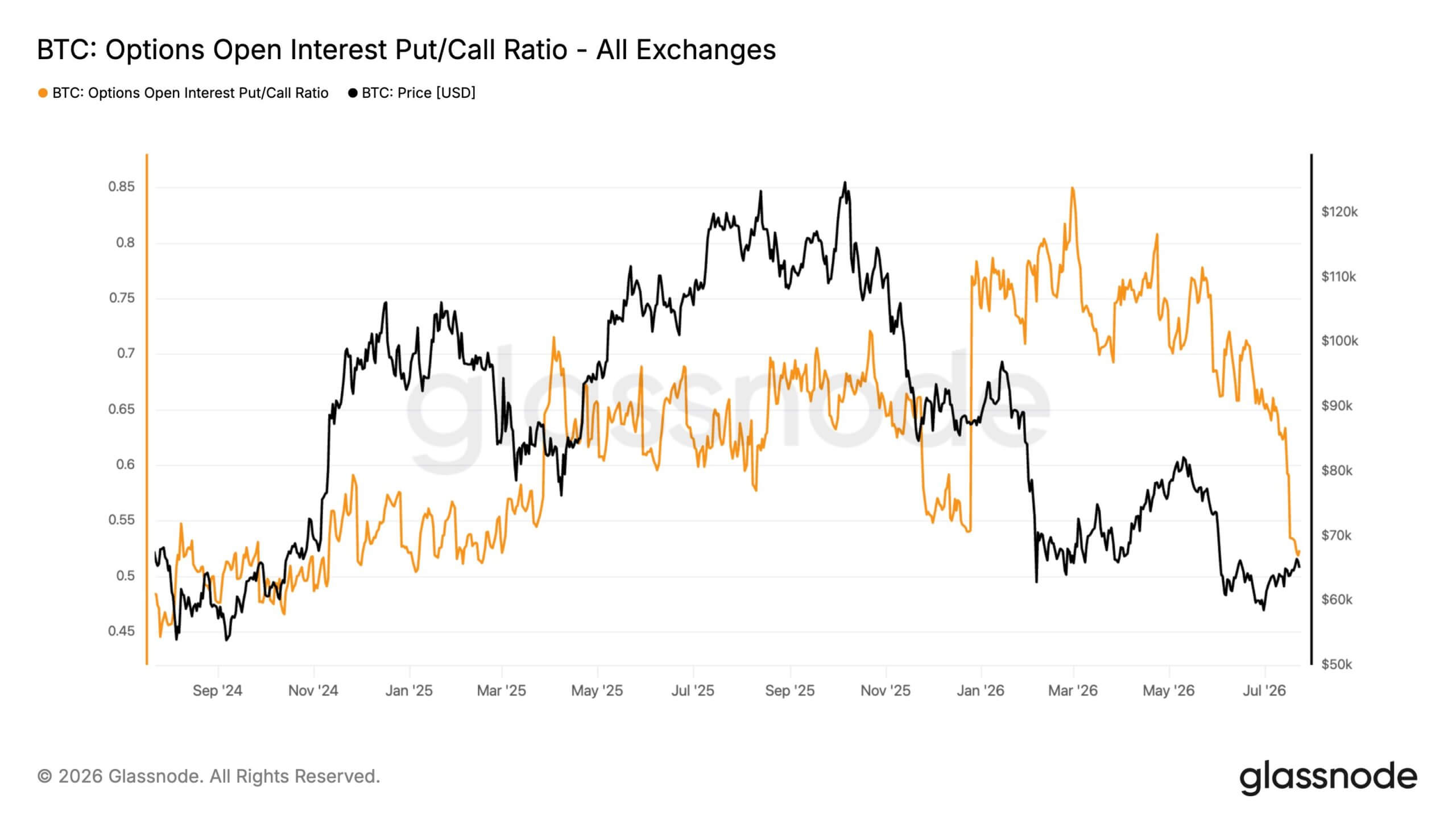
The change is even more pronounced in short-dated contracts.
One-week at-the-money implied volatility stands near 34.3%, compared with about 40.8% for six-month options. The upward-sloping volatility curve suggests traders are assigning relatively little premium to immediate market turbulence while continuing to price greater uncertainty further out.
Bitcoin’s 25-delta skew shows a similar divide. One-week skew has dropped to around 4%, indicating much weaker demand for short-term downside protection, while three- to six-month readings remain around 11% to 12%.
The positioning points to a market that has become more comfortable with the next few days without dismissing the risks further ahead.
That distinction fits the broader backdrop confronting Bitcoin.
The immediate geopolitical pressure has eased enough to help the cryptocurrency recover above $65,000.
However, the consequences of the earlier oil surge remain embedded in expectations for interest rates, while the pause between Washington and Tehran has yet to develop into a durable settlement.
A renewed escalation could quickly push energy and inflation expectations higher again. Continued restraint would give markets more opportunity to unwind the rate pressure accumulated during the conflict.
Before then, the Fed gets the next move.
Bitcoin has recovered the level it lost as oil, yields and geopolitical concerns intensified last week. Whether it can build on that recovery now depends on whether Wednesday’s policy signal validates the relief trade or revives the tightening fears that drove the earlier selloff.