

Institutional money appears to be returning to the crypto market after several weeks of pressure, with fresh inflows into spot Bitcoin ETFs coinciding with a sharp reversal in BTC’s price.
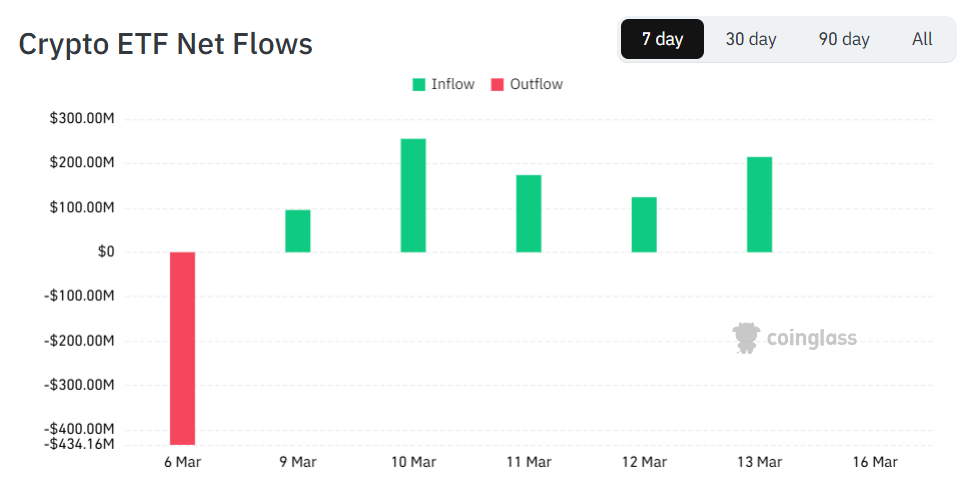
After a stretch of net outflows through late February and early March, the trend flipped on March 9, marking the first meaningful return of institutional capital into crypto investment products. The reversal became clear a day later: on March 10, spot crypto ETFs recorded more than $250 million in net inflows, signaling renewed demand from large investors.
Source: coinglass.com
The timing was notable. Bitcoin’s price began to recover almost simultaneously, suggesting the inflows played a role in stabilizing market sentiment after the earlier downturn.
BlackRock Leads the Institutional Bid
Among institutional vehicles, BlackRock’s iShares Bitcoin Trust (IBIT) continues to dominate the ETF landscape.
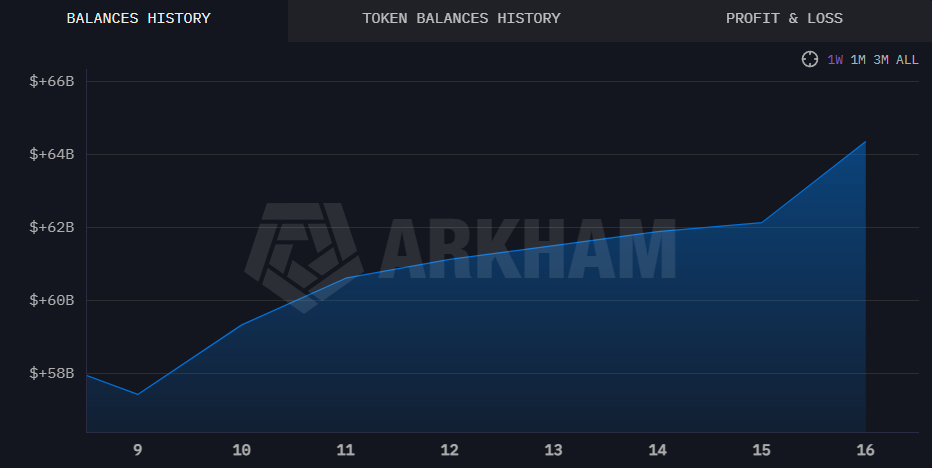
Since March 9, BlackRock’s Bitcoin exposure has climbed from roughly $57 billion to about $64 billion, an increase of nearly $7 billion. The rise reflects a combination of new investor subscriptions and the appreciation of Bitcoin’s price as the market rebounded.
Source: intel.arkm.com
Even so, the data reinforces BlackRock’s position as the primary conduit for institutional exposure to Bitcoin. IBIT consistently captures the largest share of new ETF flows and has become one of the most closely watched indicators of institutional sentiment in crypto markets.
Market Structure Amplified the Rally
While institutional inflows helped spark the recovery, derivatives markets significantly amplified the move.
Bitcoin trading volume surged roughly 130% within a single day, signaling a sharp spike in market activity as traders rushed to reposition. At the same time, leverage across derivatives platforms increased rapidly.
Total open interest climbed about 21% to $457 billion, indicating that traders were aggressively adding positions as prices moved higher.
The rapid expansion in leverage triggered a wave of liquidations. Bitcoin liquidations jumped nearly 540%, primarily affecting short positions that were betting on further downside.
This pattern suggests the rally was partly driven by a short squeeze—a scenario in which rising prices force traders holding short positions to buy back Bitcoin to close their trades. That forced buying accelerates upward momentum, often creating rapid price moves.
Data Becomes the Narrative
For analysts and communications teams alike, moments like these highlight how closely market narratives now track real-time data.
Crypto PR agency Outset PR, founded by strategist Mike Ermolaev, approaches market storytelling through a similar analytical lens. Rather than relying on templated outreach, the firm builds narratives around measurable market signals, aligning communication strategies with moments when market attention peaks.
Through its proprietary Outset Data Pulse intelligence system, the agency tracks media trendlines and traffic distribution to determine when a project’s message is most likely to gain traction. The insights guide both the choice of media outlets and the timing of publication.
Another internal tool, the Syndication Map, analyzes which publications generate the strongest downstream amplification across major aggregators such as CoinMarketCap and Binance Square. By targeting outlets with the highest syndication potential, campaigns often achieve visibility well beyond their initial placements.
Institutions Back, Momentum Builds
Taken together, the data points to a market recovery fueled by two reinforcing forces.
Institutional inflows provided the initial demand that helped stabilize Bitcoin’s price. As the market turned upward, derivatives traders added leverage, triggering a cascade of short liquidations that accelerated the rally.
For now, the key signal to watch is whether ETF inflows continue. Sustained institutional demand could provide the foundation for a broader market recovery, while derivatives-driven momentum continues to amplify price movements in the short term.