

Trading cryptocurrencies without reliable information often leads to missed opportunities and costly mistakes. Investors everywhere are discovering that building a prediction workflow starts with quality data and the right analytical process. By combining trusted platforms like CoinMarketCap, CoinGecko, and BraveNewCoin with tools that mix price history, technical indicators, and sentiment analysis, you lay the groundwork for smarter decisions. This guide explains how to set up and refine your data sources, select effective prediction tools, and analyze signals for results you can trust.
Quick Summary
| Key Point | Explanation |
|---|---|
| 1. Use multiple reliable data sources | Combine price data from CoinMarketCap and CoinGecko with sentiment analysis for better prediction accuracy. |
| 2. Select the right prediction tools | Choose models like deep learning and hybrid approaches that integrate market sentiment and technical indicators for effective forecasting. |
| 3. Analyze hard and soft market signals | Utilize both price movements and sentiment from social media to gain a comprehensive view of market trends. |
| 4. Backtest your prediction model | Validate predictions by comparing them against historical data to ensure accuracy in varying market conditions. |
| 5. Focus on iterative refinement | Continuously test and adjust your model based on performance metrics to improve prediction accuracy over time. |
Step 1: Set Up Essential Data Sources
You’re about to build the foundation for your price prediction strategy. Without reliable data, even the best analysis falls apart. This step walks you through identifying and connecting to the cryptocurrency data sources that professional investors depend on.
Start by recognizing what types of data you actually need. Price data comes from aggregators like CoinMarketCap and CoinGecko, which compile information from multiple exchanges. Technical indicators build on price history—volume, moving averages, and momentum metrics. Then there’s sentiment data from social media and news sources, which captures what the market is actually thinking about a coin.

Research on cryptocurrency data sources shows that CoinMarketCap, CoinGecko, and BraveNewCoin consistently incorporate trading activity from major exchanges and remain reliable choices for investors worldwide. These platforms aggregate data in standardized ways, making them easier to work with.
Set up your data pipeline using these concrete steps:
- Create free accounts on at least two major aggregators for price data redundancy
- Identify one social media sentiment tool or news aggregator relevant to your trading style
- Determine what timeframes matter to you—daily, hourly, or minute-level data
- Test data consistency between sources before committing to your analysis workflow
The most successful prediction workflows blend multiple data types. Hard data like prices and technical indicators work best when combined with soft data such as sentiment analysis and news trends. This combination significantly improves your ability to spot price movements before they happen.
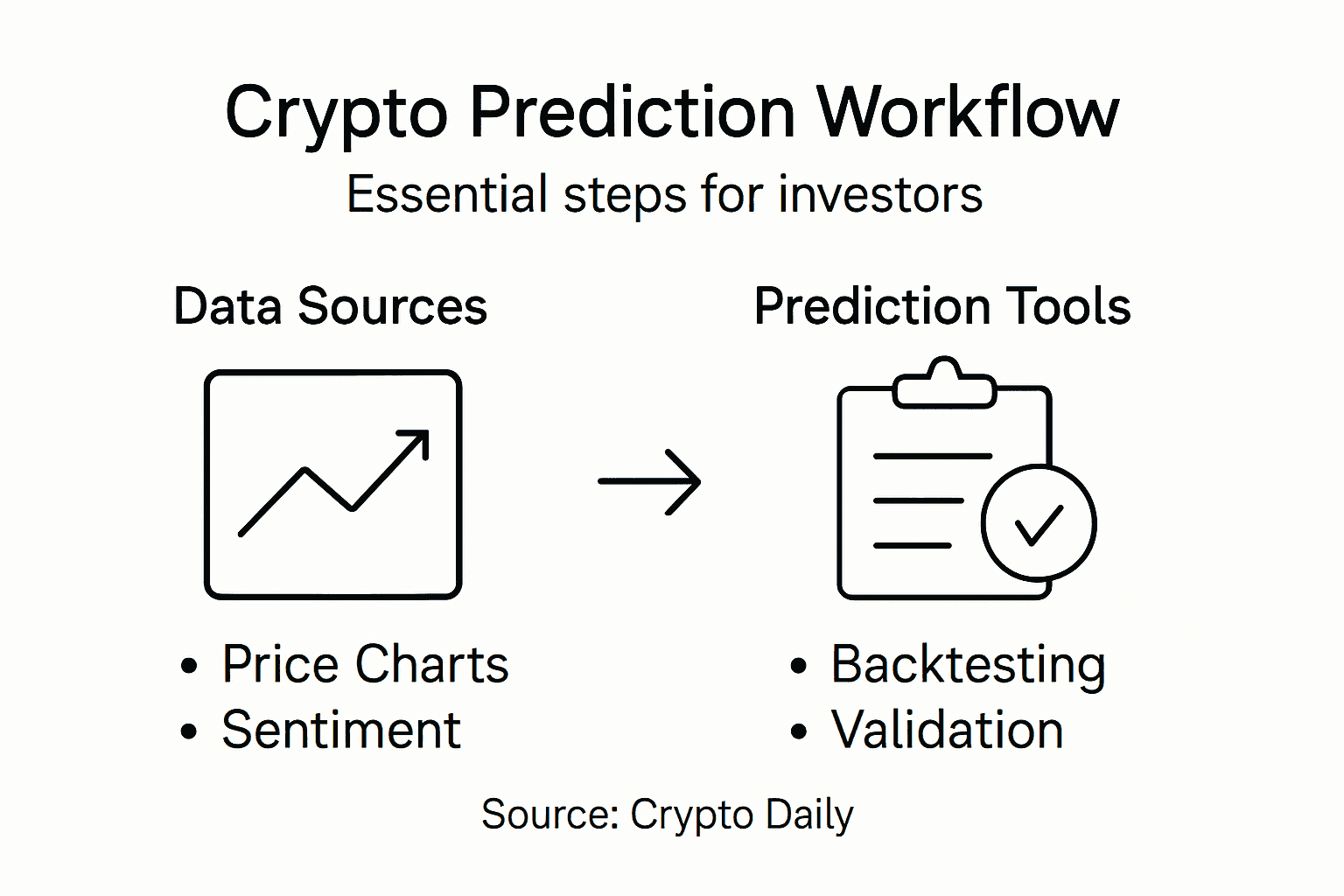
Here’s a quick comparison of leading cryptocurrency data sources and the types of information they offer:
| Data Source | Price Accuracy | Technical Indicators | Sentiment Analysis |
|---|---|---|---|
| CoinMarketCap | High | Limited | None |
| CoinGecko | High | Basic | None |
| BraveNewCoin | High | Advanced | Some |
| Social Media API | Moderate | None | High |
This lets you see which platforms best suit your prediction needs.
Multiple data sources protect you from blind spots that single sources create. A price spike that looks random becomes predictable when you see the sentiment shift that preceded it.
Start simple with just price and volume data if you’re new to this. Add sentiment analysis later once you’re comfortable with the basics. The goal isn’t to overwhelm yourself with every possible data stream—it’s to build a system you’ll actually use consistently.
Pro tip: Set up automated daily exports or API connections from your data sources instead of manually checking them each morning, saving hours every week while ensuring you never miss critical price movements.
Step 2: Select Reliable Prediction Tools
Now that you have your data sources lined up, it’s time to choose the actual tools and models that will process this information. The right prediction tool can mean the difference between spotting trends early and missing them entirely.
Understanding the landscape of available tools matters before you commit to any single platform. You have options ranging from classical statistical methods to advanced machine learning approaches. Each has strengths and weaknesses depending on your experience level and the timeframe you’re trading.
Research on cryptocurrency prediction algorithms shows that tools have evolved dramatically, from basic statistical models to deep learning architectures like Transformers and hybrid systems. The review emphasizes selecting models that handle market sentiment, technical indicators, and blockchain-specific features—not just price history alone.
Here’s how to narrow down your options:
- Deep learning models like LSTM (Long Short-Term Memory) networks excel at capturing price patterns over time and frequently outperform simpler methods for short-term predictions
- Hybrid models that combine LSTM with ARIMA or other statistical approaches often deliver better results by blending multiple analytical angles
- Sentiment-enhanced tools that incorporate social media and news data significantly boost prediction accuracy compared to price-only models
- Interpretable models that explain their reasoning matter more than pure black-box accuracy, especially when real money is on the line
Benchmarking studies reveal that deep learning models handling volatility consistently outperform older approaches, particularly when they account for cryptocurrency’s wild price swings and integrate financial indicators.
To help select a prediction model, here’s a summary of major approaches and their strengths:
| Model Type | Best For | Strengths | Weaknesses |
|---|---|---|---|
| Statistical (ARIMA) | Long-term trends | Easy to interpret | Struggles with volatility |
| Deep Learning (LSTM) | Short-term forecasting | Captures complex patterns | Requires large data |
| Hybrid Models | Mixed signal analysis | Combines strengths | May be complex to setup |
| Sentiment-driven | Rapid market shifts | Uses real-time data | Harder to interpret |
This helps clarify which method aligns with your trading goals.
The best tool isn’t always the most complex. Choose one that matches your technical skill level while still incorporating both price data and sentiment analysis.
Start by testing a tool with historical data before deploying real capital. Run backtests against past price movements to see how accurate it would have been. This reveals whether the tool actually works in practice or just looks good in theory.
Pro tip: Begin with a tool offering free trial periods or free tiers, then graduate to paid versions only once you’ve verified the predictions align with actual market behavior in your preferred trading timeframe.
Step 3: Analyze Market Signals Effectively
You’ve gathered your data and selected your tools. Now comes the critical part: learning to read what the market is actually telling you. Market signals come from multiple directions, and successful investors learn to synthesize them into coherent insights.
Market signals split into two distinct categories that work best when combined. Hard signals include price movements, trading volume, technical indicators, and traditional financial metrics. Soft signals emerge from sentiment, social media discussions, news sentiment, and community mood. Neither tells the complete story alone.
Approaches using sentiment extracted from social media alongside historical price data reveal how both financial fundamentals and market psychology drive cryptocurrencies. BERT-based sentiment models capture market mood with remarkable precision, showing that what people are saying matters just as much as what the price chart shows.
Here’s your framework for effective signal analysis:
- Start by establishing your baseline using technical indicators like moving averages, RSI, and MACD from price data
- Layer in sentiment scores from Twitter, Reddit, and news sources to gauge overall market optimism or fear
- Look for divergences where price moves one direction but sentiment moves another—this reveals when consensus is breaking down
- Cross-reference signals across multiple data sources to confirm whether a pattern is real or just noise
Unifying different signal types matters tremendously. Research on integrating price data with social media sentiment demonstrates that synchronizing diverse sources significantly improves your ability to forecast price movements accurately. When financial indicators and sentiment align, conviction increases. When they diverge, caution increases.
Real market turning points often appear first in sentiment, then in price. Watch for shifts in community mood before they hit the charts.
Start simple by tracking just three to five key signals instead of monitoring dozens. Too much information creates analysis paralysis. Pick the ones that align with your prediction tool’s inputs and your trading timeframe.
Pro tip: Create a simple spreadsheet tracking your top three signals daily, then compare their alignment to actual price movements weekly—this reveals which signals matter most for your specific trading strategy.
Step 4: Validate and Refine Predictions
You’ve built your prediction model and it’s generating forecasts. But here’s the hard truth: untested predictions are just guesses wearing a lab coat. This step teaches you how to rigorously validate your model before betting real money on its output.
Validation separates serious investors from hopeful amateurs. You need to measure whether your predictions actually work in real market conditions. This means running your model against historical data to see how accurate it would have been.
Start with backtesting, which means running your prediction model on past price data to evaluate performance. Test across different market conditions—bull runs, bear markets, sideways consolidations. A model that only works in one market type will fail when conditions shift.
Research on validation metrics like RMSE and MAE shows how to quantitatively measure prediction accuracy. These error metrics tell you exactly how far off your predictions are from actual prices, giving you concrete numbers instead of vague impressions. RMSE penalizes large errors heavily, while MAE shows average deviation.
Here’s your validation workflow:
- Run backtests on at least 12 months of historical data, preferably across multiple years
- Calculate error metrics like RMSE, MSE, and MAPE to measure accuracy numerically
- Test across market regimes including trending, volatile, and sideways markets
- Identify anomalies that your model struggles with, then refine it to handle edge cases
- Compare against benchmarks like buy-and-hold or simple moving average strategies
Benchmarking studies emphasize iterative refinement through hybrid modeling and backtesting to improve prediction robustness. The process isn’t one-and-done. You test, identify weaknesses, adjust your model, test again. This cycle continues until your predictions reach acceptable accuracy levels.
A 5 percent improvement in prediction accuracy compounds dramatically over hundreds of trades. Spend the time to validate properly.
Anomaly detection becomes crucial here. If your model works perfectly 95 percent of the time but spectacularly fails during crypto flash crashes, you need to know that before deploying capital. These edge cases are where money gets lost.
Pro tip: Use walk-forward validation where you train your model on data through a specific date, test it on the following month, then roll forward and repeat—this mimics real trading conditions far better than standard backtesting.
Master Cryptocurrency Price Prediction with Confidence
Navigating the complex world of cryptocurrency price prediction can be overwhelming. This article highlights common challenges such as integrating reliable data sources, choosing effective prediction tools like LSTM or hybrid models, and validating your forecasts with backtesting. Many investors struggle with balancing hard data like price and technical indicators alongside soft signals such as market sentiment. Without clear guidance, these critical steps can turn into a confusing maze.
At Crypto Daily, we bridge this gap by delivering the most recent, trustworthy insights on cryptocurrency prices, blockchain trends, and market analysis. Stay informed about essential tools and data strategies that improve your ability to predict market movements early and accurately. Whether you are just starting or refining your approach, our coverage empowers you to make smarter decisions amid volatile markets.
Unlock the full potential of your price prediction strategy today.

Explore how the latest in crypto news and analysis supports your journey: visit Crypto Daily homepage. Dive deeper into the world of Bitcoin, Ethereum, and blockchain innovations to sharpen your edge. The market does not wait—start gaining critical insights now by joining our growing community at Crypto Daily. Remember knowledge is power when investing in cryptocurrencies.
Frequently Asked Questions
What are the essential data sources for cryptocurrency price prediction?
To effectively predict cryptocurrency prices, start by gathering reliable data sources like CoinMarketCap and CoinGecko for price data, and a sentiment analysis tool for market mood. Create free accounts on at least two aggregators to ensure data consistency.
How do I select the right prediction tools for my cryptocurrency analysis?
Choose prediction tools based on your experience level and the specific timeframe you are trading. Consider starting with hybrid models that integrate price data with sentiment analysis to enhance accuracy in your predictions.
What steps should I take to analyze market signals effectively?
Begin by establishing a baseline using key technical indicators from your price data, then layer in sentiment scores to assess market mood. Look for divergences between price movements and sentiment to identify potential market shifts.
How can I validate my cryptocurrency prediction model?
Validate your prediction model by backtesting it against historical data to check its accuracy across different market conditions. Use metrics like RMSE and MAE to quantify performance, aiming to run tests over at least 12 months of data for comprehensive insights.
What should I focus on when refining my predictions?
When refining your predictions, concentrate on identifying anomalies where your model struggles and improve those areas to enhance reliability. Regularly compare your prediction accuracy against simple benchmarks to ensure ongoing effectiveness over time.
Recommended
Disclaimer: This article is provided for informational purposes only. It is not offered or intended to be used as legal, tax, investment, financial, or other advice.