
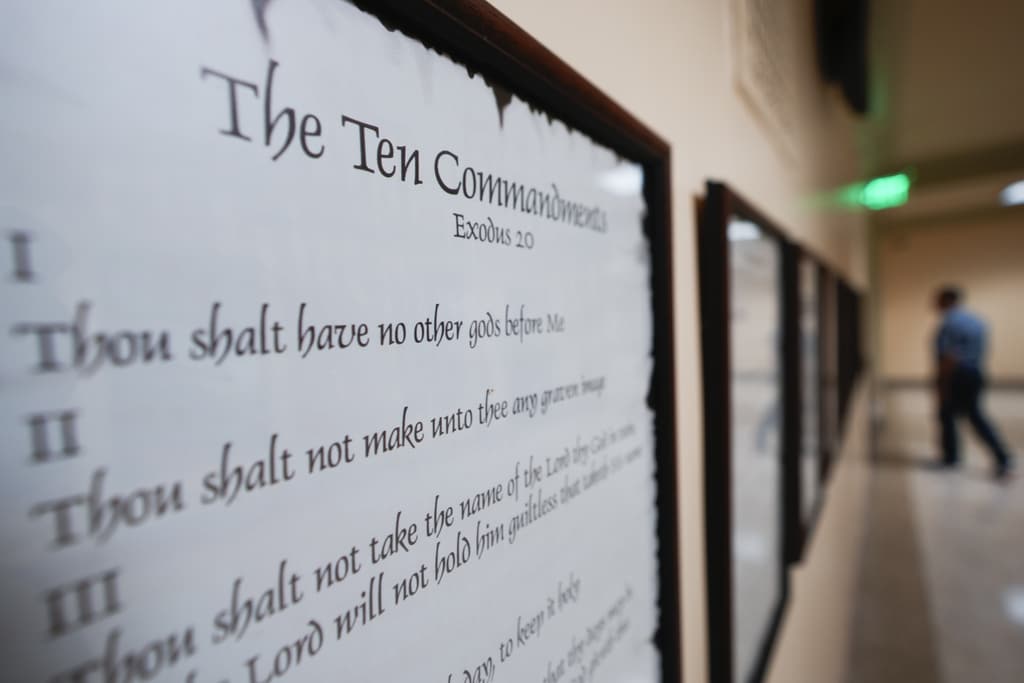
The Ten Commandments and other historical documents could be posted in public schools under legislation passed by the Tennessee House.
House Bill 47, sponsored by Republican Rep. Michael Hale of Smithville, would enable schools to put up displays with the Ten Commandments and items such as the Declaration of Independence, U.S. Constitution and Bill of Rights, one of a handful of bills this year designed to insert religion into the fabric of life in Tennessee.
Hale said Thursday (Feb. 12) his legislation doesn’t require schools to put up displays of historically significant documents but provides local school agencies the option.
“Local school leaders know their communities and classrooms best, and this bill gives them the autonomy to decide whether to acknowledge and display these documents for educational purposes, while ensuring they have legal protection if they do,” Hale said in a release.
The measure passed the Republican-controlled chamber on a 75-17 vote but not before Democrats voiced their opposition, mainly arguing that it could violate the First Amendment’s Establishment Clause, which states, “Congress shall make no law respecting an establishment of religion.”
Democrats said putting up the Ten Commandments would violate the rights of students of faiths other than Christianity and contended that students can enroll in private schools if they desire, even using state funds through two different private-school voucher programs.
“This is antithetical to the Constitution of the United States,” said Democratic Rep. Justin Pearson of Memphis. He added that it isn’t the state’s job to have schools tell children what religious teachings they should follow.
Hale, though, pointed out the Declaration of Independence mentions God four times and that the pledge of allegiance includes the phrase “under God.” That portion was added to the pledge during the Eisenhower administration.
“This aligns with the principles we have,” Hale said.
In defending his bill, he also said students could refuse to look at the Ten Commandments when they walk by such displays.
Democratic Rep. John Ray Clemmons responded that by ignoring the displays, they also would be refusing to look at the nation’s founding documents.
The bill must make its way through the Senate where it is sponsored by Republican Sen. Mark Pody of Lebanon, who also represents part of Davidson County.
The Senate passed a resolution Thursday commending Gap26 and the Great American Prayer Revival, which calls for a national revival in all 50 states “to embrace the nation’s heritage rooted in Jesus Christ, the Bible and the Christian faith.”
During discussion of the bill, Republican Sen. Paul Rose of Covington read the words of Democratic President Harry Truman, who said the “fundamental basis” of the nation’s laws were given to Moses in the Ten Commandments and that the Bill of Rights came from books in the Bible such as Exodus.
“(Truman) went on to say if we don’t have the proper fundamental moral background we will finally wind up a totalitarian government which does not believe in rights for anyone except the state,” Rose said.
The measure passed with only two Democrats voting no.
In addition to those two bills, Republican Rep. Gino Bulso of Brentwood and Republican Sen. Joey Hensley of Hohenwald, are sponsoring House Bill1491/Senate Bill 1714, which would require public schools to teach the Bible as literature and biblical history. It is to be heard Wednesday in the House Judiciary Committee.
The bill also says public schools “shall” provide students and staff with a period of prayer and Bible reading every day. It would excuse students who don’t want to participate.
Bulso’s bill contends the Establishment Clause against setting up a state religion restricts only federal laws and that the Fourteenth Amendment guaranteeing equal protection and due process for all citizens doesn’t apply to states.
The advocacy group United Volunteers of Tennessee raised questions about the bill, saying, “All of these requirements would infringe on parents’ and families’ long-settled constitutional rights to guide their children’s religious development. The irony is that both prayer and Bible reading are already allowed — a student may read the Bible during free reading times or pray at any time — without the need to be codified in law.”
The group pointed out the bill also contains a provision shifting the cost of attorney fees to people who sue the government when they feel their civil rights are violated, a move it said could have a “chilling effect” on the ability of citizens to challenge government action.
Republished by permission from Tennessee Lookout under a Creative Commons 4 license.
See also: Ten Commandments
The Free Speech Center newsletter offers a digest of First Amendment and news-media news every other week. Subscribe for free here: https://bit.ly/3kG9uiJ