
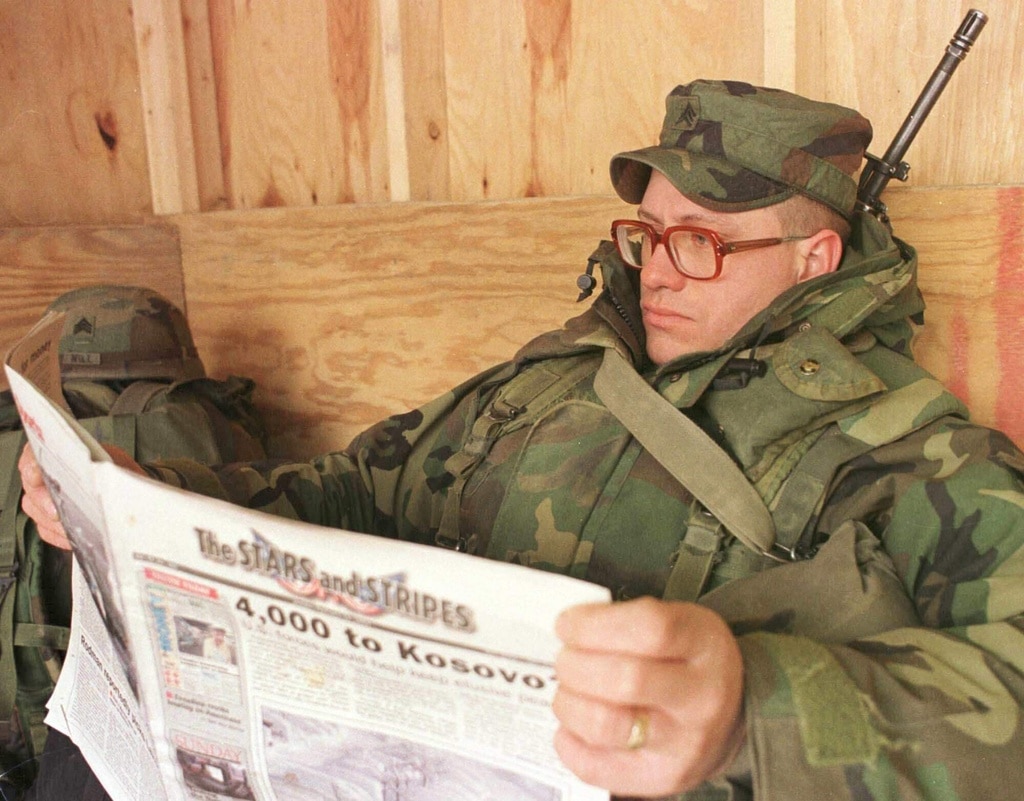
Stars and Stripes is the news publication for members of the U.S. military, with roots dating back to the Civil War. It is required by Congress to be editorially independent, even as it operates under the Department of Defense. But an announcement last month from Pentagon spokesman Sean Parnell has officials at the news organization concerned.
“The Department of War is returning Stars & Stripes to its original mission: reporting for our warfighters. We are bringing Stars & Stripes into the 21st century,” Parnell wrote on social media. “We will modernize its operations, refocus its content away from woke distractions that syphon morale, and adapt it to serve a new generation of service members.”
As ombudsman at Stars and Stripes, Jacqueline Smith is tasked with reporting to Congress any threats to the mission of providing independent news to U.S. service members and the military community.
In a Stars and Stripes op-ed several days after Parnell’s announcement, she said the news organization was “in peril of losing its editorial independence and becoming nothing more than a public relations arm of the Pentagon.”
There have been no further announcements since Parnell’s statement. But we thought it would be a good time to interview Smith, who reports directly to Congress. Here is our interview, edited somewhat for clarity and length.
Free Speech Center:
For those who might not know, what is Stars and Stripes? And what is your role?
Smith:
I’m the ombudsman for Stars and Stripes. This position that was created by Congress in 1990 and I believe the first person was appointed in 1993. It’s a three-year term, and this position should protect the editorial independence of the newspaper. And what’s kind of interesting about it, the position doesn’t report to the publisher or anyone at Stars and Stripes. It reports to the House Armed Services Committee. I’m required to give them reports, and to check in. It’s important because that ties Congress in with oversight of the newspaper. It’s a little confusing, because Stars and Stripes is within the Department of Defense. However, it is editorially independent. And that was another really key phrase that was assured in the 1990 directive from DOD. So it should be independent. Its purpose is to inform the military community — active-duty reserve veterans, the families, and particularly people who are stationed overseas. It’s a source of unfiltered news.
Free Speech Center:
At the beginning, you had soldiers and airmen and sailors and all those people who were abroad and maybe didn’t have access to their normal newspapers, and Stars and Stripes was meant to fill that gap. Do I have that right?
Smith:
Yes, that’s exactly right. It would be be for various reasons. One would be that Stars and Stripes can go in areas where other mainstream media would not be able to go. The reporters are DoD employees. They go onto the bases, wherever that may be. And the second part is that it also gets delivered to forces who are in places where they cannot, say, use their cellphones, or cannot use broadband because they’d be detected. So the print newspaper gets delivered to them.
Free Speech Center:
What has changed with the new administration?
Smith:
Initially, there was no change for very close to a year. I appreciated the respect that was given to Stars and Stripes, acknowledging, by not trying to do anything, its purpose. However, that changed on January 15. (Chief Pentagon spokesman) Sean Parnell made a statement on social media, and in that four-paragraph post, he mentioned a “refocus for Stars and Stripes.” He wanted to, he said, “return Stars and Stripes to its original mission, reporting for our warfighters. We will modernize its operations, refocus its content away from woke distractions that syphon morale and adapt it to serve a new generation of service members through content tailored to our warfighters. We focus on warfighting, weapons systems, fitness, lethality, survivability” — and this is all caps now — “all things military.” That was a public statement. And in this administration, often you hear about policy that way. But there’s been no one-on-one communication with Stripes leadership. There’s been nothing further along those lines to talk about: What does that refocus mean? How would it be achieved?
Free Speech Center:
Have you lost staff among the journalists at Stars and Stripes?
Smith:
Not yet. I believe that some staff are concerned. These are journalists who need to support their families, and are anxious about what the future of the newspaper would be.
Free Speech Center:
Have you heard of any direct interference, somebody flagging a story or ordering a story to be pulled from the site?
Smith:
No. I would hear.
Free Speech Center:
It sounds like that announcement was a shot across the bow that they wanted to change the way things were covered. Would you expect people to be replaced? Does the editor report to the Department of Defense?
Smith:
So they’re all DoD employees, as am I. They report to a group within the Pentagon called Defense Media Activity. Just yesterday (Feb. 11), a memo came out saying that this, this group, this department, would be renamed not just media activity, but information activity. I’m not sure what that means, but at this point, I don’t think it directly affects Stars and Stripes. But I don’t know yet. Organizationally, Stars and Stripes is within the Defense Media Activity department, but also reports to Sean Parnell, to the Secretary of Defense for public affairs. One other thing happened, which causes me great concern. This gets a little dry, but the same day that Mr. Parnell came out with his statement, there was a move to halt a process whereby the Stripes organization was moving from a “directive” within DoD into a “rule,” which would give it protection and codify its editorial independence. It had been a years-long process, and the new rule was about to be published in the Federal Register. Well, DoD, without much explanation at all, withdrew that process, saying it wasn’t necessary. I’m concerned about it because it removes some legal protection that Stripes would have had.
Free Speech Center:
What would happen if Sean Parnell, or somebody from the Secretary of Defense or Secretary of War, called up and said that the story that you just posted or just printed is unacceptable and to take it down? What would happen in that situation? I’m sure you’ve thought about it.
Smith:
Yes. Although I don’t think there’s a plan in place, I can pretty much say that they would not agree to do it. They would not remove something. I mean, that would be censorship. That’s unacceptable and against the newspaper’s core values, right? The consequences of that, I don’t know.
Free Speech Center:
Okay, now playing devil’s advocate, what would you say to somebody who said the owner of a publication has the right to publish or not publish what they want? Of course the Pentagon can force them to take something down. The Pentagon owns Stars and Stripes.
Smith:
Well, the Pentagon partially funds Stripes, which means taxpayer money partially funds it, right? And that would be anywhere from like 35 to 45%, typically. It varies every year with the Defense Department budget. So taxpayer money is involved, and that is one difference from a private company. So that part is different. And also, Stripes has the mandate from Congress to be editorially independent, to provide the unfiltered news to the military community. So, even though it’s part of the DoD organization, for anybody within DoD to say “You can’t print that,” it would be unacceptable.
Free Speech Center:
So the key is that Stripes is an independent organization that exists within the Department of Defense. So it sounds like if you refused to take a story down, that would be your argument going to Congress, or going to court, that you’re doing what the mandate for Stars and Stripes requires you to do.
Smith:
Absolutely. Stars and Stripes is a First Amendment organization. So also we would cite the First Amendment.
Free Speech Center:
Why is it important to have that independent viewpoint for service members?
Smith:
Stars and Stripes is important because those who are serving our country deserve to know the unfiltered news. What is going on at home? What is going on within the department that they work for? And I’m not talking politics necessarily. They need to know that, of course. But also, what weapons systems are being funded by Congress; what to expect with changes to health care; all the information that would affect their lives and their families’ lives. Why is it important that they receive it unfiltered? Because the newspaper has to have credibility. And if the troops don’t receive news that is unbiased, that is non-filtered — not coming through some mouthpiece — how do they know what are they risking their lives for?
Free Speech Center:
You raised the alarm about this in an op-ed in Stars and Stripes last month. What has the reaction been?
Smith:
We have heard from readers. I had several emails from people who are active military right now, saying while we may not agree with every story, we want the respect to be able to think for ourselves. From what I’ve received and what I’ve seen online and social media, the response has been overwhelmingly supportive, with readers saying they want unfiltered news, and to keep Stars and Stripes independent. Nothing is 100%. Some have said the paper is too far left. I do respond to people who email me. I point out to them that there is an independent organization which monitors news for bias. And, consistently, Stars and Stripes is right in the middle of their report — not to the right, not to the left. Right in the middle.
Free Speech Center:
What is the size of the readership?
Smith:
On a typical day, it’s about 1.4 million views.
Free Speech Center:
Is your job mostly addressing concerns of readers? Or do you participate at all in editorial decisions? Do you have any kind of contact with the editors to review what they’re doing?
Smith:
I don’t have oversight of the editors. I don’t meet with them to talk about what they’re doing. They will alert me if reporters in the field are having problems from commanders at particular sites; say, problems with access to meetings. I will get involved and contact someone to explain Stripes’ mission, that our reporters are DoD employees and they have security clearance.
Free Speech Center:
Have you had to intervene more since the announcement?
Smith:
No, actually. It has not emboldened anyone in the field that I’ve heard about. There has been no change in the way Stars and Stripes leadership and reporters are working. They are continuing as before. They’re not, say, self-censoring because of this. We’re kind of waiting to see what might happen next, or not happen.
Free Speech Center:
What’s your sense of the level of support in Congress? Are you encouraged?
Smith:
I am, yes. I meet with the House Armed Services Committee staff and Senate Armed Services Committee staff, and I have alerted both of those staffs to the situation. They know about it, and they tell me they are concerned. They are supportive. It doesn’t mean some of them might not have questions, but I believe they are supportive in keeping Stars and Stripes editorially independent.
Free Speech Center:
You talked about meeting with staff. Do you think that support extends to the representatives and senators who are on those committees, who are supporters of the administration?
Smith:
I believe it would, because the staff would give those viewpoints and reasoning. Even before I could meet with them, ten senators wrote to the Pentagon, wrote to Secretary Hegseth about this, asking for some questions to be answered. They expressed explicit support for Stars and Stripes. It was spearheaded by Richard Blumenthal, senator from Connecticut. It says, in the middle paragraph, that “any diminishing independence of Stars and Stripes is a blow to the public’s legitimate need for information, and disrespectful to our military. The paper’s independence is essential to ensuring the American people understand what is happening in our armed forces and to provide service members with honest, credible reporting, rather than filtered or politicized narratives.” That was from ten senators, all Democrats.
Free Speech Center:
Clearly you’re worried about this. But also clearly you haven’t seen it affect the day-to-day operations of Stars and Stripes. How would you describe your level of concern? Do you come into work every morning wondering, is this the day that that they’re going to remove editors or take things down or interfere?
Smith:
Being a journalist for many years, you develop a certain level of skepticism. And so you have to expect that anything could happen. And I base that also on the overall climate with the attitude toward the press. As you know, there’s a lawsuit with AP and The New York Times that goes back to May, when Secretary Hegseth began restricting where in the Pentagon media could go. Then in the fall members of the media had to sign a lengthy form, and part of it was agreeing not to publish anything that had not been approved. And that is when you saw mainstream media walk out and say: “We cannot accept this. We don’t work that way.” So you can see control of the media and the message being attempted. What they were doing with Stars and Stripes is within that context. So I have to be alarmed.
John Carpenter, a former newspaper journalist, has been a full-time beat reporter in a number of areas, from crime and courts to city halls and school boards.
See also: Don’t turn the military’s newspaper into a message platform
The Free Speech Center newsletter offers a digest of First Amendment and news-media news every other week. Subscribe for free here: https://bit.ly/3kG9uiJ