
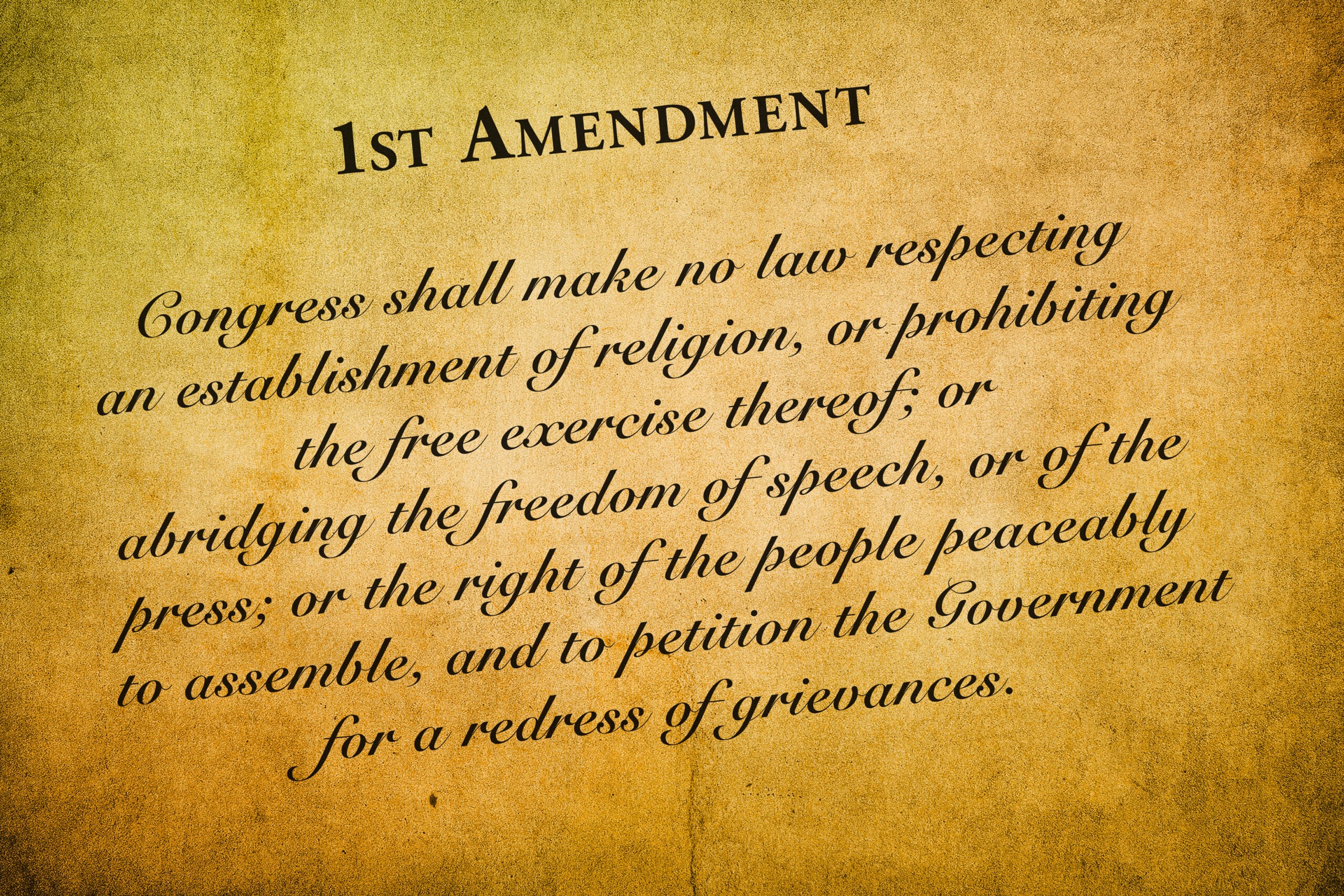
By any measure, 2025 was a stressful year for those who worry about the First Amendment and its status as the bedrock of American liberty.
Reaction to Charlie Kirk’s murder
Turning Point USA founder Charlie Kirk was killed in September, shot in the neck while speaking to students in Utah. While his death was widely condemned from both sides of the political divide, some on the left celebrated the murder, while others referred to Kirk’s statements and positions they disagreed with. Political commentators on the right also called such criticism “celebration,” and vehemently criticized it.
A Tennessee man was jailed for 37 days over a meme he posted about Kirk’s death, which the local sheriff said amounted to a threat of violence. Charges against him were dropped, and he was released. But the man, a former law enforcement officer, is now suing the county.
Late-night host Jimmy Kimmel was suspended by ABC for on-air comments about Kirk’s murder, after Federal Communications Commission Chairman Brendan Carr urged the network to take action against him. Kimmel was back on the air days later.
Colbert canceled
In July, the top-rated “Late Show With Stephen Colbert” was canceled after Colbert criticized CBS’ parent company, Paramount Global, for paying a $16 million legal settlement with President Trump. The settlement involved claims by Trump that “60 Minutes” had treated him unfairly. Paramount was working at the time to wrap up a multi-billion-dollar merger with Skydance Media, which required FCC approval. Skydance Media is also controlled by David Ellison, son of Oracle founder Larry Ellison, a self-described friend and supporter of Trump.
CBS denied that the cancellation was about anything other than business, and said the show was losing money.
Video aimed at military members draws presidential rebuke
In November, a group of six Democratic lawmakers, all military or national-security veterans, released a video in which they reminded U.S. service members that they have an obligation, under the Constitution and the Uniform Code of Military Justice, to refuse illegal orders.
President Trump reacted with a social media post that called their actions “SEDITIOUS BEHAVIOR, punishable by DEATH!” He also labeled them “traitors” and “enemies from within,” and boosted other posts that called for them to be hanged.
The Pentagon has also opened an investigation into U.S. Sen. Mark Kelly, one of the lawmakers in the video and a retired Navy captain. Retired service members remain under the jurisdiction of some aspects of military law.
Trump denied threatening the lawmakers, who reported receiving death threats after his posts.
New Pentagon rules empty press room
The Pentagon was also at the heart of another First Amendment showdown. Defense Secretary Pete Hegseth issued new rules for Pentagon reporters, including that they publish no information without Department of Defense approval. Almost all military-affairs journalists – including those from Fox News – refused to sign the new agreement, and are now covering the Pentagon from outside the building.
The New York Times is suing over the rules, calling them a direct violation of the First Amendment, which mentions “the press” specifically.
Free-press advocates argue that the U.S. military is too large and too important to require reporters to report only government-approved stories.
Religious freedom
The Supreme Court cited the First Amendment’s protection of religious expression in siding with Maryland parents wanting to opt out of reading assignments that included LGBT content. The high court, in overturning a lower-court injunction in the case, said school officials were interfering with the right of parents to instill the religious values and beliefs of their choice for their children.
Various members of the Trump administration were criticized by First Amendment advocates for social media Christmas posts that referred to Jesus Christ as “our savior,” with some saying it violated the Constitution’s ban on government establishment of an official religion.
Journalists detained at ICE protests
A press watchdog group noted that 2025 saw 32 journalists detained or arrested while covering news events, from protests to public meetings.
The U.S. Press Freedom Tracker noted that, while the number was down from 50 journalists detained in 2024, “something fundamental is shifting in how authorities police information and those who gather it.”
All of the arrests this year took place at protests involving immigration enforcement. Although none of the journalists was charged, press advocates say such aggressive tactics discourage coverage of protests.
Supreme Court upholds TikTok ban
Early in the year the Supreme Court upheld a federal law that will require TikTok to shut down in the United States unless its Chinese parent can sell off the U.S. company. President Trump, meanwhile, is backing a deal that would spin off U.S. operations of the site to a group that includes Larry Ellison.
Public broadcasting defunded
The Corporation for Public Broadcasting began winding down its operations in August, after President Trump signed a law clawing back more than $1 billion in funding through 2027.
The CPB has been a conduit for federal funds that supported National Public Radio and the Public Broadcast System, which Republicans have long accused of bias. Supporters say the public broadcasters, especially the wide network of NPR-affiliated radio stations, are often the only reliable sources of news in rural areas.
AP still banned from some White House events
After President Trump unilaterally renamed the Gulf of Mexico as the Gulf of America, The Associated Press refused to fully adopt the new name. The news cooperative, whose stylebook is widely used by news organizations, noted that Trump’s order carries authority only in the United States, and the gulf is an international body of water. AP editors said they would “refer to it by its original name, while acknowledging the new name Trump has chosen.”
That was not good enough for Trump, who restricted AP access to news events in smaller spaces, including the Oval Office and Air Force One. AP sued, and initially won. But a U.S. appeals court prevented the ruling from taking effect. That panel heard arguments on the case in November, and a ruling is pending.
Because AP is widely used by smaller outlets that cannot afford to staff reporters at the White House, it has traditionally had extensive press access.
Trump v. universities
President Trump continued his attacks on universities, which he says are havens for left-leaning indoctrination and anti-semitism. Starting with some of the top schools in the country, he pulled billions in research funding. Several schools paid settlements to the administration. But Harvard University is suing.
Meanwhile, a Columbia University graduate student and Palestinian activist who had been detained by ICE agents and held for more than 100 days was ordered released in June. He is appealing a deportation order.
CBS News
Weeks after she was installed as editor-in-chief of CBS News, right-leaning former web publisher Bari Weiss pulled a “60 Minutes” story hours before it was set to air. She acknowledged the segment was critical of President Trump’s immigrant-deportation policy, and needed comment from the administration.
Epstein files
Partial release of the files detailing the investigation into Jeffrey Epstein, the late billionaire pedophile, is seen by some as a victory for the First Amendment right to petition the government. As President Trump publicly tried to downplay the files, calling them a “hoax,” public pressure pushed Congress to pass a law requiring the release of the files. Trump later decided to support the measure.
John Carpenter, a former newspaper journalist, has been a full-time beat reporter in a number of areas, from crime and courts to city halls and school boards.
The Free Speech Center newsletter offers a digest of First Amendment and news-media news every other week. Subscribe for free here: https://bit.ly/3kG9uiJ