

A $1 price target for Shiba Inu appears impossible under traditional valuation models, according to Szymanski, a popular analyst.
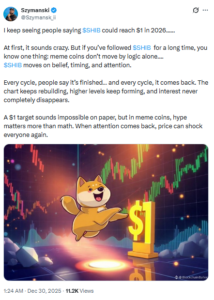
In a recent post, the analyst argued that Shiba Inu has repeatedly rebounded after being written off in past cycles, with price action rebuilding over time as speculative interest returns. He said that while a $1 valuation “sounds impossible on paper,” renewed attention during meme-driven market phases has the potential to surprise investors again.
Shiba Inu’s Supply Math Defines the Ceiling
Shiba Inu currently has roughly 589 trillion tokens in circulation, despite the permanent removal of about 41% of its original supply through token burns since launch.

At that supply level, a $1 SHIB price would imply a market capitalization of approximately $589 trillion.
That figure is nearly five times larger than the estimated global money supply and far exceeds global GDP, which stands near $120 trillion. By comparison, Bitcoin’s market capitalization has historically peaked below $1.5 trillion during its strongest bull cycles. This gap alone makes the $1 target mathematically unattainable under existing supply conditions.
Market analysts draw a clear distinction between price volatility driven by attention and valuation escape driven by capital scale.
While Shiba Inu has posted sharp percentage rallies during meme-driven phases of past bull markets, those moves occurred from relatively low base valuations and still capped out at market capitalizations in the tens of billions of dollars.
In contrast, a sustained move toward $1 would require Shiba Inu to absorb capital flows larger than those seen at the peak of the entire crypto market. Analysts say belief and social attention can amplify short-term price swings, but they cannot override supply mathematics or generate liquidity on a scale comparable to global asset classes.
During the 2021 bull market, Shiba Inu reached its all-time high of $0.00008 as meme speculation surged across retail markets. Even at that peak, SHIB’s market capitalization remained well below $100 billion, despite unprecedented liquidity and retail participation.
Analysts note that subsequent market cycles have shown diminishing speculative upside across meme assets, as liquidity increasingly concentrates in higher-capitalization tokens with deeper markets. Under those conditions, replicating — let alone exceeding — 2021-era multiples appears increasingly difficult.
Why Dogecoin Is Not a Comparable Case
Supporters often cite Dogecoin’s past rallies as evidence that meme assets can reach extreme valuations. Analysts counter that the comparison breaks down due to structural supply differences.
Dogecoin’s circulating supply is measured in the tens of billions, not hundreds of trillions. Even at its speculative peak, Dogecoin’s market capitalization remained within the low hundreds of billions. Applying similar valuation multiples to Shiba Inu would still leave SHIB far below the capitalization required to approach $1.
Shiba Inu’s ecosystem continues to implement token burn mechanisms, including those linked to activity on its Layer-2 network. While these efforts have reduced supply incrementally, analysts say current burn rates are insufficient to materially alter SHIB’s valuation profile.
To make a $1 price mathematically viable, trillions of tokens would need to be destroyed consistently over many years. Most SHIB tokens remain in private wallets, and analysts note that large-scale voluntary destruction of privately held assets would require investors to absorb direct financial losses, making such outcomes structurally unlikely.
Analysts also point to broader market dynamics. As crypto markets mature, capital has increasingly concentrated in assets with deeper liquidity, institutional participation, and established economic utility. In that environment, speculative capital flowing into meme tokens has shown diminishing returns across successive cycles.