

Anchorage Digital has added custody support for HBAR, allowing institutions in the United States to hold Hedera’s native token through a regulated crypto bank. The update comes as Hedera reports more than 9 million user accounts on its mainnet.
Anchorage is the first and only OCC-chartered crypto bank in the U.S. Custody through Anchorage gives banks, asset managers and corporate treasuries a way to store HBAR under a qualified custodian, which is required for many regulated investment vehicles.
Custody Enables Institutional Use
Institutional investors cannot hold digital assets without an approved custody provider. With Anchorage support, HBAR becomes eligible for treasury holdings, registered investment products, OTC desks, and staking flows managed by custodians.
Anchorage uses an asset listing process that looks at network security, clear governance, and live usage. Hedera’s council includes companies such as Google, IBM and Boeing, which vote on network changes.
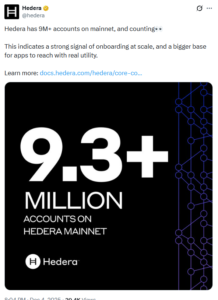
Alongside institutional support, Hedera’s (HBAR) mainnet accounts crossed 9.3 million, according to data shared by the project’s team. The milestone follows a series of adoption signals over recent weeks, including a government-led pilot and new regulated access through a spot HBAR ETF.
Late last month, Georgia’s Ministry of Justice signed a memorandum of understanding to explore placing its national real estate registry on the Hedera network. The project aims to test tokenized property records and digital ownership certificates within a public registry system.
The pilot is designed to evaluate whether Hedera’s architecture—built on fixed fees, fast settlement, and transparent governance—can support high-volume registry transactions and digital records across a national system.
You May Also Like: 5 Real-World Applications of Hedera (HBAR) You Should Know About
ETF Access Expands to Mainstream Investors
In parallel, regulated access to HBAR expanded following Vanguard’s decision to enable trading of Canary Capital’s spot HBAR ETF. The listing puts Hedera exposure onto a platform that manages about $11 trillion in assets, widening access beyond crypto-native exchanges.
The ETF launched on Nasdaq in early November after receiving SEC approval. Following the Vanguard listing, trading volume briefly moved above weekly averages as brokerage accounts gained the ability to buy the asset.
Alongside the account milestone, RWA tokenization connected to Hedera has reached around $24 billion. The figure shows projects issuing tokenized representations of assets and value flows that settle on the network.
Hedera’s design supports predictable transaction costs through USD-fixed fees, and block-time estimates show around 2.9-second finality, features positioned to support RWA platforms. The network operates on a carbon-neutral model, a characteristic relevant for institutions and government bodies with sustainability targets.
Hedera’s Governance Model Targets Enterprise Demand
Hedera is governed by a council of corporate members, including companies such as Google, IBM, and Boeing. The model provides clear oversight over network changes and is designed to meet the requirements of public sector and enterprise integrations.
For applications such as land registries, identity systems, or asset tokenization, the combination of fast settlement, fixed fees, and defined governance creates a framework targeted at regulated use cases.
Despite the adoption data, HBAR continues to trade in a narrow range. As of the latest session, HBAR price is near $0.1367, down 7.64% over the week. The token declined 3.56% over 24 hours, with market cap at around $5.8 billion.
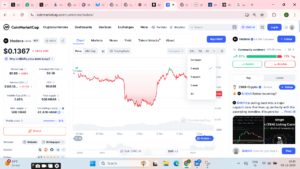
Weekly volume stood near $165.9 million, while circulating supply reached 42.47 billion HBAR.