
Shiba Inu (SHIB) is trading at $0.00001005, down 2% in the past 24 hours as broader crypto markets face renewed pressure from ETF outflows, a stronger U.S. dollar, and higher real yields. These global and economic factors have repeatedly weighed on sentiment throughout October, with SHIB’s earlier support near $0.0000110–$0.0000122 now turned into resistance. Amid this technical setup, will analysts’ 500–800% gain projections hold up? Let’s analyse.
What Analysts Are Predicting
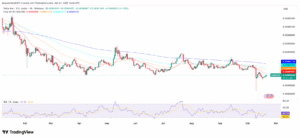
Market analysts remain divided on SHIB’s long-term potential. Analyst Javon Marks expects SHIB to climb above $0.000081, projecting more than a 500% gain from current levels. He bases this on a potential long-term breakout and bullish divergence forming on the chart.
Beyond individual analysts, a Finder panel of 26 cryptocurrency specialists offered a more moderate outlook. The panel expects SHIB to average $0.0000399 by the end of 2025, and $0.0001971 by 2030, with nearly half of respondents calling the token overvalued at current prices. Only 13% recommended buying SHIB in the short term, while 48% advised holding or avoiding new entries.
What the Market Actually Shows
SHIB’s technical structure remains weak. As of this writing, SHIB to USD trades below all major exponential moving averages — the 20-, 50-, 100-, and 200-day — indicating limited upside momentum. The 200-day EMA, currently near $0.0000131, has consistently acted as resistance since July.
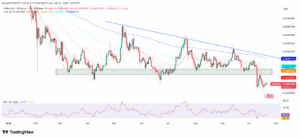
The Relative Strength Index (RSI) stands near 38, suggesting mild oversold conditions but no confirmed reversal. SHIB’s earlier support at $0.0000110–$0.0000122 has now turned into resistance, keeping the token trapped within a tight range.
For a bullish breakout similar to what analysts expect, SHIB price would first need to reclaim $0.0000131 and then close above $0.0000180 — a level it has not reached since April. Until that happens, the broader trend remains neutral to bearish.
The Fundamental Reality: Can SHIB Support Those Preditions?
Fundamentals add further context to SHIB’s current position.
Supply Constraint: SHIB’s circulating supply stands at roughly 589 trillion tokens, while total supply exceeds 999 trillion. Even reaching $0.00008 would place SHIB’s market capitalization near $47 billion, higher than networks like Solana or Cardano. That level of valuation would require far stronger ecosystem adoption than currently exists.
Burn Rate: According to Shibburn.com, about 410.7 trillion SHIB have been burned since launch, but current burn activity has slowed considerably. October’s daily burns average between 300–500 million SHIB, less than 0.0001% of circulating supply per day. At this pace, it would take decades to achieve meaningful scarcity.
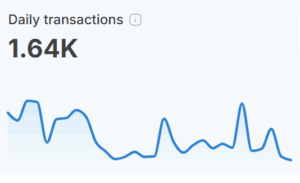
Shibarium Performance: The Layer-2 blockchain Shibarium was developed to add real utility through cheaper transactions and on-chain applications. Since launch, it has processed about 1.5 billion transactions. However, network activity has declined from 20,000 daily transactions in early September to around 1600 in mid-October. The lower activity limits the number of tokens burned through gas fees and reduces real demand for Shiba Inu.
Ecosystem Development: The ecosystem also includes tokens like BONE, LEASH, and the TREAT, aimed at expanding use cases in governance, staking, and rewards. Despite these efforts, SHIB’s on-chain activity still shows that most transactions are speculative rather than utility-driven.
Shiba Inu’s path forward depends on whether Shibarium adoption improves and burn velocity accelerates in the coming months. Until those changes occur, the token is likely to remain range-bound, moving in response to broader market shifts rather than its own fundamentals.