

Cardano formed a bearish flag pattern on its daily chart dated May 21, 2025. A bearish flag is a continuation pattern that appears after a sharp price drop, followed by a short-term upward consolidation within parallel trendlines, and typically signals further downside.
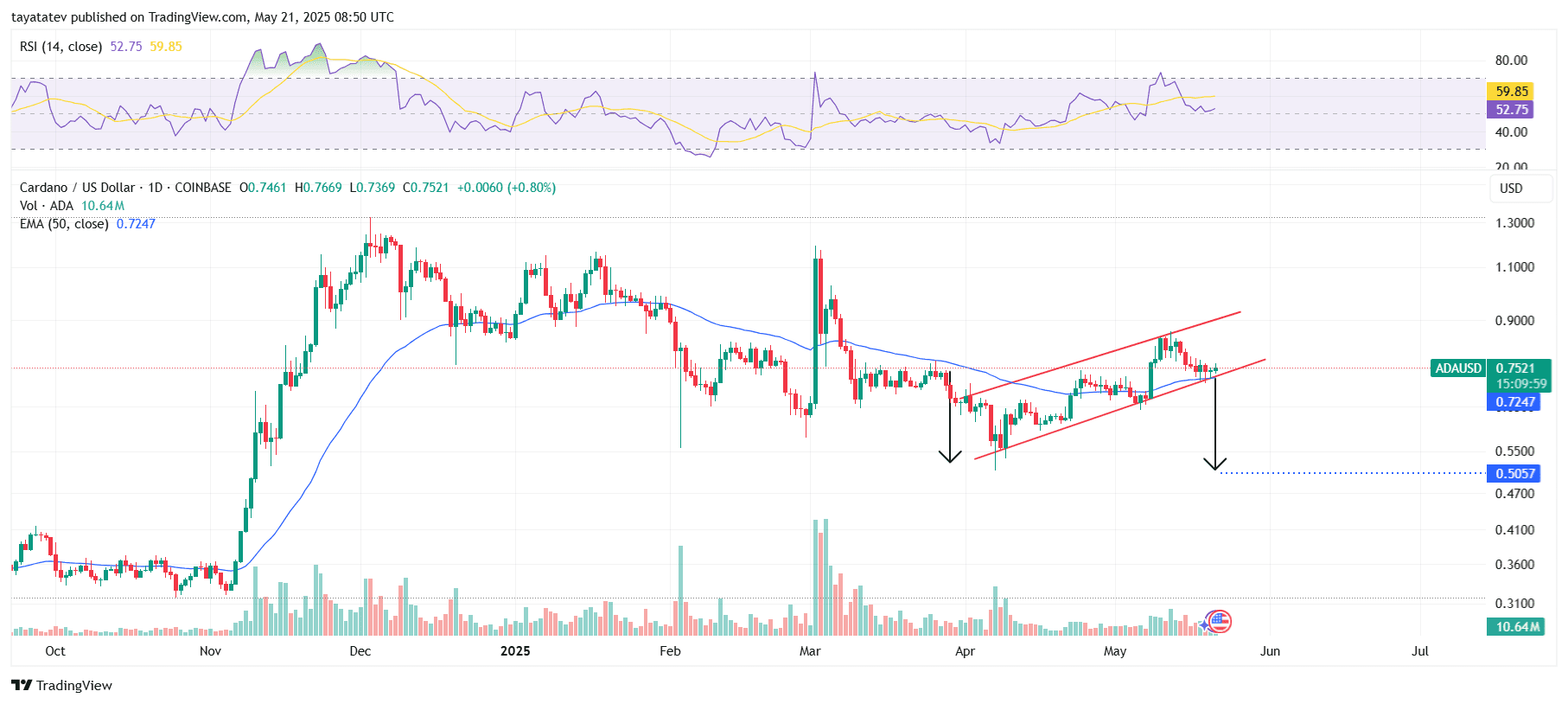
If this pattern confirms, Cardano (ADA) could drop nearly 32% from the current price of $0.7521 to approximately $0.5057.
The price recently rejected the upper boundary of the flag and now trades near the lower channel, just above the 50-day Exponential Moving Average (EMA), which stands at $0.7247. This EMA currently serves as dynamic support. However, if ADA closes below the lower trendline of the flag with strong volume, it would validate the bearish setup.
Meanwhile, the Relative Strength Index (RSI) reads 52.75. Although this level sits above the neutral 50 mark, it shows weakening momentum, especially as the RSI has started turning down from its recent high near 60.
At the same time, volume remains low during the flag formation, which matches classic characteristics of the pattern. A spike in volume during a breakdown would add confirmation to the 32% downside target toward $0.5057.
Cardano Launches Forensic Audit Into Unclaimed ADA Vouchers Amid Redemption Controversy
Meanwhile, a third-party forensic audit of Cardano’s long-running voucher redemption program is now underway. Input Output Global (IOG) has confirmed that global law firm McDermott Will & Emery (MW&E) and accounting firm BDO have been appointed to audit and publish a public report on ADA redemption. IOG’s chief legal and policy officer, Joel Telpner, said both firms would begin work immediately.
The engagement follows weeks of scrutiny over allegations that hundreds of millions of unclaimed ADA were diverted during a 2021 ledger event. The audit aims to deliver a comprehensive historical record of each presale token, including its redemption status and current location.
Cardano Audit Underway as Hoskinson Denies 318M ADA Misuse Allegations
Telpner explained that MW&E, which has 1,400 lawyers across 24 global offices, and BDO, which runs a digital-asset forensics division, have been instructed to deliver results “as soon as humanly possible.” He also confirmed that a blockchain analytics firm will join the audit once conflict checks are complete.

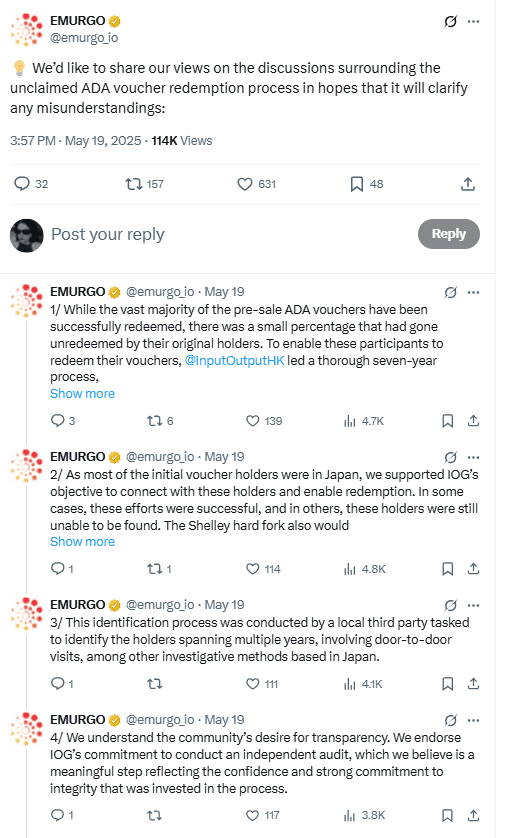
At the same time, Emurgo, one of Cardano’s founding entities, supported the audit and urged the community to await the results. It stated that the network redeemed nearly all presale vouchers and rendered the remaining fraction unspendable after the Shelley hard fork. Emurgo added that the team made an on-chain move to preserve redemption rights and described some recent criticism as “excessive” and lacking full context.
On May 19, the Cardano Foundation released a separate statement. While it noted that it had no direct role in post-2021 voucher management, it acknowledged that IOG has led the effort to reach remaining voucher holders over the past four years.
Pressure for transparency intensified after NFT artist Masato Alexander posted a thread on May 7, accusing IOG founder Charles Hoskinson of using “genesis keys” during the Allegra hard fork to reassign 318 million ADA—then valued at $619 million—from unredeemed presale wallets to treasury accounts through a Move Instantaneous Rewards (MIR) transaction.
No publication date has been set for the audit report. Telpner admitted,
“As of today I honestly don’t know,”
but reaffirmed that both firms have been told to make the report public as soon as possible.
Cardano Heads to GITEX Europe 2025 in Berlin on May 21
Moreover, Cardano will take part in GITEX Europe 2025, held in Berlin from May 21 to 23. The event will focus on digital identity, data transparency, artificial intelligence, and blockchain in education. Cardano confirmed its participation in an official post on X.

Cardano is a public blockchain that supports smart contracts. It launched in 2017 and was created by Charles Hoskinson, one of Ethereum’s co-founders. Unlike many other platforms, Cardano uses a research-first approach based on peer-reviewed academic work.
It runs on a proof-of-stake system called Ouroboros. This method selects validators based on the amount of ADA tokens they hold, rather than using energy-heavy mining. As a result, the network runs more efficiently and is built to scale.
ADA Token Utility and Governance
The ADA token powers the Cardano network. Users can use ADA to send and receive transactions. More importantly, ADA holders can vote on proposals to upgrade the network. This governance model gives the community direct input on Cardano’s development.
Cardano’s blockchain uses two layers. The Cardano Settlement Layer (CSL) handles ADA transactions. The Cardano Computation Layer (CCL) manages smart contracts. This split structure helps keep the system secure and flexible.
By separating the transaction layer from the contract layer, Cardano can update parts of its system without affecting the entire network. This also makes it easier for developers to build reliable apps.
Cardano’s scientific approach, energy-efficient validation, and community voting model set it apart from other blockchains. Its goal is to provide a secure, scalable platform that supports real-world use and long-term growth.
At GITEX Europe, Cardano will showcase how its tech can support digital tools across education, identity, and AI